Google “best books for new managers” and you’ll find lists with 25, 40, even 50 titles. You’ll see books about lean startups, executive presence, emotional intelligence, military leadership, and something involving cheese that moves.
That’s not helpful. You don’t need 50 books. You need one or two that actually address what you’re going through right now: the shift from doing the work to leading the people who do the work.
I read dozens of management books when I first got promoted. Most were written for executives running divisions, not for someone who just got handed a team of five and is wondering whether they should still eat lunch with the group. And that matters — because Gallup’s research shows companies choose the wrong person for the management role 82% of the time, largely because organizations promote for technical skill and then provide almost no training for the actual job. Books shouldn’t have to fill that gap, but they do.
Here are the five books that actually helped — the ones I keep coming back to and recommending to every new manager I meet.

What made the cut: Every book on this list is (1) written by someone who managed real teams, (2) practical enough to apply on Monday morning, (3) under 300 pages so you’ll actually finish it, and (4) rated 4.5+ stars across thousands of reviews.
1. The Making of a Manager — Julie Zhuo
The best overall book for someone who just got promoted.

- Author: Julie Zhuo (former VP of Design at Facebook/Meta)
- Published: 2019 | Pages: 288
- Rating: 4.6/5 (8,000+ ratings)
- View on Amazon
Julie Zhuo became a manager at Facebook at age 25. She had no training, no playbook, and no idea what she was doing. She wrote this book about what she wished someone had told her.
Why it made the list
This is the book I wish I’d had on my first day. Zhuo doesn’t write like a professor — she writes like a friend who just went through the same thing you’re going through. She’s honest about her early mistakes: avoiding difficult conversations, trying to be everyone’s friend, not knowing when to step in vs. step back.
What makes this book special is that it covers the emotional side of becoming a manager, not just the tactical. There’s a whole chapter on imposter syndrome. There’s a section on what to do when you don’t trust someone on your team. She talks about the weird grief of losing your identity as a “maker” and learning to find satisfaction in other people’s success.
The frameworks are simple and memorable. Her approach to giving feedback is something I still use years later.
The single most useful thing she gives you is a way to take the job apart. Zhuo argues that everything a manager does resolves into three things: purpose, people and process. Purpose is whether the team knows what outcome it exists to produce. People is whether the right people are in the right roles and growing. Process is how decisions actually get made. It sounds abstract until the first time your team is visibly struggling and you cannot say why. Then you run the three, in order, and it is almost always obvious which one is broken. Most new managers reach for process, because process is the one you can fix alone on a Sunday, and it is the least often the real problem.
Best for you if…
You were recently promoted and feel like you’re faking it. You want a book that acknowledges the emotional reality of the transition, not just the mechanics. This is the book that makes you feel less alone.
Key takeaway: “Your job as a manager is not to do the work yourself, even if you are the best at it, because that will only take you so far. Your job is to get better outcomes from a group of people working together.”
2. Radical Candor — Kim Scott
The best book on having honest conversations without being a jerk.

- Author: Kim Scott (former exec at Google, Apple, YouTube)
- Published: 2019 (Revised Edition) | Pages: 272
- Rating: 4.5/5 (12,000+ ratings)
- View on Amazon
Kim Scott’s framework is deceptively simple: care personally AND challenge directly. Do both and you get “radical candor.” Drop either one and you get manipulation, obnoxious aggression, or — the trap most new managers fall into — ruinous empathy.
Why it made the list
Every new manager I’ve ever talked to has the same problem: they don’t know how to tell someone the truth without either sugarcoating it until it’s meaningless or delivering it so bluntly that it damages the relationship. This is the book that solves that problem.
Scott’s 2×2 framework (Care Personally × Challenge Directly) is the most practical model I’ve seen for difficult conversations. She gives you the exact words to use. She explains why “nice” feedback is actually the cruelest thing you can do to someone — because it robs them of the chance to improve.
The revised edition added practical tools and removed some of the Silicon Valley jargon that made the first edition feel exclusive. It’s a genuinely useful book for managers in any industry.
The part that survives longest is the name she puts on the most common failure. Ruinous empathy is what happens when you care about someone and let that stop you from telling them the truth, and Scott’s point is that it is by far the most frequent quadrant for new managers, not the aggressive one everybody worries about. What makes the idea stick is where the axes are measured. Both care and challenge are judged by how they land on the other person, not by what you intended, which means you cannot certify your own kindness. If someone left the conversation without understanding that there was a problem, it was not kind. It was just comfortable for you.
Best for you if…
You avoid giving negative feedback because you don’t want to hurt people’s feelings. You’ve noticed that being “too nice” is actually making things worse. You need a mental model for balancing honesty with empathy.
Key takeaway: “It’s not mean. It’s clear. If you don’t tell someone the truth about their work, someone eventually will — and it will be worse because you waited.”
3. The First 90 Days — Michael Watkins
The best book for having a plan, not just good intentions.
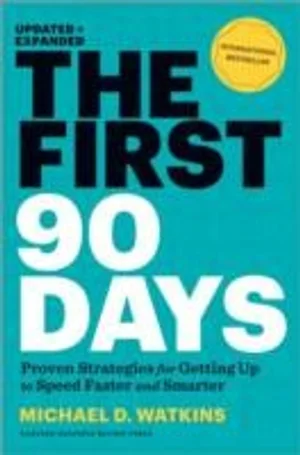
- Author: Michael Watkins (Harvard Business School professor)
- Published: 2013 (Updated Edition) | Pages: 304
- Rating: 4.5/5 (10,000+ ratings)
- View on Amazon
This is the most structured book on the list. Watkins breaks the leadership transition into a systematic process: diagnose the situation, align expectations with your boss, build your team, secure early wins. It’s like a checklist for your first three months.
Why it made the list
While Julie Zhuo’s book addresses the emotional side of the transition, Watkins gives you the strategic side. What should you actually do in week one? What conversations should you have with your boss before you make any changes? How do you assess whether your team is in a startup situation, a turnaround, or a steady-state?
The “STARS” framework (Startup, Turnaround, Accelerated Growth, Realignment, Sustaining Success) is genuinely useful for understanding what kind of situation you’ve walked into. Most new managers either change too much too fast or don’t change anything at all. Watkins shows you how to read the room first.
This book pairs perfectly with a structured plan like our First 90 Days Action Plan — Watkins gives you the “why” and the action plan gives you the “what, specifically, this week.”
The most immediately usable part is what he does to the phrase “align with your boss,” which is advice everyone gives and nobody can act on. Watkins turns it into five separate conversations that you schedule deliberately rather than hope to have: what situation you have actually inherited, what results you are expected to produce and by when, how the two of you will work together, what resources you need to make that possible, and how you will develop in the role. Holding them separately matters, because the resources conversation goes very differently once you have already agreed on the diagnosis and the expectations.
Best for you if…
You like structure. You want a week-by-week roadmap, not just inspiration. You’re the kind of person who makes spreadsheets for vacation planning — and you want that same level of rigor for your leadership transition.
Key takeaway: “The actions you take during your first few months in a new role will largely determine whether you succeed or fail. Transitions are periods of acute vulnerability.”
4. High Output Management — Andrew Grove
The best book for understanding what management actually is.
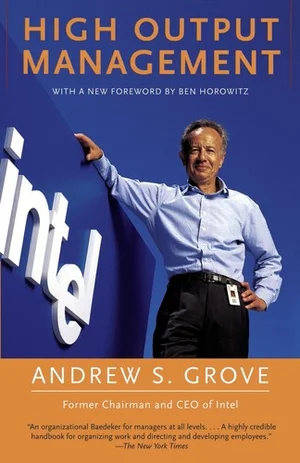
- Author: Andrew S. Grove (former CEO of Intel)
- Published: 1983 (reissued 1995) | Pages: 272
- Rating: 4.6/5 (9,000+ ratings)
- View on Amazon
This is the oldest book on the list, and it’s here for a reason. Andy Grove, the legendary CEO of Intel, wrote the original playbook on management as a practice — something measurable, improvable, and systematic. Silicon Valley’s best leaders (including Ben Horowitz, who wrote the foreword) consider this the Bible of management.
Why it made the list
Grove answers a question most management books avoid: what is a manager’s actual output? His answer: the output of the team, not your own individual work. That simple reframe changes everything about how you spend your time.
The book covers one-on-one meetings (Grove essentially invented the modern 1-on-1), delegation, performance reviews, decision-making, and meetings — all through the lens of “what produces the highest output?”
Yes, some examples feel dated (manufacturing metaphors, 1980s Intel stories). But the principles are timeless. It’s like reading Sun Tzu — the context is ancient, but the thinking is eternal.
One concept alone justifies the read for a first-time manager: task-relevant maturity. Grove’s argument is that how much you should delegate is not a property of the person, it is a property of the person paired with that specific task. The same engineer who needs zero oversight shipping code may need close involvement the first time they run a hiring loop, and that is not a regression or a trust problem. Get this wrong in one direction and you are micromanaging a senior person. Get it wrong in the other and you have abandoned someone in a task they have never done. It also gives you a clean answer to the question every new manager asks about a struggling report, which is whether the problem is capability or motivation, because those need opposite responses.
Best for you if…
You’re an engineer, analyst, or otherwise analytical person who wants management explained as a system, not a soft skill. You want to understand the “physics” of management — what levers actually move results.
Key takeaway: “A manager’s output = the output of his organization + the output of the neighboring organizations under his influence.”
5. The First-Time Manager — Jim McCormick
The best book for practical, tonight-level answers.

- Author: Jim McCormick (7th edition, originally by Loren Belker)
- Published: 2021 (7th Edition) | Pages: 256
- Rating: 4.6/5 (3,500+ ratings)
- View on Amazon
This book has been updated seven times since 1986 because it keeps being exactly what new managers need: short, practical chapters that answer the questions you’re Googling at 10 PM the night before your first team meeting.
Why it made the list
While the other books on this list go deep on specific topics, this one goes wide. It’s like a management encyclopedia organized by “things you’ll panic about in your first year.” There are chapters on hiring, firing, remote teams, handling conflict, running meetings, managing up, and dealing with problem employees — each one short enough to read during lunch.
The 7th edition was updated for 2021, so it includes modern topics like managing remote teams, dealing with generational differences, and building trust in hybrid environments. It’s the most up-to-date book on this list.
Think of it as your “emergency kit.” You wouldn’t read it cover to cover — you’d grab it when you’re about to have your first difficult conversation and you need a framework in 10 minutes, not 10 hours.
Worth naming the tradeoff honestly, because it cuts both ways. This is the only book on the list that is a reference work rather than an argument, and reference works do not reward reading cover to cover. Nothing here goes as deep as Scott on feedback or Grove on leverage, so no chapter will be the last word on its subject. What you get instead is coverage: when something lands on your desk that none of the other four books anticipated, this is the one that has a chapter on it. Buy it last, keep it closest.
Best for you if…
You need answers now. You’re not looking for a deep philosophical exploration of leadership — you need practical guidance for the specific situation you’re in this week. Keep this one on your desk.
Key takeaway: “Being a good manager isn’t about knowing everything. It’s about being willing to learn and caring enough about your people to keep getting better at it.”
Quick Comparison
| Book | Best For | Style | Pages | Rating |
|---|---|---|---|---|
| The Making of a Manager | Emotional side of the transition | Personal, story-driven | 288 | 4.6★ |
| Radical Candor | Giving honest feedback | Framework + examples | 272 | 4.5★ |
| The First 90 Days | Having a structured plan | Strategic, systematic | 304 | 4.5★ |
| High Output Management | Understanding management as a system | Analytical, principle-based | 272 | 4.6★ |
| The First-Time Manager | Quick practical answers | Reference guide, short chapters | 256 | 4.6★ |
Which One Should You Read First?
If I had to pick one — just one — for a brand-new manager, it would be The Making of a Manager. It addresses the full picture: the emotional transition, the practical skills, and the mindset shift. It’s the book that makes you feel like “OK, I can do this.”
But here’s the honest answer: it depends on your biggest pain point right now.
- Feeling like an imposter? Start with The Making of a Manager.
- Avoiding hard conversations? Start with Radical Candor.
- Need a week-by-week plan? Start with The First 90 Days (and download our First 90 Days Playbook for a ready-made action plan).
- Want to understand management as a discipline? Start with High Output Management.
- Need help with a specific problem tonight? Grab The First-Time Manager.
The Books That Did Not Make This List, and Where They Went Instead
Five slots is a brutal constraint. Most of the books you are expecting to see here are missing, and there are two different reasons for that, so it is worth separating them.
Some are excellent and simply belong on a different list. A book about one skill is usually better read when you have that specific problem, not while you are still finding your feet:
- Crucial Conversations, by Grenny, Patterson, McMillan, Switzler and Gregory. The most useful book in print on the conversation you keep postponing. It is the first entry on our books on difficult conversations at work.
- Radical Focus, by Christina Wodtke. The only goal-setting book that covers the weeks between writing the goals and scoring them, which is exactly where goals die. It sits on our books on goal setting and getting results.
- Multipliers, by Liz Wiseman, and Turn the Ship Around, by L. David Marquet. Both are about the same failure: the manager who becomes the bottleneck for every decision. Both are reviewed on our books on one-on-one meetings.
- Dare to Lead, by Brené Brown. Better read once you have a team that already trusts you enough for the ideas to have somewhere to land. It is on our books on building team trust.
Others we left off on purpose, and it is only fair to say why. None of these are bad books. They answer a different question than the one you have in month two:
- The One Minute Manager, by Blanchard and Johnson. A parable built around three short techniques. The techniques are sound, but every book on the list above now treats them as the starting point rather than the lesson, so you get them anyway and with more context.
- The 7 Habits of Highly Effective People, by Stephen Covey. A book about personal effectiveness that happens to be read by managers. Your problem right now is not how you organize yourself. It is what happens between you and five other people.
- Start With Why, by Simon Sinek. Purpose at the scale of a company, delivered persuasively. It will not help you with the performance conversation you are dreading on Thursday.
If you are looking for a specific title and cannot find it here, it is worth checking whether it lives on one of the lists above before assuming we skipped it. Between them they cover a much wider shelf than any single list of five could.
Beyond Books: Build the Habits
Books give you knowledge. But knowledge without practice is just interesting trivia. Harvard Business Review’s research on leadership development confirms what every experienced manager knows: the real learning happens on the job, not in the reading. Books accelerate that learning — but only if you apply them. Here are three ways to do that:
-
Pick one idea per book and practice it for two weeks. Don’t try to implement everything. Pick the one thing that resonated most and make it a habit before moving on.
-
Use your one-on-one meetings as a testing ground. Every book on this list has ideas you can try in your next 1-on-1 — a new question, a feedback technique, a different structure.
-
Write down your three biggest takeaways. Not highlights. Not underlines. Write, in your own words, the three things you want to remember in six months. That act of writing is where learning actually happens.
-
Be honest about the return. A management book does not cost twenty dollars. It costs the eight or ten hours of attention you give it, and the entire payoff lives in how much you actually apply afterward. The management book ROI calculator makes that trade explicit, which is a useful check before buying a sixth book instead of applying the first.
And if you want more practical guidance that goes beyond what any single book can cover — from surviving your first week to running your first team meeting to the 10 mistakes every new manager makes — that’s what this site is here for.
Good luck. And happy reading.