You know the conversation you need to have. The one you’ve been putting off for weeks — maybe months. The one where you need to tell someone their work isn’t cutting it, or that their attitude is dragging the team down, or that you disagree with your boss about something that actually matters.
You haven’t had it yet. And every day you don’t, it gets harder.
This is the number one struggle I hear from new managers. Not delegation, not time management, not strategy — just the raw, uncomfortable act of saying something difficult to another human being while keeping the relationship intact. Research from Crucial Learning (formerly VitalSmarts) found that leaders who effectively handle crucial conversations are significantly more likely to meet quality, efficiency, and stakeholder satisfaction targets. The managers who avoid them? They build teams where problems fester, resentment grows, and the best people leave because nobody tells the truth.
Here are five books that will change how you handle the conversations you’ve been avoiding — and, more importantly, give you the actual words to start them.
What made the cut: Every book on this list (1) gives you a concrete framework you can use tomorrow, (2) is backed by research or decades of real-world practice, (3) is under 400 pages, and (4) addresses the specific challenge of workplace conversations, not personal therapy or hostage negotiation.
1. Crucial Conversations — Grenny, Patterson, McMillan, Switzler & Gregory
The definitive book on handling high-stakes workplace conversations.
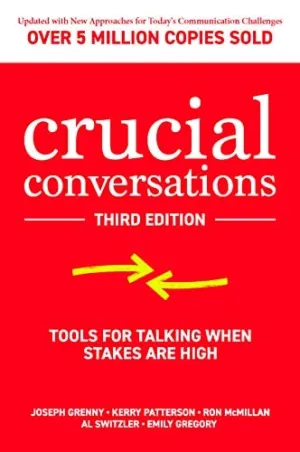
- Authors: Joseph Grenny, Kerry Patterson, Ron McMillan, Al Switzler, Emily Gregory
- Published: 2021 (3rd Edition) | Pages: 288
- Rating: 4.6/5 (30,000+ ratings)
- View on Amazon
This book defines the category. A “crucial conversation” is any discussion where stakes are high, opinions vary, and emotions run strong. As a manager, that’s basically every conversation that matters: performance reviews, salary negotiations, team conflicts, and the moment you need to tell someone their work isn’t good enough.
Why it made the list
The STATE method alone is worth the price. It gives you a step-by-step structure: Share your facts, Tell your story, Ask for the other person’s path, Talk tentatively, and Encourage testing. It sounds simple. It’s not. But once you internalize it, you’ll stop blurting out accusations (“You clearly don’t care about this project”) and start opening doors (“I’ve noticed three missed deadlines this month. I’m worried something might be going on. Can you help me understand?”).
The 3rd edition is significantly updated from the original 2002 version, with modern examples that include remote work, digital communication, and the reality that many crucial conversations now happen over Slack and Zoom, not in a conference room.
What I appreciate most: the book is honest that your instincts during high-stakes conversations are almost always wrong. When adrenaline kicks in, your brain reverts to fight-or-flight. The entire book is a system for overriding those instincts with something more productive.
Best for you if…
You have a specific difficult conversation coming up and you want a reliable structure to follow. You tend to either explode (say too much) or shut down (say nothing) when conversations get emotional. This is the book that gives you a middle path.
Key takeaway: “At the core of every successful conversation lies the free flow of relevant information. People who are skilled at dialogue do their best to make it safe for everyone to add their meaning to the shared pool.”
2. Difficult Conversations — Stone, Patton & Heen
The best book for understanding why your conversations keep going sideways.
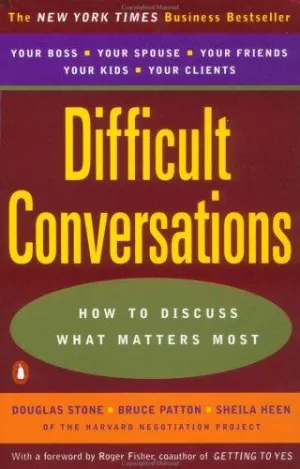
- Authors: Douglas Stone, Bruce Patton, Sheila Heen (Harvard Negotiation Project)
- Published: 2010 (10th Anniversary Edition) | Pages: 352
- Rating: 4.5/5 (8,000+ ratings)
- View on Amazon
If Crucial Conversations gives you the structure, this book from the Harvard Negotiation Project gives you the understanding. Stone, Patton, and Heen argue that every difficult conversation is actually three conversations happening simultaneously: the “What Happened?” conversation, the Feelings conversation, and the Identity conversation. Most people only address the first one and wonder why things blow up.
Why it made the list
This book changed how I think about disagreements at work. Before reading it, I assumed difficult conversations went badly because someone was being unreasonable. After reading it, I realized they go badly because both people are telling themselves a story about what happened — and neither story is complete.
The “Third Story” concept is brilliant and immediately useful: instead of starting a conversation from your perspective (“You missed the deadline”) or theirs (“I was overwhelmed”), you start from a neutral observer’s perspective (“We have a situation where the deadline was missed and I’d like to understand what happened so we can figure out the next step together”). That one shift de-escalates most conversations before they even begin.
For new managers, the Identity chapter alone is worth buying the book. It explains why some feedback conversations feel like a personal attack — because they threaten the other person’s story about who they are (“I’m a competent person” or “I’m a team player”). Once you understand this, you can have difficult conversations without making people feel like you’re attacking their character.
Best for you if…
You’ve tried having difficult conversations and they keep going wrong despite your good intentions. You want to understand the psychology behind why people get defensive, shut down, or escalate. This book gives you the “why” behind the “how.”
Key takeaway: “Difficult conversations are almost never about getting the facts right. They are about conflicting perceptions, interpretations, and values.”
3. Thanks for the Feedback — Stone & Heen
The best book for understanding why people resist what you’re telling them.
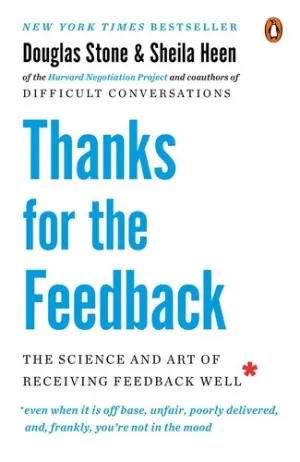
- Authors: Douglas Stone, Sheila Heen
- Published: 2014 | Pages: 368
- Rating: 4.5/5 (5,000+ ratings)
- View on Amazon
This is the companion book to Difficult Conversations, but it flips the script. Instead of focusing on how to deliver tough messages, it focuses on how to receive them. Why does that matter for managers? Because understanding why people resist feedback makes you dramatically better at giving it.
Why it made the list
Stone and Heen identify three triggers that cause people to reject feedback — even feedback that’s accurate and well-intentioned:
- Truth triggers: “That’s just not true” — they disagree with the content
- Relationship triggers: “Who are you to tell me?” — they have a problem with the messenger
- Identity triggers: “I’m a failure” — the feedback threatens their self-image
As a new manager, you’ll hit all three. You’ll give feedback and the person will argue about the facts. You’ll give feedback and they’ll say “But you’ve only been managing us for two months.” You’ll give feedback and they’ll either spiral into shame or dismiss everything because acknowledging one flaw feels like admitting they’re terrible at their job.
Once you can recognize which trigger you’ve hit, you can address it directly instead of just repeating your point louder. And the book’s distinction between three types of feedback — appreciation, coaching, and evaluation — is something every new manager needs. Most of us mash all three together and then wonder why the other person looks confused and hurt.
Best for you if…
You give feedback that you think is clear and constructive, but people don’t seem to hear it — or they react in ways that feel disproportionate. You want to understand the conversation from the other side of the desk.
Key takeaway: “We swim in an ocean of feedback. But even when the feedback is right, it can be hard to take. Understanding why we resist feedback is the first step to getting better at receiving it — and giving it.”
4. Nonviolent Communication — Marshall B. Rosenberg
The best book for having hard conversations without triggering defensiveness.
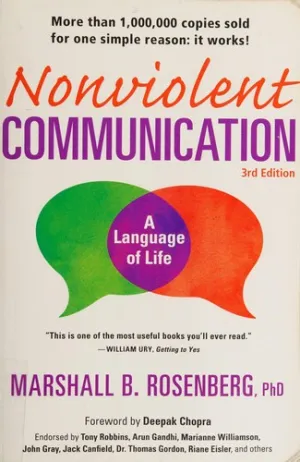
- Author: Marshall B. Rosenberg, Ph.D.
- Published: 2015 (3rd Edition) | Pages: 264
- Rating: 4.6/5 (15,000+ ratings)
- View on Amazon
I’ll be honest: the title is terrible for a business audience. “Nonviolent Communication” sounds like a workshop at a yoga retreat. Ignore the title. This book has the single most practical framework for removing blame, judgment, and accusation from your language — which is the number one reason workplace conversations turn into arguments.
Why it made the list
Rosenberg’s framework is four steps: Observe (without judgment), Feel (name the emotion), Need (identify the unmet need), and Request (make a specific, actionable ask).
Here’s why this matters for managers. Compare these two openings for the same conversation:
Without NVC: “You’re always late to meetings. It’s disrespectful and it needs to stop.”
With NVC: “In the last four meetings, you arrived 10-15 minutes after the start time. When that happens, I feel frustrated because I need the team to be aligned on decisions. Would you be willing to commit to arriving on time, or if something is blocking that, can we talk about it?”
The first one is technically accurate. It’s also guaranteed to make the other person defensive. The second one states the same concern — but in a way that opens a conversation instead of closing one.
The book goes deep on the distinction between observation and evaluation — a distinction most managers don’t even realize exists. “You’re disengaged” is an evaluation. “In the last two team meetings, you didn’t speak up once” is an observation. The difference in how people respond to these is enormous.
Best for you if…
People frequently get defensive or shut down when you bring up issues. You tend to use language like “You always…” or “You never…” or “You’re being…” and you notice it doesn’t work. You want to learn how to say hard things without triggering a fight.
Key takeaway: “What others do may be a stimulus of our feelings, but not the cause. Every criticism, judgment, and expression of anger is the tragic expression of an unmet need.”
5. Fierce Conversations — Susan Scott
The best book for building the courage to say what needs to be said.
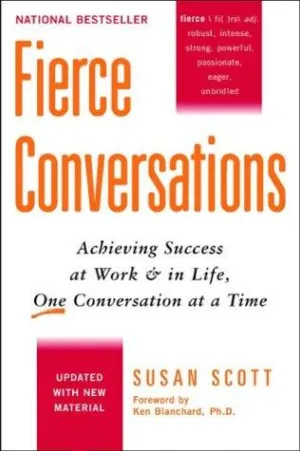
- Author: Susan Scott
- Published: 2017 (Revised Edition) | Pages: 320
- Rating: 4.5/5 (3,000+ ratings)
- View on Amazon
Scott’s core thesis is one sentence: “The conversation is the relationship.” Every relationship in your professional life — with your team, your boss, your peers — is only as strong as the conversations you’re willing to have. Avoid the hard ones and the relationship deteriorates, slowly and invisibly, until someone quits or blows up.
Why it made the list
While the other books on this list focus on how to have difficult conversations, this book focuses on why you must. Scott makes a compelling case that the cost of silence is always higher than the cost of speaking up. Every conversation you avoid doesn’t go away — it goes underground, where it does more damage.
The “Mineral Rights” conversation model is the book’s most practical tool: a 7-step structure for the deep, honest conversations that most managers never have. You start by identifying the most important issue (not the symptom), describe the current impact, state what’s at stake if nothing changes, identify your contribution to the problem, describe the ideal outcome, and commit to action.
What I love about this book is that it doesn’t pretend these conversations are easy. Scott is honest: “fierce” doesn’t mean aggressive. It means real, present, and complete. It means addressing conflict directly instead of dancing around it. And she acknowledges that most of us avoid these conversations not because we’re cowards, but because we don’t want to hurt people we care about.
Best for you if…
Your biggest problem isn’t technique — it’s courage. You know what to say, you just can’t make yourself say it. You need someone to convince you that speaking up is an act of respect, not aggression. This is the book that lights that fire.
Key takeaway: “While no single conversation is guaranteed to change the trajectory of a career, a company, a relationship, or a life — any single conversation can. The conversation is not about the relationship. The conversation is the relationship.”
Quick Comparison
| Book | Best For | Core Framework | Pages | Rating |
|---|---|---|---|---|
| Crucial Conversations | High-stakes conversations | STATE method | 288 | 4.6★ |
| Difficult Conversations | Understanding why conversations fail | Three Conversations + Third Story | 352 | 4.5★ |
| Thanks for the Feedback | Understanding resistance to feedback | Three Triggers | 368 | 4.5★ |
| Nonviolent Communication | Removing blame from language | Observe → Feel → Need → Request | 264 | 4.6★ |
| Fierce Conversations | Building courage to speak up | Mineral Rights model | 320 | 4.5★ |
Which One Should You Read First?
If I had to pick one — just one — it would be Crucial Conversations. It’s the most immediately applicable, with a clear structure you can use in your next meeting. The STATE method alone will change how you open every difficult conversation for the rest of your career.
But here’s the more honest answer: it depends on your specific problem.
- Have a specific hard conversation coming up? Start with Crucial Conversations. It gives you a plan.
- Conversations keep going wrong despite good intentions? Start with Difficult Conversations. It explains why.
- Your feedback gets rejected or ignored? Start with Thanks for the Feedback. It shows you what’s happening on the other side.
- People get defensive no matter how carefully you speak? Start with Nonviolent Communication. It changes your language.
- You keep avoiding conversations you know you need to have? Start with Fierce Conversations. It gives you the courage.
And if you want ready-made scripts for the 10 most common difficult conversations managers face — the ones you can literally print out and keep on your desk — check out the Difficult Conversations Scripts Pack. It includes the exact words to use when you need to address poor performance, push back on your boss, deliver a PIP, and more. It’s the practical companion to the frameworks in these books.
Beyond Books: Practice Is Everything
Reading about difficult conversations is like reading about swimming. Useful — but you still have to get in the water.
Research from the Center for Creative Leadership confirms what these authors all agree on: the biggest predictor of whether a manager can handle difficult conversations is not knowledge — it’s practice. The managers who get good at this aren’t the ones who read the most books. They’re the ones who had the most conversations.
One thing worth doing before the practice, though. Most managers do not avoid these conversations at random, they avoid them in a consistent direction, and for the large majority that direction is softening the message until it stops being a message. The am I too soft? quiz tells you which side you lean on, which decides how you should read every book on this list. And if there is a specific conversation you have been postponing for weeks, the conversation delay cost calculator puts a number on the delay itself. That number is usually what finally gets it scheduled.
Three ways to build the muscle:
-
Start small. Don’t save these techniques for the high-stakes annual review. Practice in your one-on-ones first. Give one piece of real feedback every week. The more you do it in low-stakes settings, the more natural it becomes in high-stakes ones.
-
Pick one framework and use it for a month. Don’t try to learn all five books at once. Pick the one that fits your biggest challenge right now, practice it until it’s automatic, then move on.
-
Debrief after every difficult conversation. What went well? What didn’t? What would you say differently? The debrief is where the real learning happens — not the reading.
The hardest part isn’t learning the framework. It’s opening your mouth when every instinct is telling you to stay quiet. But here’s what every one of these authors agrees on: the conversation you’re avoiding is exactly the one that needs to happen. And the sooner you have it, the smaller the problem stays.
Good luck. And remember — the fact that you’re looking for help with this means you already care more than most managers do.
If you are still building your broader manager reading shelf and want one canonical list to start from, our top 5 books for first-time managers is the curated list new managers come back to — the five books that cover the whole role (the identity shift, the trust work, the feedback craft, the cadence of decisions), not just the difficult conversations slice. Difficult conversations get easier once the relationship underneath them is healthy, and that broader list is how most new managers build it.