The first time you need to tell someone their work isn’t good enough, your brain will try to talk you out of it. You’ll rehearse the conversation in your head twenty times. You’ll draft a message, delete it, draft another one. You’ll consider whether it’s really that bad. Maybe you should wait until the next review cycle. Maybe they’ll figure it out on their own.
They won’t figure it out on their own.
I delayed my first real piece of constructive feedback for over a month. By the time I finally gave it, the person was genuinely surprised — and hurt. Not because the feedback was harsh, but because I’d watched them struggle for weeks without saying anything. “Why didn’t you tell me sooner?” they asked. I didn’t have a good answer.
Feedback isn’t the thing that damages relationships. Withholding feedback is. This guide will teach you how to give feedback that’s honest, specific, and kind — the kind that actually helps people get better. If you want the script library that pairs with this guide, the constructive feedback examples for every workplace situation article walks through fifteen common situations with the bad version and the good version side by side — useful once you’ve internalized the mindset below and you need words for the actual conversation.
If the feedback loop has already broken down and you’re wondering whether to escalate, the Should I Put This Employee on a PIP? free decision tool walks you through 15 scenarios across performance gap clarity, coaching investment, and alternatives. Most managers who reach for the PIP prematurely have skipped 2-3 of the steps this article is about to cover.
The Feedback Mindset
Before we talk about technique, let’s fix the way you think about feedback.
Feedback Is Not Criticism
Criticism says: “You did this wrong.” Feedback says: “Here’s what I observed, here’s the impact, and here’s how to improve.”
If you search for “constructive criticism examples workplace,” you’ll find hundreds of templates. But criticism is a judgment. Feedback is a gift. The distinction matters because it changes your entire approach — your tone, your words, your body language.
Feedback Is Not Optional
Some new managers treat feedback as something reserved for performance reviews or serious problems. That’s like only going to the doctor when you’re in the emergency room.
Feedback should be continuous, lightweight, and normal. Real-time feedback vs performance review isn’t an either/or — but when feedback is a regular part of how your team operates, it stops being scary — for you and for them.
If you want a concrete number on how often that actually means per direct report, the Feedback Frequency calculator plans the sustainable weekly cadence based on your team size, tenure mix, performance distribution, and work complexity. Most managers find they should be giving roughly 2 to 4 hours per week of structured feedback across the whole team, weighted heavily toward struggling and newer reports. If your current cadence is “annual review only,” the gap is usually 10x.
Positive Feedback Is Not “the Easy Part”
Most guides spend 90% of their time on constructive feedback and treat positive feedback as an afterthought. That’s backwards.
Positive feedback is how you build the trust that makes constructive feedback possible. Positive reinforcement at work is how you retain your best people. It’s how you reinforce the behaviors you want to see more of. It’s not a warm-up act — it’s the headliner.
The SBI Framework: Your Go-To Tool
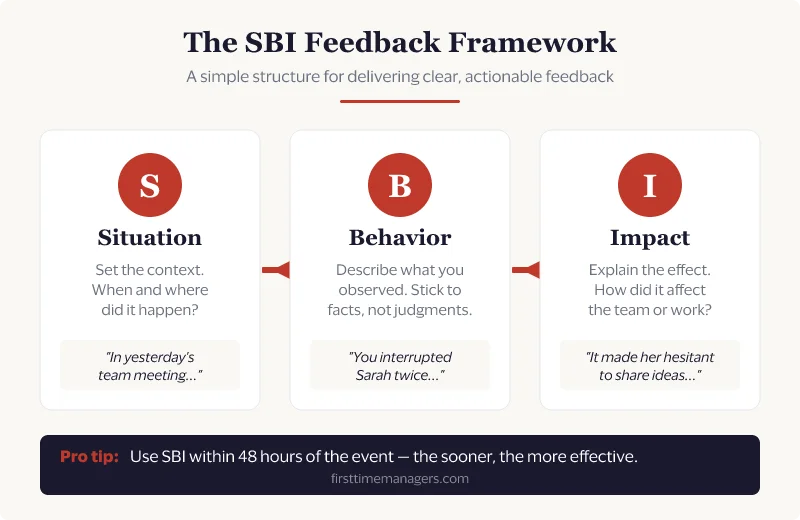
There are dozens of feedback models out there — COIN, STAR, DESC — but the one that works best for new managers is the SBI feedback model: Situation, Behavior, Impact. It’s simple, it’s specific, and it keeps you out of judgment territory. (For a deeper dive into the best frameworks from the best books, see our guide to the top 5 books on difficult conversations at work.)
How It Works
Situation — When and where did this happen? Anchors the feedback to a specific moment. Prevents vague accusations.
Behavior — What exactly did the person do? Observable actions only. What you saw or heard — not what you interpreted or assumed.
Impact — What was the result? The effect on you, the team, the project, or the customer. This is the “why it matters.”
Constructive Feedback Example
Situation: “In yesterday’s sprint review…”
Behavior: “…when the client asked about the timeline, you said ‘I’m not sure’ and moved to the next topic…”
Impact: “…the client followed up with me after the meeting, concerned about whether we’re on track. It created uncertainty we’ll need to address.”
Compare that to: “You were unprepared in the meeting yesterday.” The SBI version is specific, factual, and gives the person something they can actually work with.
Positive Feedback Example
Situation: “In this morning’s team standup…”
Behavior: “…when Jake mentioned he was stuck on the API integration, you immediately offered to pair with him after the meeting…”
Impact: “…they unblocked it in an hour. That kind of proactive collaboration is exactly what makes this team work well.”
Notice: positive feedback follows the same structure. Not “Great job today!” but a specific observation tied to a specific impact. This is what makes praise meaningful instead of generic.
Giving Constructive Feedback: Step by Step
Before the Conversation
1. Check your facts. Are you reacting to a pattern or a single incident? One missed deadline might have a reasonable explanation. Three in a row is a pattern worth addressing.
2. Check your emotions. If you’re angry, frustrated, or disappointed — wait. Cool down first. Feedback delivered in the heat of the moment almost always comes across as an attack, no matter how carefully you word it.
3. Check your intent. Ask yourself: “Am I giving this feedback to help them improve, or to make myself feel better?” If it’s the latter, you’re not ready.
4. Prepare your SBI. Write it down. Literally. The act of writing forces you to be specific and separates facts from feelings.
During the Conversation
1. Open with directness and respect.
“I want to share some feedback about [topic]. I’m bringing this up because I want to see you succeed, and I think this will help.”
Don’t apologize for giving feedback. “I’m sorry, but…” undermines the message before you’ve even delivered it. As Kim Scott’s Radical Candor framework emphasizes, the best feedback combines caring personally with challenging directly. You’re not doing anything wrong — you’re doing your job.
2. Deliver the SBI.
State the Situation, Behavior, and Impact clearly and concisely. Don’t ramble. Don’t soften it with qualifiers until the point is lost. Just say it.
3. Pause.
After you’ve said your piece, stop talking. Give them space to process. The silence might feel uncomfortable — sit with it. They need a moment.
4. Ask for their perspective.
“That’s what I observed. What’s your take? Is there context I’m missing?”
This is critical. You might learn something that changes your understanding. Maybe the “unprepared” person in the meeting was dealing with a production emergency right before. Maybe they didn’t have the information because another team dropped the ball.
Listen genuinely. This isn’t a formality — it’s how you get the full picture.
5. Agree on next steps.
“So what do you think we should do differently next time?”
Let them propose solutions first. People commit more to plans they create. If their plan is solid, endorse it. If it’s not enough, build on it:
“I like that. Could we also add [specific action]? I think that would make a real difference.”
6. End with support.
“I appreciate you hearing this. I know it’s not easy to receive feedback. I’m here to help — let me know what you need.”
After the Conversation
Follow up within a week. If you see improvement, say so immediately:
“I noticed you came prepared with timeline details in today’s client call. That’s exactly the kind of ownership I was hoping for. Nice work.”
This closes the loop. It tells the person: I see you making the effort. It matters.
If you don’t see improvement, have another conversation. Don’t wait another month hoping it’ll click. When feedback alone isn’t enough, it may be time to learn how to have difficult conversations as a new manager.
Giving Positive Feedback: Why Most Managers Get It Wrong
“Good job.” “Nice work on the project.” “You’re doing great.”
These feel like feedback. They’re not. They’re pleasantries. They make someone smile for five seconds and then evaporate.
Effective positive feedback is specific, timely, and tied to impact. In fact, HBR research on what makes feedback effective suggests that focusing on strengths drives more performance improvement than fixating on weaknesses. Here’s the difference:
| Weak | Strong |
|---|---|
| ”Great presentation." | "The way you opened the presentation with the customer story immediately grabbed the room. I saw three people put their phones down. That’s the kind of opening that makes people listen." |
| "Thanks for staying late." | "You staying to fix the deployment issue last night meant the client didn’t even notice the problem. That’s the kind of reliability that builds trust." |
| "Good job on the report." | "The executive summary in your report was clear, concise, and hit every point the VP asked about. She specifically mentioned how useful it was.” |
The Rules of Positive Feedback
1. Be specific. Name the exact behavior and its impact. “Great job” tells someone nothing about what to repeat.
2. Be timely. Give it as close to the moment as possible. Praise from two weeks ago lands with half the impact.
3. Be public when appropriate. A shout-out in a team meeting amplifies the impact tenfold. It signals to the whole team: this is what good looks like here.
4. Be genuine. People can smell fake praise from a mile away. If you don’t mean it, don’t say it. One genuine piece of specific praise per week is worth more than daily empty “good jobs.” (For the full framework on making recognition land, see our guide to giving recognition as a new manager.)
5. Don’t always attach it to constructive feedback. If positive feedback only ever comes as a lead-in to criticism (the “sandwich method”), people will learn to brace for impact every time you say something nice. Decouple them. Give positive feedback on its own, for its own sake.
Receiving Feedback: The Other Half
Here’s something nobody tells new managers: you need to actively seek feedback too. And it’s harder than giving it.
Why It Matters
- It models the behavior you want from your team
- It gives you information you genuinely need (you have blind spots — everyone does)
- It builds trust faster than almost anything else
How to Ask
Don’t say: “Do you have any feedback for me?” (Answer: “No, everything’s great!” — every time.)
Instead, try:
“What’s one thing I could do differently to better support you?”
“In last week’s team meeting, was there anything I could have handled better?”
“If you could change one thing about how I manage, what would it be?”
These questions are specific and give permission to be honest. They also make it clear that you want honest answers.
How to Receive It
When someone gives you feedback:
- Listen. Don’t defend, don’t explain, don’t deflect.
- Thank them. “Thank you for telling me that. I really appreciate it.”
- Reflect. Don’t react immediately. Think about it for a day.
- Act. If the feedback resonates, change something. And tell them you did: “You mentioned X last week. I’ve been working on it. Let me know if you notice a difference.”
The fastest way to kill future feedback is to argue with it or ignore it.
Building a Feedback Culture
The ultimate goal isn’t to be a manager who gives great feedback. It’s to build a feedback culture in teams where everyone gives great feedback — to each other, freely and naturally.
How to Get There
1. Normalize it early. In your first team meeting, say something like:
“On this team, feedback is normal. It’s not a sign something’s wrong — it’s how we get better. I’ll give you feedback, and I expect you to give me feedback too.”
2. Model it constantly. Give feedback in front of the team (positive publicly, constructive privately). Ask for feedback in front of the team. Show that it’s safe.
3. Make it a habit, not an event. Feedback shouldn’t live in quarterly reviews. It should happen in the flow of work — after a presentation, during a code review, in a 1-on-1, in a Slack message.
4. Celebrate it when it happens. When someone on your team gives constructive feedback to a peer (respectfully), call it out: “I appreciate you bringing that up directly. That’s exactly the kind of honesty we need.”
5. Respond to it visibly. When your team gives you feedback and you act on it, tell them. “You told me our standups were too long. I’ve cut them to 15 minutes. Let me know if that’s better.” This proves the feedback loop is real, not performative.
The Cheat Sheet
| Situation | What to Do |
|---|---|
| Good work you want to see more of | Positive SBI — specific, timely, public if appropriate |
| Small issue, first occurrence | Quick private SBI — “Hey, I noticed X. Just wanted to flag it.” |
| Recurring issue or pattern | Scheduled 1-on-1 conversation with full SBI + next steps |
| Serious performance problem | Private meeting, documented, with clear expectations and timeline |
| You’re not sure if it’s worth mentioning | It is. Say it. Small feedback now prevents big feedback later. |
| You’re too emotional to be constructive | Wait 24 hours. Then deliver it calmly. |
The Feedback You’re Sitting On Right Now
You have feedback you haven’t given yet. I know because every new manager does. Maybe it’s positive — something someone did well that you meant to mention but never got around to. Maybe it’s constructive — an issue you’ve noticed but keep postponing.
Here’s your assignment: give one piece of feedback today. Just one. Use SBI. Keep it simple.
If you’re feeling brave, start with the constructive one. If you want a warm-up, start with the positive one.
Either way, start. Because the gap between “I should give feedback” and “I gave feedback” is where most managers get stuck. And once you close that gap the first time, every time after gets easier.
Your team deserves to know where they stand. Not once a year. Not when things go wrong. Now. And that starts with you.
Are you holding back feedback because you’re too nice? Take the free Am I Too Soft as a Manager? quiz — 15 scenario-based questions that measure where softness is costing you. 4 minutes, no email.
Go deeper with the SBI framework. The Difficult Conversations Scripts Pack includes a full SBI Feedback Planner (works for positive feedback too), 10 word-for-word conversation scripts, a prep worksheet, and follow-up email templates. Everything in one 18-page PDF. Get the Scripts Pack →