You said yes to the flexible schedule. Yes to the extra tool subscription. Yes to extending the deadline by a week. Yes to the exception that was supposed to be a one-time thing but somehow became permanent.
And now someone’s standing in your doorway with another request, and you can feel it in your chest — you want to say no, but the word won’t come out.
So you say yes again. And you go home that night carrying the weight of promises you can’t keep, timelines you can’t defend, and a calendar that belongs to everyone except you.
I know this pattern because I lived it for my entire first year as a manager. I thought being supportive meant being agreeable. I thought being liked mattered more than being clear. As Greg McKeown argues in Essentialism, the best leaders succeed precisely because of what they choose to say no to. I was wrong on both counts, and my team paid the price before I did.
Why New Managers Default to “Yes”
Let’s talk about why “no” feels so dangerous when you’re new to management.
You want to be liked. This is the big one. You just stepped into a role where your relationship with everyone changed overnight. If you were promoted from within the team, you’re terrified of being the person who “changed.” If you came from outside, you’re desperate to prove you’re on their side. Either way, “no” feels like a fast track to resentment.
You feel guilty about authority. You didn’t fully choose this power dynamic. It was handed to you. Saying no reminds both you and the other person that you have authority they don’t. That feels uncomfortable — especially when you still see yourself as “one of the team.”
You confuse being supportive with being agreeable. These are not the same thing. A supportive manager removes obstacles, provides clarity, and advocates for their team. An agreeable manager just says yes to everything and hopes it works out. One builds trust. The other builds chaos.
You don’t want conflict. Saying no can lead to pushback. Pushback can lead to an uncomfortable conversation. And uncomfortable conversations are the thing you’ve been avoiding since you got this job.
You haven’t learned how yet. Nobody teaches you this. There’s no “Declining Requests 101” in the management training, if you even got management training. So you default to the path of least resistance.
Every one of these reasons is understandable. And every one of them will eventually bury you.
The Paradox Nobody Tells You About
Here’s the thing that took me way too long to figure out: a manager who says yes to everything doesn’t earn respect. They lose it.
Think about it from your team’s perspective. When the manager says yes to every request, every exception, every deadline extension — what does that signal?
It signals that nothing has weight. That standards are negotiable. That whoever asks loudest gets the most. That the manager lacks the prioritization skills for managers that the role demands — either the judgment or the backbone to use it.
Your team doesn’t want a pushover. They want a leader who thinks clearly, makes decisions, and can be trusted to hold the line when it matters. They want to know that when you do say yes, it actually means something.
A well-delivered “no” builds more trust than a hundred hollow yeses.
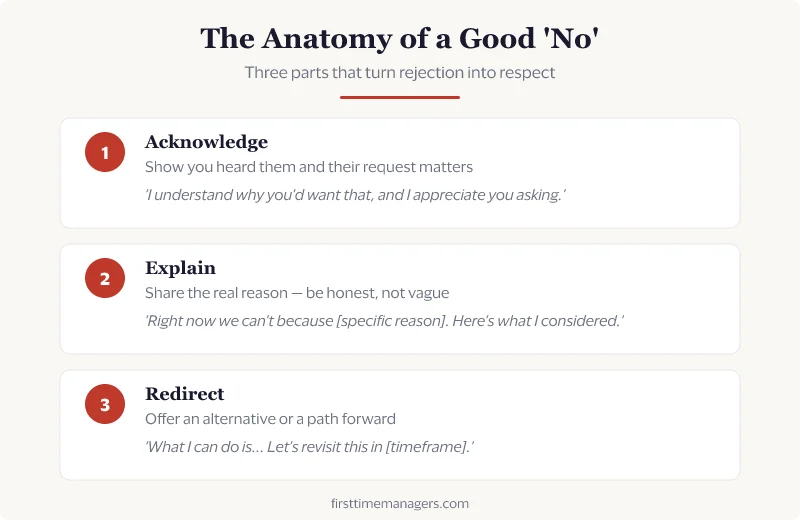
The Anatomy of a Good “No”
Before we get into specific situations, here’s the structure that works for almost any “no” you need to deliver. Three steps:
1. Acknowledge the request. Show the person you actually heard them. Don’t rush past this — it’s the part that prevents them from feeling dismissed.
2. Explain the reason. Not an essay. Not an apology tour. Transparent decision making leadership means giving a clear, honest reason why you can’t say yes. People can handle “no” far better when they understand why.
3. Offer what you can. This is where “no” transforms from a door slamming shut to a door pointing somewhere else. You’re not just blocking — you’re redirecting.
That’s it. Acknowledge, explain, redirect. It takes thirty seconds, and it changes the entire tone of the interaction.
7 Situations Where You Need to Say No (With Scripts)
Let’s get specific. These are the requests that land on every new manager’s desk, and they’re the ones where “yes” will cost you.
1. “Can I work from home every Friday?”
The situation: Your company has a hybrid policy — say, three days in office. This person wants to carve out a permanent exception.
Why you want to say yes: It seems harmless. They do good work. You hate being the policy police.
Why you need to say no: Because the moment you make this exception for one person, you’ve created a two-tier system. Everyone else will notice. And they’ll either resent you or start asking for their own exceptions.
The script:
“I get why you’d want that — Fridays from home sounds great, honestly. But our hybrid policy applies to everyone equally, and I can’t make exceptions for individual team members without it becoming unfair to the rest. What I can do is make sure our in-office Fridays are actually worth showing up for. And if the policy changes down the road, you’ll be the first to know.”
2. “Can we push the deadline?”
The situation: A project deadline is approaching and someone wants more time. But this deadline was set by a client, a stakeholder, or the business — it’s not yours to move.
Why you want to say yes: You can see they’re stressed. You want to protect them. And honestly, the work probably would be better with more time.
Why you need to say no: Because moving a deadline you don’t own will damage your credibility upward and teach your team that timelines are suggestions. Managing team expectations around deadlines is one of the hardest parts of the job.
The script:
“I hear you — the timeline is tight, and I know you want to deliver quality work. I respect that. But this deadline is committed to [client/stakeholder], and I don’t have the authority to move it unilaterally. What I can do is help you figure out what to cut or simplify so you can hit the date with work you’re proud of. Let’s look at the scope together.”
3. “I want a raise” or “I deserve a promotion”
The situation: Someone approaches you about a raise or promotion, but the timing isn’t right — they haven’t been in role long enough, the performance isn’t there yet, or the budget doesn’t exist.
Why you want to say yes: You probably agree they’re doing good work. You want to keep them. Saying no feels like you’re punishing them for asking.
Why you need to say no (for now): Because saying yes when the criteria aren’t met devalues the promotion for everyone. And making promises you can’t keep is worse than being honest.
The script:
“I’m glad you brought this up — the fact that you’re thinking about growth is a good sign. Right now, I can’t make that happen because [specific reason — budget cycle, tenure, specific skills gap]. But I don’t want this to be a dead end. Let’s map out exactly what it would take to get there, and I’ll commit to checking in on your progress every month. I want to be able to advocate for you when the time is right.”
This is where good feedback skills matter enormously. You need to be specific about the gap without being crushing.
4. “Can you make an exception for me?”
The situation: Someone wants to skip a process, bend a rule, or get special treatment. Maybe they have a reason. Maybe it’s a good one.
Why you want to say yes: You’re empathetic. The rule might seem arbitrary. You want to be the “cool manager.”
Why you need to say no: Because fairness is the foundation of trust. The moment your team sees you playing favorites, psychological safety crumbles.
The script:
“I understand why you’re asking, and I don’t think it’s unreasonable. But if I make this exception for you, I have to be willing to make it for everyone — and I’m not sure that works. The reason this [rule/process] exists is [reason]. What I can help with is [alternative] — would that solve the underlying problem you’re dealing with?“
5. “I don’t want to work with [teammate]”
The situation: Someone tells you they can’t stand working with a specific colleague. They want to be moved to a different project or have the collaboration end.
Why you want to say yes: Nobody wants to force people into a bad partnership. And the person in front of you seems genuinely frustrated.
Why you need to say no: Because in most workplaces, you don’t get to choose your colleagues. And resolving the conflict is better than avoiding it — for everyone.
The script:
“I appreciate you being honest with me about this. That takes guts. But I can’t restructure projects based on personal preferences — it’s not fair to the rest of the team, and it doesn’t solve the actual problem. What I want to do instead is understand what’s happening between you two so we can fix it. Can you tell me specifically what’s making the collaboration difficult?”
From there, you’re moving into conflict resolution territory. That’s a different skill, but the first step is refusing to let avoidance be the solution.
6. “Can we skip the [process/meeting]?”
The situation: Someone wants to drop the weekly stand-up, skip the code review, bypass the approval workflow. They think it’s a waste of time.
Why you want to say yes: Maybe you secretly agree. Meetings can be pointless. Processes can be bloated.
Why you need to say no (at least right now): Because processes exist for reasons, even imperfect ones. Killing them without a replacement creates chaos.
The script:
“I hear you — nobody loves process for the sake of process, and I’m not going to pretend every meeting we have is perfectly designed. But [process/meeting] exists because [reason]. Here’s what I’m open to: if you think there’s a better way to achieve the same outcome, bring me a proposal. I’ll genuinely consider it. But we’re not going to just drop it without a plan.”
This approach does something powerful — it turns a “no” into an invitation to lead. You’d be surprised how many people back down when you ask them to propose an alternative. And the ones who actually do? Those are your future leaders.
7. “Can you handle this for me?”
The situation: A team member brings you a problem and wants you to solve it. Talk to the difficult client. Escalate the issue. Write the email.
Why you want to say yes: It’s faster. You know how to do it. And there’s a part of you that misses doing the work instead of managing the work.
Why you need to say no: Because every time you solve a problem your team should own, you’re robbing them of growth — and drowning yourself in work that isn’t yours.
The script:
“I understand this feels like a tough one. And I’m not going to leave you hanging. But this is your problem to solve, and I think you’re more capable of handling it than you realize. Here’s what I can do — I’ll help you think through your approach, and if you get stuck, come back to me and we’ll troubleshoot together. But the first move is yours.”
This is one of the most common mistakes new managers make — swooping in to rescue instead of coaching. It feels helpful in the moment. It’s devastating in the long run.
”Not Now” vs. “Not Ever”
Not every “no” is permanent, and your team needs to know the difference.
“Not now” means: The timing is wrong, the budget isn’t there, or there are higher priorities. It’s a no with a future. Signal this clearly:
“I can’t approve this right now because [reason]. But let’s revisit it in [timeframe]. Here’s what would need to change for me to say yes.”
“Not ever” means: This conflicts with a value, a policy, or a principle you won’t budge on. Be direct about it:
“I’m not going to be able to do this, and I want to be straight with you about why. [Reason]. I know that’s not what you wanted to hear, but I’d rather be honest than string you along.”
The worst thing you can do is deliver a “not ever” disguised as a “not now.” People can handle a firm no. What they can’t handle is false hope followed by repeated disappointment.
When to Say Yes Even Though Your Gut Says No
I’ve spent this whole article talking about the importance of saying no. But I’d be dishonest if I didn’t say this: sometimes the right answer is yes, even when it’s uncomfortable.
Say yes when:
- The request is reasonable and you’re only hesitating because of precedent anxiety. Not every yes creates a slippery slope. Sometimes a Friday off is just a Friday off.
- The person has earned trust. High performers who rarely ask for exceptions deserve more flexibility, not less. That’s not favoritism — it’s earned trust.
- The rule is genuinely outdated. If you find yourself defending a process that serves no purpose, that’s not leadership — that’s bureaucracy. Kill the rule instead.
- Saying no would cost more than saying yes. Pick your battles. Not every hill is worth dying on.
The goal isn’t to become the “no” manager. The goal is to become the manager whose yes and no both mean something.
Saying No to Your Boss (On Behalf of Your Team)
This is the advanced move, and it’s the one that separates good managers from great ones.
Your boss comes to you with an unrealistic timeline. An additional project to pile on your already-stretched team. A directive that you know will burn people out.
Most new managers absorb the pressure and pass it straight down. They say yes upward and dump the consequences downward. Your team notices. And they stop trusting you to protect them.
Here’s how to push back without torching your career:
Lead with alignment, then reality:
“I want to make sure we hit this goal — it’s important and I’m aligned on the priority. Here’s my concern: with our current workload, adding this means either [timeline] slips or [quality] drops. I want to give you options rather than just a problem. We can [option A], [option B], or [option C]. Which would you prefer?”
You’re not saying “no” to your boss. You’re saying “yes, and here’s what it costs.” That’s resource constraints communication at its best — what HBR describes as the art of saying no to more work — and it’s one of the most valuable things you can do for your team.
What I Learned the Hard Way
My turning point came about eight months into my first management role. I’d said yes to so many schedule exceptions that my team’s in-office days looked like a random number generator. I’d approved deadline extensions so many times that nobody took deadlines seriously anymore. I’d taken on so much of my team’s work that I was staying until 8pm most nights while they left at 5.
And then one of my best people quit. In the exit interview, she said something that hit me like a truck: “I never knew where the boundaries were. It felt like nothing mattered enough for you to hold the line.”
She wasn’t asking me to be harsh. She was asking me to be clear. To make decisions and stand behind them. To be a leader, not a people-pleaser.
That conversation changed how I managed. I started saying no — awkwardly at first, then more naturally. And something unexpected happened. My team didn’t resent me for it. They respected me more. They stopped testing boundaries because the boundaries were clear. They stopped bringing me problems they could solve themselves because they knew I’d send them back with a coaching question.
The team got better. And I got my evenings back.
The Bottom Line
Saying no is not the opposite of being supportive. It’s a requirement of it.
Every time you say yes when you should say no, you’re borrowing from your future self — your credibility, your energy, your team’s respect. And that debt compounds fast.
You don’t need to be cold about it. You don’t need to enjoy it. You just need to do it — clearly, kindly, and with a reason that makes sense.
The first few times will feel terrible. You’ll replay the conversation in your head. You’ll worry you were too harsh. You’ll want to walk it back.
Don’t.
Because on the other side of that discomfort is a team that knows where they stand, a workload you can actually manage, and the kind of trust that only comes from a manager who means what they say.
Struggling to set boundaries? Take the free Am I Too Soft as a Manager? quiz — 15 scenarios that reveal where niceness is undermining your effectiveness. 4 minutes, no email required.
Saying no is just one of many hard conversations. The Difficult Conversations Scripts Pack gives you 10 word-for-word scripts for situations like underperformance, conflict, delivering bad news, and pushing back on your own boss — plus a prep worksheet and follow-up email templates. Get the Scripts Pack →