Here’s a comforting truth: almost every new manager makes the same mistakes. Not because they’re bad at their job — but because nobody prepared them for how different management is from everything they’ve done before. In fact, Gallup research shows companies pick the wrong manager 82% of the time — largely because organizations promote for technical skill, not leadership readiness. The pillar guide on leadership skills for new managers breaks down the ten skills that actually close that readiness gap on a small team — useful as a roadmap once you have flagged which mistakes from the list below are yours.
I made at least eight of these ten. Some of them more than once. The managers I respect most? They made them too. The difference is they recognized them, learned, and adjusted.
This list isn’t here to scare you. It’s here to give you a head start. If you can avoid even half of these, you’ll be ahead of 90% of first-time managers.
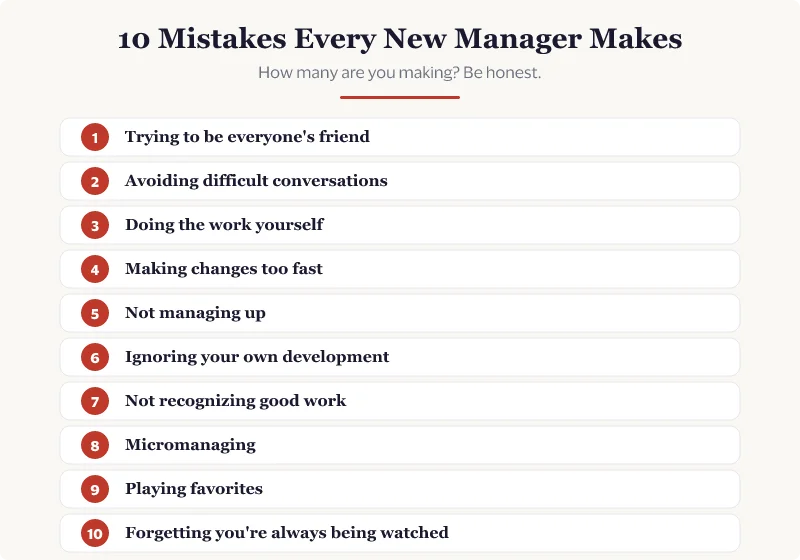
One note before the list: reading about mistakes tells you what to avoid, not which one you are currently making. The Am I a Good Manager? assessment is the faster way to find that out, because most of the mistakes below are invisible from the inside until someone asks the right scenario question.
1. Trying to Still Be “One of the Gang”
This is the hardest one, especially if you were promoted from within. Managing former peers is one of the most common new leader common pitfalls. Yesterday you were grabbing lunch with these people, venting about deadlines, sharing memes in the group chat. Today you’re their boss. If you’ve been promoted from peer to manager, you know exactly how disorienting this feels.
The mistake: Acting like nothing changed. Continuing to vent about leadership, gossiping, or bending rules for your former peers because “we’re all friends here.”
Why it’s a problem: The dynamic has changed, whether you acknowledge it or not. When you need to give someone tough feedback or make an unpopular decision, that blurred line becomes a wall. Your team won’t trust you to be fair, and you won’t trust yourself to be honest.
What to do instead: You can be warm, approachable, and genuinely caring without being everyone’s buddy. This goes double if you’re managing someone older or more experienced than you — the urge to overcompensate is even stronger. The shift is subtle but important:
- Stop participating in gossip about the company or other teams
- Be consistent in how you treat everyone — no favorites
- Be friendly in every interaction, but accept that some distance is healthy
- When someone tests the boundary (“Come on, you’re not really going to enforce that, are you?”), hold the line kindly but firmly
The test: If you’re about to say or do something you’d be uncomfortable with your boss seeing, don’t do it.
2. Doing Everything Yourself
You were probably promoted because you were great at your job. Fast, reliable, high quality. So when a task lands on the team, your instinct screams: “I’ll just do it myself — it’ll be faster.”
The mistake: Holding on to your individual contributor work instead of delegating. Strong delegation skills for managers are built over time — but they start with letting go.
Why it’s a problem: You’re creating a bottleneck. Your team isn’t growing. And you’re burning out trying to do two jobs — your old one and your new one. Worse, your team starts to feel like you don’t trust them.
What to do instead:
- Accept that someone will do it differently than you — and that’s okay
- Delegate the outcome, not just the task. “I need X result by Y date” gives people room to own the work
- Start with low-risk tasks and build up as trust grows
- When you catch yourself thinking “it’s faster if I do it” — that’s your signal to delegate
The rule: If someone on your team can do a task at 70% of your quality, delegate it. They’ll get to 100% with practice. You’ll never get to 100% as a manager if you’re still doing their work. Building a solid delegation habit is one of the key goals in your first 90 days as a manager.
3. Avoiding Difficult Conversations
A team member is underperforming. Two people on your team aren’t getting along. Someone has a habit that’s annoying the entire group. You notice it. You think about it. You lose sleep over it.
And you do nothing.
The mistake: Hoping problems will resolve themselves if you just give them more time.
Why it’s a problem: They won’t. Small issues grow into big ones. The underperformer drags down the team. The conflict festers. And your team loses respect for you because they can see the problem too — and they’re watching to see if you’ll address it.
What to do instead:
- Set a personal rule: if something bothers you for more than a week, schedule the conversation
- Use a simple framework: state the specific behavior, explain the impact, ask for their perspective, agree on next steps. If you’re not sure where to begin, this guide on how to give feedback for the first time walks you through it step by step.
- Remember: having the conversation is an act of respect. Avoiding it is actually the unkind choice — you’re letting someone fail without telling them
The reframe: A difficult conversation that goes okay is infinitely better than no conversation at all.
4. Making Changes Too Fast
You see inefficiencies everywhere. Meetings that waste time. Processes that make no sense. Tools that should have been replaced years ago. You have ideas. You want to prove yourself.
The mistake: Overhauling systems, canceling meetings, or introducing new processes in your first few weeks.
Why it’s a problem: You don’t have the full picture yet. That meeting you think is pointless? It might be the only time two critical teams sync up. That process you think is clunky? It was built to solve a problem you haven’t encountered yet.
More importantly: change without trust feels like arrogance. Your team thinks, “You’ve been here two weeks and you already know better than us?”
What to do instead:
- Spend your first 30 days in listen-and-learn mode
- Ask “Why do we do it this way?” before assuming the answer is “no good reason”
- When you do make changes, start with one thing at a time
- Involve your team in the change: “I’ve noticed X. What do you think? Would Y be better?”
- Earn the right to change things by first proving you understand how they are
The timeline: Observe for 30 days. Make small improvements in days 30-60. Tackle bigger changes after day 60.
5. Not Managing Up
Your team is your primary responsibility. But your boss is your primary enabler. Forget that, and you’ll struggle.
The mistake: Focusing entirely on your team and forgetting to keep your own manager informed, aligned, and confident.
Why it’s a problem: Your boss can’t support you if they don’t know what’s happening. They can’t defend your team’s priorities if they don’t understand them. And if they’re surprised by bad news — a missed deadline, a team conflict, a departure — they’ll lose trust in your judgment.
What to do instead:
- Proactively share updates. Don’t wait for your boss to ask. A weekly 3-line email works: “What’s going well / What’s at risk / What I need from you.”
- Give early warnings. “I think we might miss the deadline — here’s why and here’s my plan” is 100x better than “We missed the deadline.”
- Understand their priorities. What does your boss care about? What makes them look good? Align your work accordingly.
- Ask for feedback. “How am I doing? What could I be doing better?” Shows maturity and builds trust.
The mindset shift: Managing up isn’t politics or sucking up. It’s making sure the person who controls your resources, your team’s visibility, and your career trajectory has the information they need. As Harvard research on the myths new managers believe points out, relying solely on your formal authority instead of building these relationships is one of the most damaging misconceptions new leaders hold. If this resonates, read our full guide on how to manage up as a new manager — including scripts for the expectations conversation, delivering bad news, and pushing back on bad ideas.
6. Confusing Being Busy with Being Effective
Your calendar is packed. Back-to-back meetings from 9 to 5. You’re replying to Slack messages at 10 PM. You haven’t had a lunch break in three weeks. You must be doing a great job, right?
The mistake: Equating activity with impact. Measuring your worth by how many hours you work or how many meetings you attend.
Why it’s a problem: Busyness is the enemy of effectiveness. If every hour is filled, you have no time to think strategically, prepare for important conversations, or simply be available when your team needs you. You become reactive instead of proactive.
What to do instead:
- Audit your calendar weekly. For each meeting, ask: “Do I need to be here? Does this meeting need to exist? Could it be shorter?”
- Block focus time. At least 2-3 hours per week of uninterrupted time for thinking, planning, and preparing
- Say no more often. Every “yes” to a meeting is a “no” to something else. Be intentional about the trade-off
- Measure output, not input. At the end of the week, ask yourself: “What actually moved forward because of me?” If you can’t answer, you were busy but not effective
The test: If you removed yourself from half your meetings, would anything break? If not, you’re in too many meetings. For a complete framework, see our guide to time management for new managers.
7. Giving Only Negative Feedback
You’re overloaded, stressed, and the only time you think to give feedback is when something goes wrong. A missed deadline triggers a conversation. A quality issue prompts a message. An error in a presentation makes you pull someone aside.
The mistake: Only speaking up when something is wrong, never when something is right.
Why it’s a problem: Your team starts to dread hearing from you. Every ping, every “can we talk?” triggers anxiety. People become risk-averse — why try something new if the only feedback they’ll get is criticism? And the people doing great work? They feel invisible. Then they leave. This is one of the fastest paths to losing top performers — silence on their wins paired with criticism on their misses.
What to do instead:
- Aim for a 3:1 ratio — three positive observations for every constructive one
- Be specific with praise too. “Good job” is nice. “The way you handled that client escalation yesterday — staying calm, getting the facts, proposing a solution within an hour — that was exactly the kind of ownership we need” is powerful.
- Catch people doing things right. Actively look for it. It takes practice because our brains are wired to notice problems
- Praise publicly, critique privately. Team meeting shout-outs cost nothing and mean everything
The habit: Every Friday, send one specific, genuine piece of positive feedback to a team member. It takes two minutes. The impact lasts all week. (Need the full system? Here’s how to give recognition that actually motivates.) This matters even more if you’re managing Gen Z employees — they have lower tolerance for negative-only feedback and will disengage fast.
8. Not Setting Clear Expectations
You assume people know what “good” looks like. You say “handle this” and expect the outcome you imagined. You assign a project and check in three weeks later to find something completely different from what you wanted.
The mistake: Being vague about what you expect and then being disappointed when people don’t meet standards they didn’t know existed.
Why it’s a problem: Your team isn’t psychic. “Handle the client report” means very different things to different people. Without clear expectations, people either guess (and get it wrong) or become paralyzed (and don’t act at all). Then you get frustrated, and they feel set up to fail.
What to do instead:
- Define “done” explicitly. “I need a 2-page summary of client feedback, with the top 5 issues ranked by frequency, by Thursday at 3 PM” is clear. “Handle the client feedback” is not.
- Share the “why.” People make better decisions when they understand the purpose. “This report goes to the VP to decide whether we renew the contract” changes how someone approaches the task.
- Clarify the level of autonomy. “Do this exactly as I describe” vs. “Here’s the goal — figure out the best approach” are very different instructions. Say which one you mean.
- Check for understanding. “Can you walk me back what you’re going to do?” isn’t micromanaging employees. It’s making sure you’re aligned before someone spends 20 hours going the wrong direction.
The principle: Every frustration about unmet expectations is a signal that the expectations weren’t clear enough.
9. Playing Favorites
Maybe you don’t realize you’re doing it. But your team does.
The mistake: Giving the best projects to the same person. Spending more 1-on-1 time with people you click with. Being more lenient with people you like. Publicly praising the same team member while others do equally good work unnoticed.
Why it’s a problem: It destroys team morale faster than almost anything else. The “favorites” feel uncomfortable pressure. Everyone else feels undervalued and resentful. Trust erodes — people stop believing that performance matters, because advancement seems based on relationship, not results.
What to do instead:
- Distribute high-visibility projects deliberately. Track who gets what. If the same name keeps coming up, rotate.
- Spend equal 1-on-1 time. Don’t skip or shorten meetings with people you find harder to connect with.
- Base decisions on data, not gut. When choosing who leads a project, write down the criteria first. Then pick the person who fits best.
- Ask yourself regularly: “If the whole team could see how I allocate my time and attention, would they think it’s fair?”
- Get feedback. Ask your team anonymously: “Does everyone on this team get equal opportunities?” The answers might surprise you.
The hard truth: You probably have unconscious preferences. Everyone does. The goal isn’t to eliminate them — it’s to be aware enough to compensate for them.
10. Not Taking Care of Yourself
You’re working longer hours than ever. You’re thinking about work problems in the shower, at dinner, at 2 AM. You feel guilty taking a day off because your team might need you. You’ve stopped exercising, seeing friends, doing things that recharge you.
The mistake: Treating self-care as a luxury instead of a necessity. Believing that a good manager is always available, always “on.”
Why it’s a problem: Burned-out managers make bad decisions. They’re reactive instead of thoughtful. They snap at people. They lose perspective. And their team can feel it — a stressed manager creates a stressed team. You’re not helping anyone by running yourself into the ground.
What to do instead:
- Set boundaries and hold them. Choose a time when you stop checking messages. Communicate it to your team. Stick to it.
- Take your vacation days. All of them. And actually disconnect.
- Protect one non-negotiable in your personal life — the gym, family dinner, Saturday mornings, whatever it is. Don’t let work eat it.
- Find a peer group. Other managers who understand what you’re going through. You need people to vent to who aren’t your team or your boss.
- Ask for help. A mentor, a coach, a great management book, a course. You don’t have to figure everything out alone.
The reframe: Taking care of yourself isn’t selfish. It’s the most responsible thing you can do for your team. A rested, clear-headed manager is better than a burned-out hero in every measurable way.
The Mistake Behind All These Mistakes
If there’s one thread connecting all ten of these, it’s this: trying to be perfect instead of trying to be honest.
The perfect manager doesn’t exist. But the honest one — the one who says “I’m still learning,” who admits mistakes, who asks for feedback, who adjusts when things aren’t working — that manager earns real trust.
You’re going to make mistakes. Probably some of the ones on this list. That’s fine. What matters is:
- Recognize it. Self-awareness is the most important management skill.
- Own it. Don’t blame circumstances or other people.
- Fix it. Adjust your approach and try again.
- Learn from it. Every mistake is data for becoming better.
The fact that you’re reading an article about avoiding management mistakes already tells me something about you: you care about doing this well. That puts you ahead of most. Keep going.
Want a cheat sheet for the moments when these mistakes are about to happen? The Manager’s Cheat Sheet Pack gives you 12 printable one-page cards — covering feedback, meetings, difficult conversations, recognition, and more. Pin them to your wall and glance at them before the moment hits. See all 12 cheat sheets →