You used to get things done. Now you spend all day in meetings and go home wondering what you actually accomplished.
Sound familiar? You’re not imagining it. A Harvard Business Review study found that managers spend an average of 23 hours per week in meetings — up from fewer than 10 hours in the 1960s. Add emails, Slack messages, and “quick questions” from your team, and your calendar becomes a battlefield where everyone else’s priorities win.
Here’s the uncomfortable truth: nobody is coming to fix your calendar. Your boss won’t tell you to block focus time. Your team won’t stop asking questions. HR won’t redesign your meeting schedule. Time management as a manager is entirely on you.
But here’s the good news — it’s a skill, not a personality trait. And like any skill, there’s a framework for it.
Why Time Management Is Different for Managers
As an individual contributor, your job was to do the work. As a manager, your job is to make sure the right work gets done. That’s a fundamentally different relationship with time.
The traps are predictable:
- The helper trap. Someone asks for help, and you drop everything. You feel useful, but your own priorities never move.
- The meeting trap. Your calendar fills up because saying “yes” is easier than saying “let me check.” By Wednesday, you have no unscheduled time left.
- The doing trap. You keep doing your old job because it feels productive — while your actual management work (coaching, planning, unblocking) gets pushed to “later.”
- The urgency trap. Everything feels urgent when you’re new. You react to every Slack ping, every escalation, every “quick question” — and end up managing everyone else’s priorities except your own.
If you see yourself in any of these, you’re normal. The question is what to do about it. (And if you want the deeper thinking on why execution beats planning, the top 5 books on goal setting and getting results has the reading list.)
The Eisenhower Matrix: Your Daily Decision Filter
Before you reorganize your calendar, you need a way to decide what actually deserves your time. The Eisenhower Matrix, named after President Dwight Eisenhower, is the simplest framework that works.
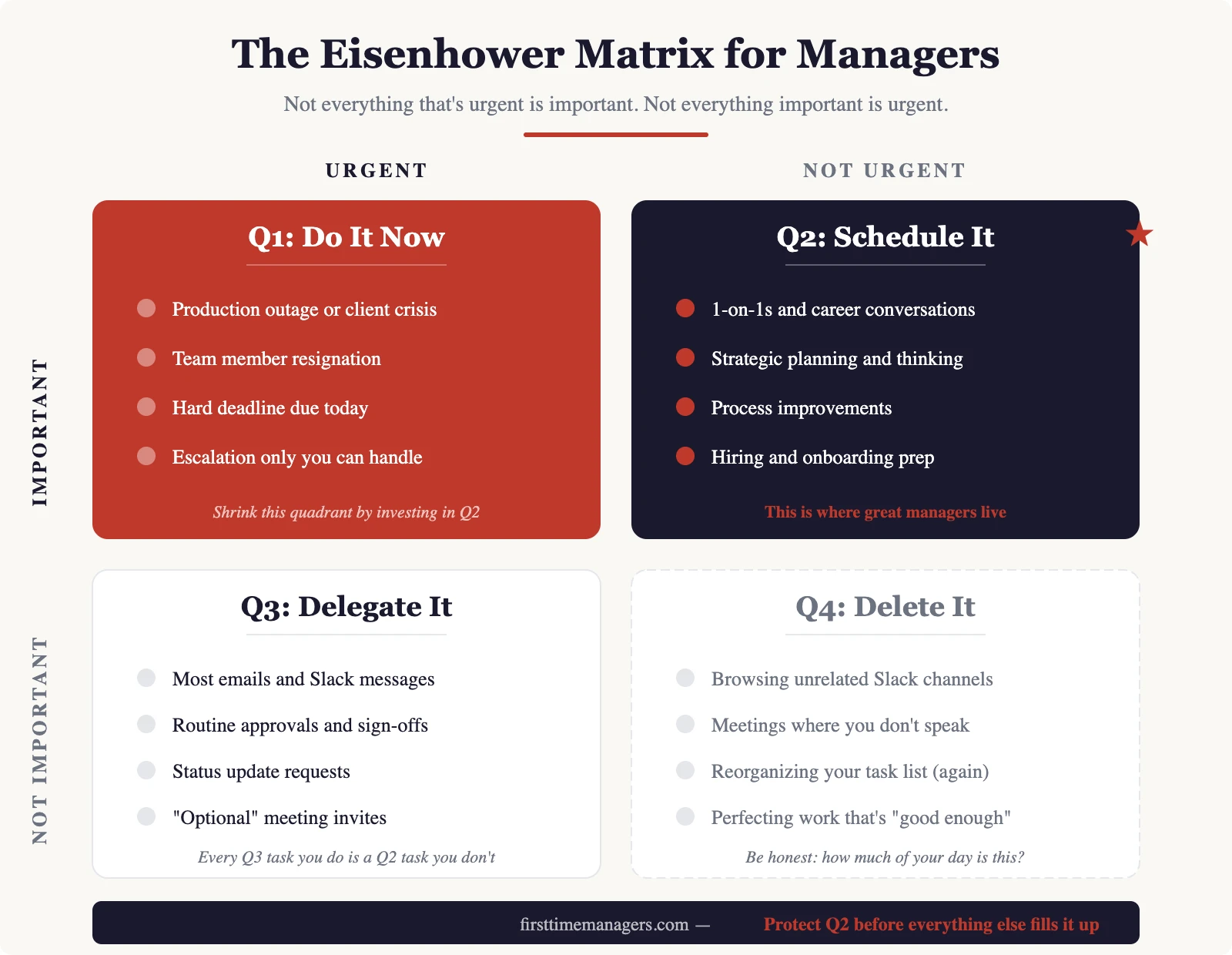
It splits everything into four buckets:
Quadrant 1: Urgent + Important — Do It Now
These are crises, hard deadlines, and escalations that can’t wait. A production outage. A team member’s resignation. A client emergency your team can’t handle without you.
You can’t avoid Q1, but you can shrink it. Most Q1 fires exist because someone skipped Q2 work earlier — planning, prevention, relationship-building. The better you get at Q2, the fewer Q1 emergencies you’ll face.
Quadrant 2: Important + Not Urgent — Schedule It
This is where managers win or lose. One-on-ones. Career development conversations. Strategic planning. Process improvements. Hiring. Thinking.
Q2 never screams at you. It just quietly determines whether you’re a good manager or a busy one. The single most important habit in time management is protecting Q2 time on your calendar before everything else fills it up.
Quadrant 3: Urgent + Not Important — Delegate It
Most emails. Routine approvals. Status update requests. Meeting invites where you’re “optional.” These feel urgent because someone is waiting, but they don’t move the needle for your team.
Your first instinct will be to handle these yourself because it’s faster. Resist that instinct. Every Q3 task you do is a Q2 task you don’t. Learn to delegate — not because you’re lazy, but because your team needs you working on things only you can do.
Quadrant 4: Not Urgent + Not Important — Delete It
Browsing Slack channels that don’t involve your team. Attending meetings where you don’t speak or make decisions. Reorganizing your task list for the third time this week.
Be honest with yourself: how much of your day is Q4 disguised as work?
Time Blocking: How to Protect Your Calendar
Knowing what’s important is useless if your calendar won’t let you do it. Time blocking is the practice of scheduling specific types of work into dedicated slots — and defending them like you would a meeting with your boss.
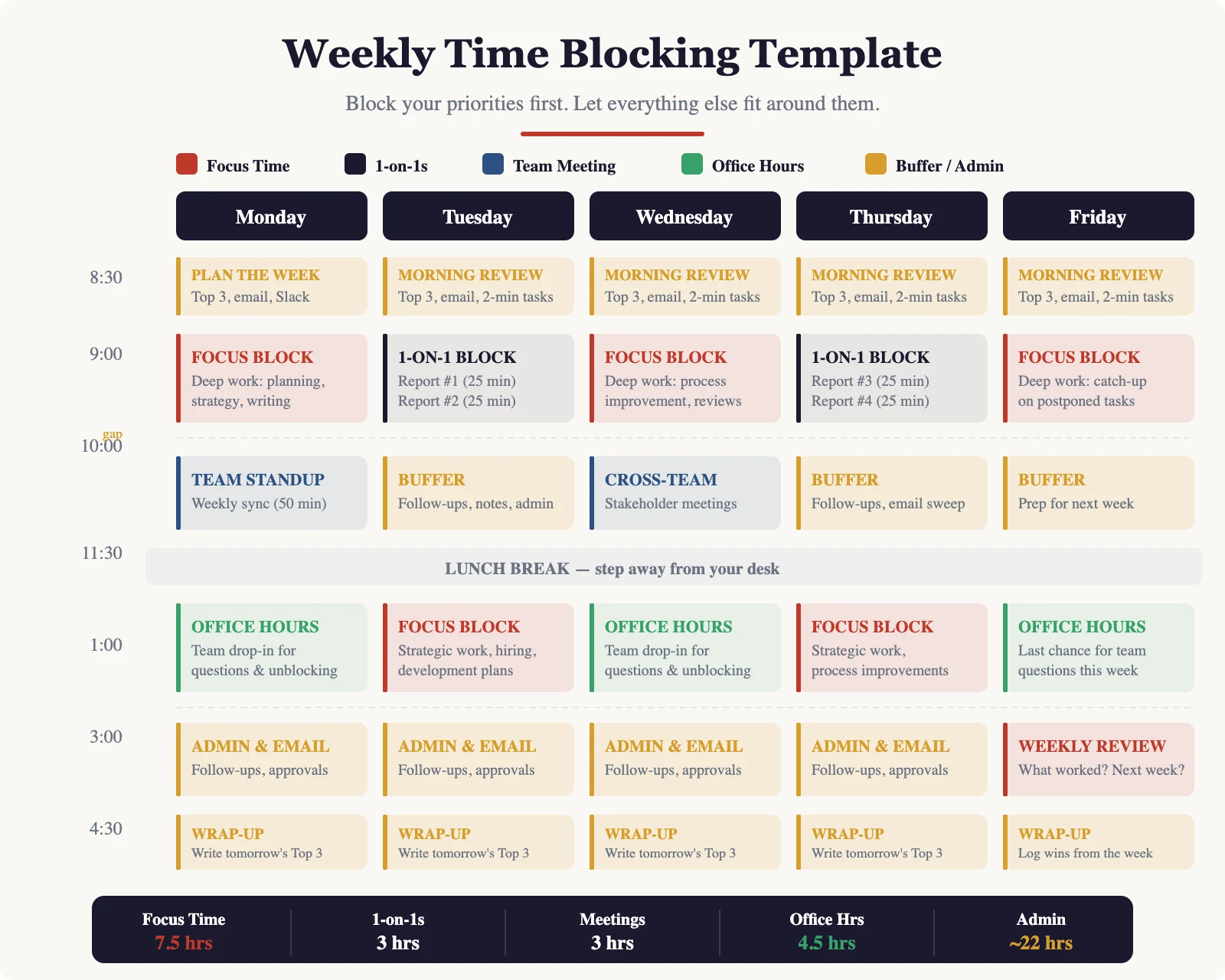
Five Rules That Actually Work
1. Block focus time first — at least 3 hours per week. Open your calendar on Sunday evening or Monday morning. Before anything else, block 2-3 slots of 60-90 minutes for deep work: planning, writing, thinking, reviewing. Mark them as “busy.” If someone tries to book over them, decline. You wouldn’t cancel a meeting with your VP — treat your focus time the same way.
2. Batch your 1-on-1s on one or two days. Spreading five 1-on-1s across five days means five context switches. Grouping them on Tuesday and Thursday means two days of people-work and three days with longer uninterrupted blocks. Your conversations will be better too — you’ll be in “coaching mode” instead of constantly switching gears.
3. Leave 30-minute gaps between meetings. Back-to-back meetings don’t save time. They cost you time because you carry the mental residue of one conversation into the next. A Microsoft Human Factors study showed that back-to-back virtual meetings increase stress and reduce the ability to focus. A 30-minute gap lets you process, write notes, send follow-ups, and arrive at the next meeting with a clear head.
4. Schedule “office hours” instead of being always available. Tell your team: “I’m available for quick questions from 10-11 AM and 3-4 PM. Outside those windows, Slack me and I’ll get back to you by end of day.” This isn’t being unavailable — it’s being predictable. Your team adapts fast, and you gain uninterrupted hours.
5. Review your calendar every Sunday. Spend 10 minutes looking at your upcoming week. For each meeting, ask: “Is this still necessary? Do I need to be there? Can it be shorter?” Cancel or shorten anything you can. This one habit, done consistently, reclaims 2-3 hours per week.
The Meeting Audit: Find Your Hidden Hours
If your calendar is already full, blocking new time won’t help — you need to free some up first. A meeting audit is a 15-minute exercise that most managers never do but always wish they had.
The Three Questions
Look at every recurring meeting on your calendar and ask:
-
“Could this be an async update instead?” Status meetings where people read updates one by one are almost always better as a Slack post or a shared document. Kill them. (Watch the async side too: the email time waste calculator prices what your inbox habits cost, and which slice of that bill is avoidable.)
-
“Does this need to be 60 minutes?” Most one-hour meetings have 25 minutes of useful content and 35 minutes of filler. Default to 25 minutes for 1-on-1s and 50 minutes for group discussions. People will be more focused with less time.
-
“Do I need to be there?” If you’re not making decisions, providing input, or learning something critical — you don’t need to attend. Ask for notes instead. Your team can survive without you in every room.
Research from Microsoft’s WorkLab found that the number of weekly meetings increased 153% globally since 2020. Not all of that increase was necessary. Most managers who do their first meeting audit find 3-5 hours of recoverable time immediately. If you want the most radical version of this fix, run the numbers on a fully protected day: the meeting-free day savings calculator shows what one empty Wednesday per week is worth for your team. (For a deeper dive into making the meetings you keep actually productive, see our guide on running effective team meetings.)
The 2-Minute Rule and Other Quick Wins
Not everything needs a framework. Some habits are small enough to adopt today:
The 2-Minute Rule: If a task takes less than 2 minutes, do it immediately. Replying to a simple email, approving a request, forwarding a document — just do it now. The overhead of noting it down, remembering it later, and context-switching back costs more than 2 minutes.
Touch email 3 times a day, not every 3 minutes. Check email at 9 AM, after lunch, and before end of day. Turn off notifications in between. You’ll be surprised how few things are truly urgent.
End every day by writing tomorrow’s top 3. Before you close your laptop, write down the three most important things for tomorrow. Not a full task list — just three. This takes 2 minutes and gives your morning self a running start instead of a blank stare.
Say “Let me check my calendar” instead of “Yes.” This one phrase buys you the space to make a conscious choice instead of a reflexive commitment. Most people respect it. The ones who don’t are the ones who keep taking your time.
Block Friday afternoon for weekly review. Look back at what you accomplished, look ahead at next week, and adjust. Setting your own goals as a manager becomes much easier when you review weekly instead of hoping you’ll remember at the end of the quarter.
What to Do When Everything Is Urgent
Some weeks, everything genuinely is on fire. A project is at risk. Two people are out sick. Your boss needs something by Friday. These weeks will happen, and the Eisenhower Matrix won’t save you. (A realistic project timeline set at the start, with an honest buffer, prevents a surprising share of these fires from ever igniting.) (If “everything is on fire” has become your default — not the exception — that’s a different problem. Read about manager burnout and how to recognize it.)
When everything is urgent, use the “If I can only do three things today, what are they?” filter. Write them on a sticky note. Do those three things. Everything else either waits, gets delegated, or doesn’t happen.
This feels wrong. You’ll feel like you’re dropping balls. But here’s the truth: you’re already dropping balls. The only question is whether you drop them consciously (choosing your priorities) or unconsciously (letting other people’s priorities win).
The best managers are not the ones who do everything. They’re the ones who are clear about what they won’t do — and communicate it honestly. A quick message to your team: “This week is packed. I’m focusing on X, Y, and Z. If you need me for something else, flag it and we’ll figure out timing.” That’s not weakness. That’s leadership.
Your Time Management Cheat Sheet
Here’s the daily rhythm that works for most new managers:
| Time | Activity |
|---|---|
| Morning (first 30 min) | Review your top 3 priorities. Check email/Slack once. Handle anything under 2 minutes. |
| Mid-morning | Focus block: deep work, planning, or strategic thinking. No meetings. |
| Late morning / early afternoon | 1-on-1s and team meetings (batched). |
| Mid-afternoon | Office hours: available for your team’s questions. |
| Late afternoon (last 30 min) | Email sweep, follow-ups, write tomorrow’s top 3. |
| Friday afternoon | Weekly review: what worked, what didn’t, next week’s plan. |
You won’t follow this perfectly. No one does. But having a default rhythm means you start each day with a structure instead of reacting from minute one.
The Real Truth About Time Management
You will never have enough time. That’s not a problem to solve — it’s a condition of the job. The promotion from individual contributor to manager is a permanent trade: you give up control of your own tasks in exchange for influence over your team’s outcomes.
The goal isn’t to “get it all done.” The goal is to spend your limited time on the things that matter most — your team’s goals, their development, the roadblocks only you can remove. Everything else is noise.
Start small. Pick one habit from this article — just one — and do it for two weeks. The 2-minute rule. The Sunday calendar review. Batching your 1-on-1s. Whatever resonates. Build from there.
Your calendar will always be full. The question is: full of what?
Still doing work your team should own? The how to delegate as a new manager guide walks through what to hand off and how to brief without micromanaging. The Delegation ROI calculator shows when the math actually justifies the time investment to teach.
Want a one-page version of these frameworks? The Manager’s Cheat Sheet Pack includes a printable Time Management card with the Eisenhower Matrix, 5 time blocking rules, and the meeting audit questions — plus 11 more cheat sheets covering feedback, difficult conversations, goal setting, and more. See all 12 cheat sheets →