You just became a manager, and you’re drowning. Your calendar is stacked. Your to-do list has a to-do list. You’re in every meeting, CC’d on every email, and approving every decision — because that’s what managers do, right?
Meanwhile, two of your team members are visibly underutilized. One asked you last week if there was anything more they could take on. You said “let me think about it” and never followed up.
You know you should delegate. Everyone says so. Your boss said it. That leadership book said it. But every time you try to hand something off, a voice in your head whispers: it’ll be faster if I just do it myself. Or worse: what if they mess it up and it comes back to me?
I lived this exact cycle for months. I was working 12-hour days while my team clocked out at five — not because they were lazy, but because I hadn’t given them anything meaningful to own. Gallup’s research on delegation found that leaders who effectively delegate authority grow their teams faster, generate more revenue, and create more jobs. I was doing the opposite — hoarding work and wondering why I was burned out.
Why New Managers Don’t Delegate (Even When They Know They Should)
Let’s be honest about what’s really going on. Delegation isn’t a knowledge problem — it’s an emotional one.
You’re afraid it won’t be done right. You built your reputation on the quality of your individual work. Now you’re supposed to hand that work to someone who might do it differently — or worse, do it badly. And when it goes sideways, your name is still on it.
You feel guilty assigning work. Especially if you were recently promoted from the team. It feels strange to tell people who used to be your peers what to do. Delegation can feel dangerously close to bossing people around.
You think it’s faster to do it yourself. And honestly? In the short term, you’re right. Explaining a task, answering questions, reviewing the output — it is slower the first time. But this logic is a trap. You’re trading ten minutes today for ten hours next month, because that task will come back again and again, and you’ll still be the only one who can do it.
You don’t know what to let go of. Nobody gave you a list of “tasks you should stop doing now that you’re a manager.” So everything feels like it’s still yours. The reports, the client calls, the code reviews, the slide decks — you keep doing all of it, plus the new management stuff on top.
You confuse being busy with being valuable. This is the deepest one. When you were an individual contributor, your value was directly tied to your output. More work meant more value. As a manager, that equation flips entirely — but it takes a long time for your brain to catch up.
Every one of these reasons is human. And every one of them will cap your team’s potential and burn you out in the process.
The Mindset Shift That Changes Everything
Here’s what took me embarrassingly long to understand: delegation is not about getting tasks off your plate. It’s about putting the right work on the right plates.
When you delegate well, three things happen simultaneously:
- You free up time for work only you can do — setting direction, removing obstacles, developing people, having the difficult conversations nobody else will have.
- Your team members grow. They learn new skills, gain confidence, and start solving problems you used to solve. That’s not losing control — it’s multiplying your impact.
- Your team’s capacity increases. Instead of one bottleneck (you) through which every decision flows, you have multiple capable people who can act independently.
HBR’s research on delegation puts it clearly: companies led by executives who delegate effectively grow faster and generate more revenue. The same principle applies at every management level. A team with a delegating manager outperforms a team with a hoarding one.
The reframe is simple but powerful: every task you hold onto that someone else could do is a task you’re stealing from their development and adding to your burnout.
What to Delegate (And What to Keep)
This is where most delegation advice falls apart. “Just delegate more!” is about as useful as “just be more confident!” You need a framework for deciding what stays with you and what goes.
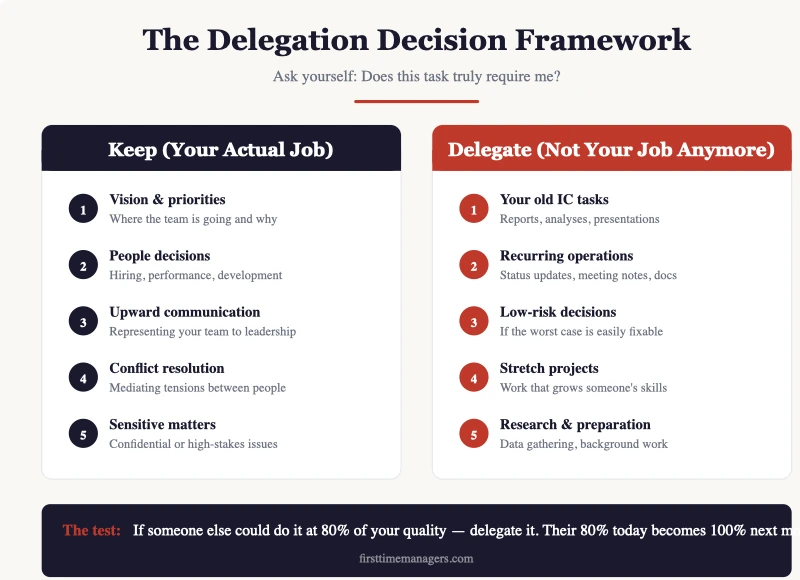
Keep these (your actual job as a manager):
- Vision and priorities. Your team needs you to decide where we’re going and what matters most. That’s not delegatable.
- People decisions. Hiring, performance conversations, career development — this is core management work. Don’t outsource it.
- Upward communication. Representing your team to leadership, fighting for resources, managing expectations with your boss — that’s yours.
- Conflict resolution. When tensions arise between team members, you need to step in. You can’t delegate that to one of the parties involved.
- Sensitive or confidential matters. Anything involving personal information, performance issues, or organizational changes stays with you.
Delegate these (they’re not your job anymore):
- Tasks you used to do as an individual contributor. This is the big one. The reports you wrote, the analyses you ran, the presentations you built — someone else needs to own those now.
- Recurring operational work. Status updates, meeting notes, process documentation, routine approvals — if it happens regularly and doesn’t require your judgment, delegate it. (Handing off something that currently lives only in your head takes longer than you expect; the knowledge transfer time calculator estimates how long until someone can run it without you.)
- Decisions with limited blast radius. If the worst case is easily fixable, let your team decide. Not every choice needs to go through you.
- Projects that stretch someone’s skills. This is delegation at its best — assigning work that helps a team member grow, not just work that helps you breathe.
- Research and preparation. You don’t need to be the one gathering data for the quarterly review. Delegate the research; keep the synthesis.
The gray zone (delegate gradually):
- Client or stakeholder interactions. Start by including a team member in meetings, then let them lead one, then hand it off.
- Cross-team coordination. As your team members build relationships across the organization, they can represent the team in more contexts.
- Process improvements. If someone sees a better way to do something, let them own the change — don’t redesign every workflow yourself.
The 5-Step Delegation Process That Actually Works
Knowing what to delegate is half the battle. Knowing how to delegate is the other half. Here’s the process I wish someone had taught me before I spent six months failing at it.
Step 1: Choose the right person
This isn’t just about who has capacity (though it is worth checking the team actually has some to give: the team capacity calculator shows what is left after meetings and overhead). Consider:
- Who would grow from this? Delegation should develop people, not just distribute labor.
- Who has the foundational skills? They don’t need to be an expert — but they need enough baseline competence that the gap is bridgeable.
- Who’s interested? People do better work on things they care about. If possible, match the task to someone’s interests or career goals.
Don’t always delegate to the same person just because they’re reliable. That’s how you burn out your best people while underinvesting in everyone else. (And if you’re refusing to delegate because you don’t trust anyone enough — or because you’re too exhausted to set up the handoff — those are signs of burnout, not signs of a bad team.)
How much structure to hand over along with the task also depends on the person: someone new to this kind of work needs more direction, someone experienced needs more autonomy. That per-person calibration is the core of situational leadership, and it is worth learning as a system rather than guessing case by case.
Step 2: Define the outcome, not the method
This is the single biggest mistake new managers make when delegating: they describe every step of the process instead of describing what success looks like.
Bad delegation: “Go to the shared drive, open the Q2 template, pull the numbers from Salesforce, format them like I did last quarter, and send the draft to me by Thursday.”
Good delegation: “I need a Q2 performance summary ready for the leadership meeting next Monday. The audience cares about revenue trends and pipeline health. Here’s last quarter’s report for reference — but feel free to improve the format if you think something works better. Draft by Thursday so we have time to iterate.”
See the difference? The first version turns your team member into a typist. The second turns them into a thinker. You’ve defined the what and the why while leaving room for the how.
Step 3: Set the authority level
Not all delegation is equal. Be explicit about how much autonomy they have. I use four levels:
- Level 1 — Research and recommend. “Look into this and tell me what you’d suggest. I’ll make the final call.”
- Level 2 — Decide and inform. “Make the decision, then let me know what you chose and why.”
- Level 3 — Decide and act. “Handle it. Loop me in only if something goes sideways.”
- Level 4 — Full ownership. “This is yours. I trust your judgment. I don’t need to be involved unless you want me to be.”
Most new managers default to Level 1 for everything, which defeats the purpose. Push yourself to use Level 2 and 3 more often than feels comfortable. That discomfort is the feeling of actually delegating.
Step 4: Agree on check-ins (not check-ups)
There’s a critical difference between checking in and checking up. One says “I’m here to support you.” The other says “I don’t trust you.”
When you delegate a task, agree upfront on when you’ll touch base. This prevents two failure modes:
- You hovering. Without a scheduled check-in, you’ll be tempted to ask for updates constantly. That’s micromanagement, and it undermines every benefit of delegation.
- Radio silence until deadline. Without any check-in, a small misunderstanding in week one becomes a major rework in week four.
A simple structure: “Let’s check in briefly on Wednesday — just 10 minutes. I want to make sure you have what you need and we’re aligned on direction.” If you’re already running regular one-on-one meetings, delegation check-ins can happen there naturally.
Step 5: Debrief after — especially when it doesn’t go perfectly
The task is done. Now what? Most managers skip this step. They either silently redo the parts they didn’t like (which teaches the other person nothing) or they say “great job” regardless of quality (which teaches them nothing different).
Instead, have a brief two-way debrief:
- What went well? Start here. Recognize what they did right.
- What would you do differently? Let them self-assess before you add your perspective. You’ll be surprised how often they already know.
- What support would have helped? This one’s for you. Maybe you under-explained the context. Maybe they needed access to someone or something you forgot to provide.
This turns delegation from a one-time transaction into a learning cycle. Each round gets better.
The Delegation Conversation: What It Actually Sounds Like
Theory is great. But what do you actually say when you delegate something? Here’s a realistic example:
“Hey Sarah, I’ve got something I’d like you to take on. We need to put together the monthly client satisfaction report for the leadership team — that’s something I’ve been doing myself, but I think it’s a great opportunity for you to get more visibility with the senior team and build your analytical skills.
The goal is a clear, concise report that highlights trends in our client NPS scores — what’s improving, what’s declining, and any patterns we should act on. The audience is non-technical, so clarity matters more than detail.
I’ll share last month’s report so you can see the format, but don’t feel locked into it. If you think there’s a better way to present the data, I’m open to it.
For this first one, let’s do Level 2 — make your calls on the content, then walk me through it before it goes out. Once you’re comfortable, we’ll move to Level 3.
Can we check in on Thursday to see how it’s shaping up? And if you hit any roadblocks before then, just ping me. Sound good?”
That conversation took two minutes. And it covered everything: the what, the why, the how much autonomy, the check-in cadence, and the growth opportunity. Your team member walks away clear, motivated, and trusted.
The Five Traps That Kill Delegation
Even when you start delegating, these patterns can sabotage you:
Trap 1: Delegating tasks but not authority
You hand someone a project but then require them to check with you before every decision. That’s not delegation — it’s creating a puppet with extra steps. If you delegate the task, delegate enough authority to actually complete it.
Trap 2: Taking it back at the first sign of struggle
Your team member hits a snag. They’re not doing it the way you would. The instinct screams: just take it back and do it yourself. Resist. Struggle is where learning happens. Coach them through it instead of rescuing them from it. This is closely related to one of the most common mistakes new managers make — jumping in to “help” when you should be teaching.
Trap 3: Expecting perfection on the first try
Their version won’t be as good as yours the first time. Accept that. As HBR recommends, accepting 80% quality on a delegated task is not settling — it’s investing. Their 80% this month becomes 95% next month, and then 100% the month after — while you’ve reclaimed hours of your time.
Trap 4: Delegating only the boring stuff
If you only delegate the tasks nobody wants — data entry, scheduling, formatting — your team will learn that “delegation” means “dump.” Mix in meaningful, challenging work. The report that gives them visibility. The project that stretches a skill they want to build. That’s how delegation becomes development, not just distribution.
Trap 5: Not delegating enough, soon enough
Most new managers start delegating way too late. They wait until they’re completely overwhelmed, then frantically hand off tasks without proper context. By that point, it feels like desperation, not trust. Start delegating in your first 90 days, not after your first burnout.
When Delegation Goes Wrong (And How to Fix It)
Let’s be real — delegation doesn’t always work. Sometimes the outcome isn’t what you expected. Here’s what to do when it doesn’t go as planned:
The work quality is low. Before you blame the person, check yourself. Did you clearly define the outcome? Did you give them enough context? Did you set realistic expectations for someone doing this for the first time? Often, poor delegation results from poor communication, not poor performance. Have a direct feedback conversation that focuses on the gap between expectation and result, not on the person.
They missed the deadline. Same questions apply — was the timeline realistic? Did they know it was firm? Did they have the resources they needed? If yes to all three and they still missed it, that’s a coaching conversation about reliability and communication. The right response isn’t to never delegate to them again — it’s to use shorter check-in intervals next time.
They did it completely differently than you would have. This one’s tricky because it might not actually be a problem. If the outcome is good, does it matter that the path was different? If you defined the outcome clearly (Step 2), judge the outcome, not the method. If you catch yourself thinking “but that’s not how I would have done it” — good. That’s the point. You’re building a team that can think, not a team that can copy you.
Building a Delegation Culture on Your Team
The goal isn’t just for you to delegate. It’s to create a team where delegation flows naturally at every level — where people proactively pick up work, where ownership is clear, and where asking for help or offering to take something on is normal.
Here’s how to build that:
Talk about delegation openly. In a team meeting, share what you’re delegating and why. Normalize it. “I’m handing the client report to Sarah because she’s building her analytics skills and deserves more visibility with leadership. I’ll still own the client relationship.”
Encourage your team to delegate to each other. Delegation isn’t just a manager-to-report thing. When team members can redistribute work among themselves based on skills and capacity, you’ve built real team trust.
Celebrate ownership, not just output. When someone takes on a delegated task and makes it their own — improving the process, catching something you missed, bringing a new perspective — call that out publicly. That’s the behavior you want to reinforce.
Set goals that require delegation. When you set team goals — whether for your first 90 days or beyond — include objectives that are impossible to achieve alone. This forces delegation by design, not by crisis.
What I Wish I’d Known from Day One
Eight months into my first management role, I hit a wall. I was working late every night, my team was bored, and my boss pulled me aside to say something I didn’t want to hear: “You’re still doing the job you were promoted from.”
She was right. I was the best individual contributor on a team that desperately needed a manager. I was writing reports instead of reviewing them. I was fixing bugs instead of coaching the engineers who should fix them. I was answering client emails instead of empowering my team to own those relationships.
The turning point wasn’t a dramatic moment — it was a spreadsheet. I wrote down every task I did in a week. Then I put a checkmark next to the ones that only I could do. The result? About 30% of my work actually required me. The other 70% was work I was doing because I hadn’t let go of it yet.
That week, I delegated three things. The client satisfaction report. The sprint planning prep. The onboarding documentation. All three things I “always did” because I was good at them. My team picked them up, stumbled a bit, and within a month was doing them better than I had.
And I finally had time to do the job I was actually hired for.
The Bottom Line
Delegation is not about doing less. It’s about doing the right things — the things that actually require a manager — while empowering your team to do the rest.
It will feel slower at first. It will feel uncomfortable. You’ll watch someone struggle with something you could finish in twenty minutes, and every fiber of your being will want to grab the keyboard.
Don’t.
Because on the other side of that discomfort is a team that’s growing, a workload that’s sustainable, and a version of you that’s finally managing instead of just doing with a fancier title.
Start small. Delegate one thing this week. Define the outcome. Set a check-in. Resist the urge to take it back. Then do it again next week. And the week after that.
The best managers aren’t the ones who do the most. They’re the ones whose teams do the most — because they were trusted enough to try.
Run the math before you delegate. The Delegation ROI calculator shows when the upfront teaching time actually pays back. The Manager Leverage calculator shows whether you are operating as a multiplier or a bottleneck. And if you suspect your span is wrong in the first place — too many reports to delegate well, or too few to develop people — the Span of Control calculator tells you whether your team size is right for the complexity, tenure mix, and interdependence of the work. Most managers underestimate all three.
Delegation is just one piece of the puzzle. The First 90 Days Playbook covers delegation alongside everything else you need in your first three months — week-by-week actions, reflection exercises, and quick-reference cards. Get the full plan →