Your first 90 days as a manager will define how your team sees you for the next year. That sounds like pressure, but it’s actually freedom. Because it means you don’t need to have everything figured out forever. You just need a solid first three months. Michael Watkins’ The First 90 Days framework shows that the management transition timeline you follow in these early months has an outsized impact on long-term success.
I remember my own first 90 days. I swung between “I’ve got this” on Monday and “what have I gotten myself into” by Wednesday. The problem wasn’t lack of effort. It was lack of structure. I didn’t know what to focus on when.
This plan fixes that. It’s the 30-60-90 day plan for managers I wish I’d had: a structured roadmap for establishing credibility as a new leader.
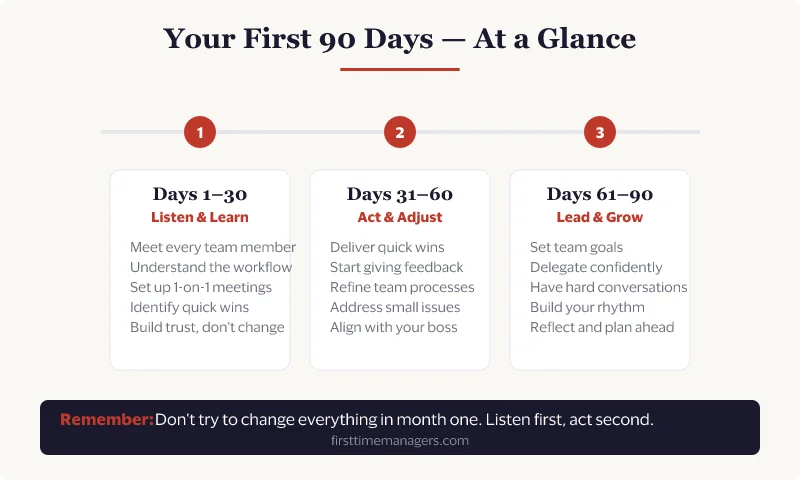
The Three Phases
Your first 90 days break naturally into three phases:
- Days 1-30, Listen & Learn. Understand the landscape before you touch anything
- Days 31-60, Build & Act. Start making targeted improvements
- Days 61-90, Lead & Accelerate. Step fully into the role with confidence
Each phase has a different job. Rushing through them, especially Phase 1, is the most common mistake new managers make. For a broader view of the entire transition, see our first-time manager’s complete guide.
This Plan Assumes One Starting Point. Check Whether It Is Yours.
The week-by-week structure below is written for the most common case: you were promoted inside a team that already knows you, the previous manager left on reasonable terms, and nothing is on fire. Plenty of new managers start somewhere else, and the differences almost all land in Phase 1. The rest of the plan holds.
You were promoted from within the team. This is the default the plan assumes, and its specific difficulty is not competence, it is renegotiating relationships that already have a shape. Your 1-on-1s in week one are doing double duty: gathering information and resetting the terms of every friendship on the team. Yesterday’s colleague, today’s boss covers that reset, including the conversation with whoever else applied for the job.
You came from outside the company. Add two weeks to Phase 1. You are learning the team and the organization at the same time, and the organization is the slower of the two: who really decides things, which commitments are real, what the last three reorganizations taught people to expect. Your advantage is that nobody has a prior read on you, so how you introduce yourself carries more weight than it would for an internal hire, and your first team meeting is a genuine first impression rather than a formality.
You replaced someone who was pushed out. Expect a quieter, more careful team than the plan assumes, and expect week-one answers to be shorter than they should be. People are working out whether you are here to continue what happened or to end it. Two rules: do not criticize your predecessor, even when the team invites you to, because it reads as an early signal about how you will talk about people who are not in the room. And do not promise that nothing else will change, because you cannot know that yet. “I don’t know yet, and I’ll tell you when I do” is worth more here than reassurance.
Your team is remote and you have never met them. Everything you know arrives secondhand, through the handover and the channel history, and distance removes the accidental contact that would normally correct it. Keep the listening phase, but treat the handover’s judgments as unverified until you have your own evidence, and be careful with early requests for information, which read as an audit from someone the team has never met. Our guide to taking over a remote team you have never met covers that first month.
You inherited a live crisis. A missed deadline, an outage, an audit. You do not get 30 days of listening, and pretending otherwise is how the plan fails you. Compress Phase 1 into the first week, run it in parallel with the crisis rather than before it, and be explicit with the team that you are doing this: “I’m making calls this month with less context than I’d like. Tell me when I’m about to get one wrong.” Then go back and do the real Phase 1 once the fire is out, because the information you skipped does not stop mattering.
Phase 1: Listen & Learn (Days 1-30)
Your only job this month: understand everything before you change anything.
You’ll feel pressure to prove yourself. To show you deserve the promotion. To make your mark. Resist that urge. The managers who earn the most respect are the ones who listen first.
Week 1: Orient Yourself
This week is about getting your bearings. You’re mapping the territory. If you want a day-by-day breakdown, our new manager checklist for the first week gives you exactly that.
Do this:
- Schedule a 1-on-1 with every team member. 30 minutes each, and our guide on how to run your first one-on-one meeting covers exactly how to structure these. Ask open-ended questions:
- “What’s going well that I should know about?”
- “What’s the biggest frustration on the team right now?”
- “What should I absolutely not change?”
- “How do you prefer to get feedback?”
- Run your first team meeting. Keep it short and keep it about them. This is not the place for a vision statement, and the temptation to deliver one is strong. Our guide to your first team meeting as a new manager has an agenda that works whether you came from inside the team or outside it.
- Meet your boss. Align on expectations. Ask: “What does success look like for me in 90 days?” Write it down.
- Identify key stakeholders outside your team: other managers, clients, leadership. Stakeholder relationship building starts with a brief introduction and genuine curiosity about how your teams connect.
- Learn the tools and processes. How does work get tracked? What meetings exist? Where does information live?
Don’t do this:
- Don’t announce changes or new initiatives
- Don’t skip the 1-on-1s because “you already know everyone”
- Don’t reorganize anything, even if it’s clearly broken
Week 2: Go Deeper
Now you start connecting dots.
Do this:
- Map out current projects. What’s in progress? What’s the priority? Who owns what? Where are the risks?
- Understand the team dynamics. Who works well together? Where is there tension? Who’s the go-to person for what?
- Review past performance data if it exists: previous reviews, team metrics, project retrospectives.
- Have a 1-on-1 with your own manager focused on: “Here’s what I’ve observed so far. Am I reading this right?”
- Start a private notes document. Write down observations, patterns, questions. You’ll be glad you did.
Key question to answer this week: What’s working well that I need to protect?
Week 3: Identify Quick Wins
By now you’ve heard the same frustrations from multiple people. That’s your signal.
Do this:
- Pick 2-3 new manager quick wins. Small, concrete improvements that solve real pain points. Examples:
- A meeting that everyone hates? Cancel it or shorten it.
- A process that creates unnecessary busywork? Simplify it.
- A decision that’s been stuck? Make it (or escalate it).
- Don’t implement yet. Just identify them and validate with your team: “I’ve noticed X is frustrating. Would it help if we Y?”
- Start establishing your 1-on-1 rhythm. Weekly, same time, same place. Make it a habit your team can count on.
Key question to answer this week: What small changes would make people’s lives easier right now?
Week 4: Share What You’ve Learned
End your first month by closing the loop with your team.
Do this:
- Hold a team meeting where you share your observations (not judgments). Something like:
- “Here’s what I’ve heard and observed in my first month.”
- “Here’s what I think is going well.”
- “Here are areas I think we can improve.”
- “Here’s what I plan to focus on next month.”
- Ask for corrections. “Did I miss anything? Am I reading this wrong?”
- Implement your quick wins. You validated them last week, so now ship them.
- Write a personal 30-day reflection. What surprised you? What’s harder than expected? What’s your biggest concern?
Phase 1 Checklist
- 1-on-1 with every team member completed
- Boss alignment on 90-day expectations
- Key stakeholders identified and met
- Current projects and priorities mapped
- Team dynamics understood
- 2-3 quick wins identified and implemented
- Weekly 1-on-1 rhythm established
- First team meeting held with observations shared
Phase 2: Build & Act (Days 31-60)
You’ve earned some credibility. People have seen that you listen, that you follow through on quick wins, and that you don’t make reckless changes. Now you can start building.
Week 5: Set Clear Goals
Time to move from observation to direction.
Do this:
- Define 2-3 team goals for the next 60 days. Make them specific and measurable:
- Bad: “Improve code quality”
- Good: “Reduce production bugs by 30% by implementing code review for all PRs”
- Align these goals with your boss before sharing with the team. You need air cover.
- Share the goals with your team. Explain the “why,” not just what you want to achieve, but why it matters.
- Assign clear ownership. Every goal needs a person responsible, not just “the team.”
Week 6: Improve Processes
Now that you understand how things work, improve what’s not working.
Do this:
- Audit your team’s meetings. For each one, ask: Does this need to exist? Does it need to be this long? Do these people all need to be here? (Our guide on running effective team meetings has a full audit framework.)
- Streamline one workflow. Pick the process that creates the most friction and simplify it. Involve the people who actually use it.
- Set up basic feedback loops if they don’t exist:
- Weekly team sync (15-30 min max)
- Regular retrospectives (biweekly or monthly)
- A way for the team to flag blockers quickly
Common process improvements that almost always work:
- Cutting a recurring meeting from 60 to 30 minutes
- Creating a shared document for status updates instead of a status meeting
- Establishing “no meeting” blocks for focused work
- Clarifying who makes what decisions (so people stop waiting for permission)
Week 7: Start Developing People
This is where you shift from managing work to managing people.
Do this:
- Have a career conversation with each team member. Not a performance review, a real conversation:
- “Where do you want to be in a year?”
- “What skills do you want to develop?”
- “What kind of work energizes you?”
- Identify one growth opportunity per person. A stretch project, a new responsibility, a skill to develop. It doesn’t need to be big.
- Start delegating intentionally. Not just offloading tasks, but giving people work that develops them. Match the challenge to the person.
- Give more feedback. By now you’ve seen enough to give specific, actionable feedback, both positive and constructive. Aim for at least one piece of feedback per person per week.
Week 8: Address What’s Not Working
If there are performance issues or team conflicts, month two is when you address them. Not month six.
Do this:
- If someone is underperforming, have a direct conversation. Use the SBI model:
- Situation: “In the last two sprints…”
- Behavior: “The deliverables have been late and had quality issues…”
- Impact: “Which means the team has to pick up the slack and our stakeholders are losing confidence.”
- Then: “What’s going on? How can I help?”
- If there’s a team conflict, don’t ignore it. Talk to each person individually first, then facilitate a conversation together.
- Document everything. Not to build a case, but to track commitments and progress. Both yours and theirs.
Phase 2 Checklist
- 2-3 clear team goals set and communicated
- At least one process improved
- Meeting audit completed
- Career conversations held with each team member
- Growth opportunities identified per person
- Intentional delegation started
- Performance issues addressed (if any)
- Regular feedback cadence established
Phase 3: Lead & Accelerate (Days 61-90)
By now you’re not “the new manager” anymore. You’re the manager. Phase 3 is about stepping fully into that identity and building momentum.
Week 9: Think Strategically
Lift your head above the daily work.
Do this:
- Review your team goals. Are you on track? What needs adjusting? What external factors have changed?
- Think about the next quarter. What should the team focus on in months 4-6? Start forming a point of view.
- Build relationships with peer managers. You’ll need allies. Find managers in other teams, compare notes, share challenges. This network becomes invaluable.
- Share your emerging vision with your boss. Not a grand strategy, just: “Here’s where I think we should go next and why.”
Week 10: Strengthen the Team Culture
Culture isn’t about ping-pong tables. It’s about how people treat each other when things are hard.
Do this:
- Establish team norms if you haven’t already. Simple agreements like:
- “We give feedback directly, not behind backs”
- “We disagree openly, then commit together”
- “We celebrate wins, even small ones”
- Create rituals that reinforce the culture you want:
- A weekly “shout-out” in your team meeting
- Monthly team retrospective
- Celebrating project completions (even just acknowledging them)
- Model the behavior you want. If you want openness, be open about your own mistakes. If you want accountability, hold yourself accountable publicly.
Week 11: Systematize What Works
Take the good habits from the last two months and make them permanent.
Do this:
- Document your team’s processes. Not bureaucratic manuals, just clear “how we do things” guides that help new people ramp up and ensure consistency.
- Create templates for recurring work: 1-on-1 agendas, project kickoff checklists, decision-making frameworks.
- Build dashboards or reports that give you visibility into team health and progress without micromanaging.
- Automate what you can. If you’re doing something manually every week that a tool could handle, fix it now.
Week 12: Reflect and Reset
Your first 90 days are ending. Time to take stock.
Do this:
- 90-day review with your boss. Come prepared:
- “Here’s what I set out to do. Here’s what I accomplished.”
- “Here’s what I learned about the team, our challenges, and our opportunities.”
- “Here’s my plan for the next quarter.”
- Ask your team for feedback. Anonymous survey or direct conversation:
- “What should I start doing?”
- “What should I stop doing?”
- “What should I continue doing?”
- Reflect personally. Write down:
- Your three biggest wins
- Your three biggest lessons
- What you’d do differently if you started over
- What you’re most excited about going forward
Phase 3 Checklist
- Team goals reviewed and adjusted
- Next-quarter priorities identified
- Peer manager relationships established
- Team norms and rituals in place
- Key processes documented
- Templates created for recurring work
- 90-day review with boss completed
- Team feedback collected
- Personal reflection written
The Mistakes That Derail First 90 Days
I’ve seen these kill otherwise promising starts. McKinsey’s research on leadership transitions confirms that most derailments happen not from lack of skill, but from missteps in the first few months:
1. Changing too much too fast. You lose trust before you earn it. One quick win per week is plenty.
2. Ignoring the inherited culture. Every team has a culture before you arrive. Understand it before you reshape it.
3. Avoiding tough conversations. Month one, understandable. Month three? You’re just letting problems grow.
4. Focusing only on the work, not the people. Projects matter. But if your people aren’t growing and engaged, the projects will suffer eventually.
5. Not managing up. Your boss can be your biggest ally or your biggest obstacle. Keep them informed, aligned, and confident in your progress.
6. Trying to be liked. Your job is to be respected, fair, and effective. Being liked is a bonus, not the goal.
7. Not taking care of yourself. The first 90 days are intense. If you burn out in month two, nothing else matters. Protect your energy. Ask for help. Take the weekend off.
What to Do When the Plan Breaks
Every week-by-week plan, including this one, quietly assumes twelve uninterrupted weeks. Almost nobody gets them. A reorganization lands in week five, your best engineer resigns in week seven, your own manager changes in week nine, or a project you inherited turns out to be three weeks behind what you were told.
When that happens, the instinct is to abandon the plan and firefight, then feel behind for the rest of the quarter. The better move is triage, and it depends on one distinction: some items here are cumulative and some are episodic.
Cumulative items compound and cannot be caught up. Weekly 1-on-1s are the clearest case. Twelve consecutive 30-minute conversations build something that four 90-minute conversations do not, because most of what you learn arrives in the sessions where nothing much was scheduled. Skipping four weeks of 1-on-1s does not save two hours, it deletes a month of context you will not recover. The same is true of feedback cadence and of your own weekly alignment with your boss. Protect these first, and shorten them rather than cancel them: a 15-minute 1-on-1 keeps the thread alive, a cancelled one does not.
Episodic items are events, and events can move. Auditing meetings, streamlining a workflow, documenting processes, building templates, creating rituals. Every one of these is worth doing and none of them cares whether it happens in week six or week eleven. When something blows up, this is the column you raid.
One item looks episodic and is not: addressing underperformance in week eight. Delay makes it worse rather than merely later, because every additional week of unaddressed poor performance is a week in which the rest of the team concludes the standard is optional. If your week eight gets consumed, move the process audit, not this.
Coming back is its own trap. Do not try to replay every week you missed. Rejoin the plan at the week you are actually in, then add exactly one skipped item per week until you are whole. Attempting to run weeks five through eight simultaneously in week nine produces a manager doing four things badly, which is how the crisis wins twice. If you are unsure where you actually stand after a disrupted quarter, the are you winning your first 90 days quiz scores you across the five dimensions this plan is built on and tends to be more honest than a self-assessment made in the middle of a bad week.
The One-Page 90-Day Cheat Sheet
| Week | Focus | Key Action |
|---|---|---|
| 1 | Orient | 1-on-1s with everyone, align with boss |
| 2 | Understand | Map projects, dynamics, history |
| 3 | Identify | Find quick wins, validate with team |
| 4 | Share | Present observations, implement quick wins |
| 5 | Direct | Set 2-3 clear team goals |
| 6 | Improve | Audit and fix one process |
| 7 | Develop | Career conversations, start delegating |
| 8 | Address | Tackle underperformance or conflicts |
| 9 | Strategize | Think ahead, build peer relationships |
| 10 | Culture | Establish norms and rituals |
| 11 | Systematize | Document, template, automate |
| 12 | Reflect | Review with boss, get team feedback |
Want to actually work through this plan, not just read it? The First 90 Days Playbook turns this roadmap into an editable workbook with checkboxes, fill-in prompts, reflection exercises, and 6 quick-reference cards you can print and keep on your desk. Everything you need to execute week by week. Get the Playbook →
What Happens After Day 90
Day 91 isn’t a finish line. It’s a checkpoint. You’ve built a foundation, and now you build on it.
It is worth being realistic about where 90 days actually leaves you, because the number invites the wrong conclusion. Ninety days is roughly when you stop costing the team more than you contribute, not when you become good at this. The manager ramp-up calculator works through the arithmetic for your own situation, and the break-even it lands on is usually somewhere in month six or seven. That is not a discouraging finding. It is the difference between “I am three months in and still find this hard” meaning something is wrong and meaning you are exactly where the timeline says you should be.
The habits that matter most going forward:
- Keep your 1-on-1s sacred. Never stop doing them.
- Keep learning. Read, talk to other managers, ask for feedback. If you want a short reading list rather than a long one, five books on the first 90 days covers the ones that earn their length.
- Keep adjusting. What worked in month two might not work in month six. Stay flexible.
- Keep investing in people. This is the job now. Everything else is secondary.
You’ve survived the hardest part. The transition. The uncertainty. The “am I doing this right?” spiral.
You made it through 90 days. You’ve got what it takes for the next 90. And the 90 after that.
Before day 90 ends, put goals on paper for the next quarter. Most new managers skip this, then spend Q2 doing reactive firefighting instead of deliberate work. Our companion guide on how to set goals in your first 90 days as a manager walks through the specific goals that make sense at this stage (learning goals, visibility goals, early-win goals) and why they differ from the team goals you’ll set later.
Ready to delegate but do not know where to start? The how to delegate as a new manager guide covers the decision (what to delegate first) and the briefing (how to hand off without micromanaging). The Delegation ROI calculator shows when the time investment to teach pays back.