You got the promotion. Or maybe you started a company and suddenly have people reporting to you. Either way, something shifted overnight, and nobody gave you a manual.
Here’s the thing nobody tells you: every single manager felt exactly what you’re feeling right now. The doubt. The impostor syndrome. The weird moment when your former peers start treating you differently. And the stakes are real: managers account for 70% of variance in team engagement, which means how you show up matters more than you think.
I’ve been there. Most of us have. And the good news is: you don’t need to figure this out alone.
This guide is everything I wish someone had told me on day one.
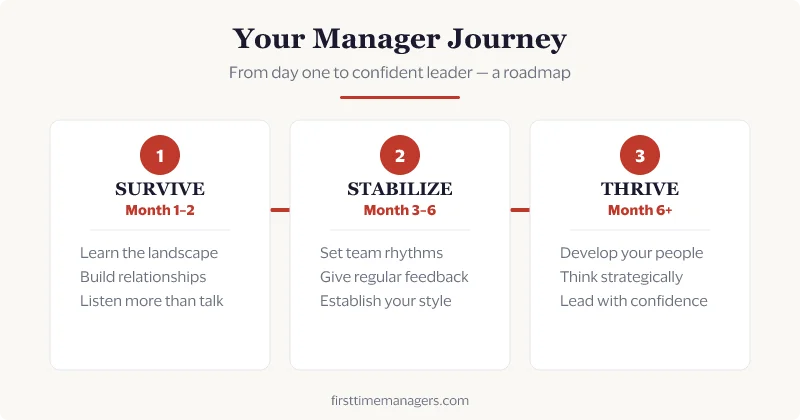
The Mindset Shift That Changes Everything
The biggest mistake new managers make isn’t a tactical one. It’s a mindset one.
The shift from individual contributor to manager is the biggest career identity change most people face. As an individual contributor, your value came from what you produced. Your code, your designs, your sales numbers, your reports. You were measured by your output.
As a manager, your value comes from what your team produces. Your job is no longer to be the best performer. It’s to make everyone around you better.
This sounds simple. It’s not. It means:
- Letting someone do a task slower than you would, because they need to learn
- Resisting the urge to jump in and “fix” things
- Measuring your success by other people’s growth, not your own tasks completed
The sooner you internalize this, the faster everything else clicks.
These Skills Have an Order. Most Guides Present Them as a Menu.
The rest of this guide covers trust, 1-on-1s, feedback, delegation, and difficult conversations. Laid out like that, they look like five things to work on. They are not. They are a sequence, and taking them out of order is why month three often feels harder than month one.
Here is the dependency chain:
Trust comes first, because everything downstream is read through it. The same sentence lands as coaching from a manager the team trusts and as an attack from one they do not. If you give corrective feedback in week two to someone who has no read on you yet, they will not hear the content. They will spend the conversation trying to work out what it means for their job.
Feedback comes second, because delegation without it is a trap. Handing someone real work only functions if you can say “this part missed” without either of you flinching. Managers who skip this step delegate, notice something is off, say nothing, and quietly take the work back. The team learns that your handoffs are provisional, and they stop treating them seriously.
Delegation comes third, because it is what buys you the time for everything else. Difficult conversations, career development, and thinking beyond this week all require hours you do not currently have. Those hours come from one place.
Difficult conversations come last, and this is the one exception in the chain. They come last in terms of what to practice, but they arrive on their own schedule. If a real problem surfaces in week two, you handle it in week two. Just go in knowing you are spending credit you have not finished earning, so be more careful with specifics, slower to conclude, and more willing to say “I might be missing context here.”
The practical version: work on one of these at a time, roughly six weeks each, and stop grading yourself on the other four while you do. Trying to improve all five at once produces a manager who is slightly worse at everything and confident in nothing. The ten skills that actually compound on a small team follow the same logic, with a protocol for choosing which two to start with.
Your First Week: What Actually Matters
Forget about making big changes. Your first week has one job: listen and learn.
Here’s what to do:
1. Have a 1-on-1 with every team member
Schedule 30 minutes with each person. Not to give direction, but to ask questions (and if you want a full walkthrough of how to structure these, read our guide on how to run your first one-on-one meeting):
- “What’s going well right now?”
- “What’s frustrating you?”
- “What should I know that I probably don’t?”
- “How do you prefer to receive feedback?”
- “What does a good week look like for you?”
Don’t promise anything. Just listen. Take notes. Thank them for being honest.
2. Understand the current reality
Before you can improve anything, you need to know:
- What are the team’s current goals?
- What processes exist (even informal ones)?
- Where are the bottlenecks?
- Who are the key stakeholders your team works with?
- What did the previous manager do well? What didn’t work?
3. Don’t change anything yet
I know: you have ideas. You see things you’d improve. You want to prove you deserve this role.
Hold that impulse for at least two weeks. Changes made too early, without context, destroy trust faster than anything else. Your team needs to know you understand their world before you start reshaping it.
Building Trust: The Foundation of Everything
Nothing works without trust. Not feedback, not delegation, not difficult conversations. Trust is the operating system. Everything else is just an app.
Here’s how you build it:
Be consistent
Say what you’ll do. Do what you said. Every time. This sounds obvious, but inconsistency is the #1 trust killer for new managers. If you say “I’ll get back to you by Friday,” get back to them by Friday, even if the answer is “I don’t have an answer yet.”
Be honest about what you don’t know
You don’t need to have all the answers. In fact, pretending you do will backfire spectacularly. Try:
- “I don’t know yet, but I’ll find out.”
- “That’s a great question. What do you think?”
- “I’m still learning this area. Can you walk me through it?”
Your team already knows you’re new. Owning it makes you trustworthy. Faking it makes you a liability.
Have their back
When credit is due, give it publicly. When blame comes down, absorb it. This is non-negotiable. A manager who throws their team under the bus, even once, loses trust that takes months to rebuild.
Show up as a human
You don’t need to share your life story. But letting people see that you’re a real person, with doubts, learning moments, and bad coffee days, makes you approachable. And approachable managers hear problems early, before they become crises.
The Art of the 1-on-1
If you’re looking for the single most important management skill for beginners, make it this one.
Regular 1-on-1 meetings are the single most impactful thing you can do as a manager. They’re where trust is built, problems surface early, and your team members feel heard.
The basics
- Frequency: Weekly, 30 minutes minimum. Don’t cancel them. Don’t reschedule them unless absolutely necessary.
- Ownership: This is their meeting, not yours. They set the agenda. You listen, ask questions, and remove blockers.
- Location: Somewhere private. Never in an open space where others can overhear. If your team is distributed, our remote one-on-one meetings guide covers the nuances.
A simple structure that works
- Check-in (5 min): “How are you doing? How was your week?”
- Their topics (15 min): Whatever they want to discuss. Blockers, ideas, frustrations, career goals.
- Your topics (5 min): Updates, feedback, alignment on priorities.
- Action items (5 min): What are we each doing before next week?
Common mistakes to avoid
- Don’t turn it into a status update. That’s what standups and project tools are for.
- Don’t do all the talking. If you’re talking more than 30% of the time, recalibrate.
- Don’t skip them when things are busy. That’s actually when they matter most.
Giving Feedback Without Breaking Things
Feedback is the skill that separates okay managers from great ones. And it terrifies most first-timers. If you want a deeper dive, we wrote an entire guide on how to give feedback for the first time without destroying morale.
Here’s a framework that works:
The SBI Model
- Situation: When and where did this happen? (Be specific.)
- Behavior: What exactly did the person do? (Observable actions, not interpretations.)
- Impact: What was the result? (On the team, the project, or you.)
Example:
“In yesterday’s client meeting (Situation), when you jumped in to answer Sarah’s question before she finished speaking (Behavior), it made her pull back for the rest of the call and the client didn’t get to hear her expertise (Impact).”
Compare that to: “You need to stop interrupting people.” See the difference? The first one is specific, factual, and actionable. The second is a judgment that triggers defensiveness.
Key principles
- Give feedback quickly. Don’t store it up for a monthly review. Address things within 24-48 hours.
- Give positive feedback too. If you only speak up when something’s wrong, people will dread seeing your name in their inbox.
- Be direct but kind. You can be honest without being harsh. “This isn’t working” is direct. “This is terrible” is cruel. There’s a huge difference.
- Ask for feedback on yourself. “What’s one thing I could do better as your manager?” This takes courage. Do it anyway.
Delegation: Your New Superpower
Here’s a hard truth: if you’re still doing your old job plus managing, you’re doing both badly.
Delegation isn’t about dumping tasks you don’t want. It’s about developing your team while freeing yourself to do work only you can do. Google’s Project Oxygen research identified key behaviors of the best managers, and empowering the team, not doing everything yourself, was near the top.
The Delegation Spectrum
Not everything needs the same level of handoff:
- “Do exactly this.”: For critical, time-sensitive tasks where the method matters.
- “Here’s the goal. Here’s my suggested approach. Adjust as needed.”: For most work.
- “Here’s the outcome I need. Figure out how to get there.”: For your experienced team members who need autonomy.
What to delegate
- Tasks someone else can do 80% as well as you (they’ll get to 100% with practice)
- Tasks that develop someone’s skills
- Recurring work that doesn’t require your specific judgment
What NOT to delegate
- Hiring and firing decisions
- Performance conversations
- Strategic decisions that affect the whole team
- Anything you’d only delegate because you’re avoiding it
The biggest delegation mistake
Delegating the task but not the authority. If you ask someone to lead a project but then require them to check with you on every decision, you haven’t delegated. You’ve created a bottleneck with extra steps.
Handling Difficult Conversations
They’re coming. An underperformer. A conflict between team members. Someone asking for a raise you can’t give. A project that’s failing.
The instinct is to avoid these conversations. Don’t. Delayed difficult conversations only get more difficult.
Before the conversation
- Write down the specific issue and desired outcome
- Separate facts from feelings
- Prepare, but don’t script (it’ll sound robotic)
- Choose a private setting with enough time
During the conversation
- Start with the point. Don’t bury it in small talk. “I want to talk about X” is fine.
- Be specific. Use the SBI model from the feedback section.
- Listen. You might be missing context. Give them space to respond.
- Focus on the path forward. Don’t dwell on what went wrong. “What can we do differently?” is more productive than “Why did this happen?”
After the conversation
- Send a brief summary of what you discussed and agreed on
- Follow up on commitments, yours and theirs
- Don’t avoid the person afterward (it’s tempting, but it signals that something is still wrong)
Common First-Time Manager Mistakes
I made most of these. You probably will too. That’s okay, just recover quickly:
-
Trying to be everyone’s friend. You can be friendly without being friends. The distinction matters when you need to give hard feedback.
-
Avoiding conflict. Small problems ignored become big problems. Address things early.
-
Doing everything yourself. You’re not helping. You’re creating a single point of failure and stunting your team’s growth.
-
Changing everything immediately. Earn trust first. Understand context. Then change things, one at a time.
-
Not asking for help. Find a mentor, a peer group, or the right books. Managing people is a skill. You wouldn’t expect to learn programming by guessing. A leadership development plan, even an informal one, accelerates your growth enormously. The pillar guide on leadership skills for new managers lays out the ten skills that actually compound on a small team in the first eighteen months: self-awareness, listening, EQ, style flexibility, coaching, decisions, strategy, influence, servant mindset, leading change, with a two-gap protocol that tells you which two to work on first instead of trying to improve everything at once.
-
Confusing being busy with being effective. Your calendar full of meetings isn’t a badge of honor. Protect time for thinking, planning, and being available.
-
Forgetting to manage up. Your boss needs updates, alignment, and early warnings. Don’t make them chase you for information.
Your First 30-Day Checklist
Here’s a concrete plan to get you started. For a more detailed week-by-week roadmap, check out our first 90 days as a manager action plan.
Week 1: Listen
- Schedule 1-on-1s with every team member
- Understand current goals, projects, and deadlines
- Identify key stakeholders and introduce yourself
- Set up recurring 1-on-1s going forward
Week 2: Learn
- Map out team processes and workflows
- Identify quick wins (small fixes that make people’s lives easier)
- Start building relationships with peer managers
- Have a 1-on-1 with your own manager to align on expectations
Week 3: Plan
- Share your observations with the team (what you’ve learned so far)
- Pick 1-2 quick wins to implement
- Set clear team goals for the next 30 days
- Start giving regular feedback (positive first)
Week 4: Act
- Implement your quick wins
- Review and adjust 1-on-1 cadence based on what’s working
- Ask your team: “What’s one thing I should start, stop, or continue?”
- Reflect on your own first month. What surprised you?
Want a structured version of this plan you can actually work through? The First 90 Days Playbook expands this checklist into a full 12-week editable workbook with fill-in prompts, reflection exercises, 3 worksheets, and 6 quick-reference cards. See what’s inside →
How to Tell Whether Any of This Is Working
Most new managers assess themselves on feeling. Did the week feel under control? Did anyone seem unhappy? That signal is close to useless, because a team can be quietly disengaging while every interaction stays pleasant. If you want the structured version of this question, the Am I a Good Manager? self-assessment runs fifteen scenarios across the five dimensions your team actually experiences and hands you your weakest one with a specific next step.
Three observable tests are better, and all three trace back to the mindset shift at the top of this guide.
Test one: where your calendar actually went. Open last week and sort every hour into two buckets. Work you personally produced, and work that made someone else more effective. Coaching, unblocking, reviewing, deciding, and connecting people all land in the second bucket. If you are six months in and the first bucket is still the bigger one, you are an individual contributor with a title and a longer meeting load. The Manager Leverage calculator turns this into a ratio, which is more honest than a memory of the week.
Test two: what happens in the week you are away. Take a real week off and watch what breaks. Nothing breaking is the goal, but partial failure is diagnostic rather than damning: whatever stalls is precisely what you have not delegated, and now you know the name of it. Managers who cannot take a week off do not have a vacation problem. They have a single-point-of-failure problem.
Test three: the last time someone told you that you were wrong. Not a polite hedge. An actual “I don’t think that’s right.” If you cannot recall an instance in the past month, the likeliest explanation is not that you were right every time. It is that disagreeing with you costs more than staying quiet, and the price of that is you stop hearing about bad decisions while they are still cheap to reverse.
None of these three improve because you decided to be a better manager. They improve because of the specific habits in the sections above, which is what makes them worth checking every month or two.
Where to Go Deeper
Each section of this guide is a summary. Every one has a fuller treatment elsewhere on the site, and the useful thing is knowing which one you need right now.
- You were promoted from inside the team you now manage. This is the hardest opening variant and it has its own guide: yesterday’s colleague, today’s boss deals with the friendship problem directly, including what to say to the person who wanted your job.
- You keep waiting to feel qualified. That feeling is close to universal and it does not resolve on its own timeline. Start with imposter syndrome as a new manager, or take the imposter syndrome quiz if you want to know whether what you are experiencing is the ordinary version or something worth acting on.
- You are still doing the work yourself. The delegation section above covers the mechanics. Why you are addicted to being the hero covers the reason the mechanics keep failing, which is usually identity rather than technique.
- You gave the team autonomy and it went badly. Worth reading before you conclude that they cannot handle it: your team does not want empowerment, they want clarity separates the two, because handing someone freedom without a definition of done is not empowerment.
- You want the failure modes laid out in advance. Ten mistakes every first-time manager makes expands the shortlist in this guide into the full set, with the recovery move for each one.
- You want a structured curriculum rather than articles. The five books worth reading first is the shortest path, and deliberately short.
The Truth About Being a New Manager
It gets easier. Not because the job gets simpler. It doesn’t. But because you develop instincts, build relationships, and learn to trust yourself. Building management confidence is a gradual process. Every hard conversation you have, every decision you own, adds to it.
The fact that you’re reading this means you care about doing it well. That already puts you ahead of most.
You don’t need to be perfect. You need to be honest, consistent, and willing to learn.
You’ve got this. And you’re not alone in this.
Keep the essentials within arm’s reach. The Manager’s Cheat Sheet Pack is a set of 12 printable one-page cards: frameworks for meetings, difficult conversations, goal setting, recognition, and more. Print them, pin them to your wall, and reach for the right one when you need it. See all 12 cheat sheets →