You’re sitting in your first meeting as a manager. Someone asks you a question about priorities for the quarter. Everyone turns to look at you. And the only thought in your head is: They’re going to figure out I have no idea what I’m doing.
You answer anyway. Something comes out — probably reasonable, maybe even good. But the voice doesn’t stop. It follows you back to your desk. It’s there when you open your laptop the next morning. It whispers during every one-on-one, every decision, every time someone calls you “the boss.”
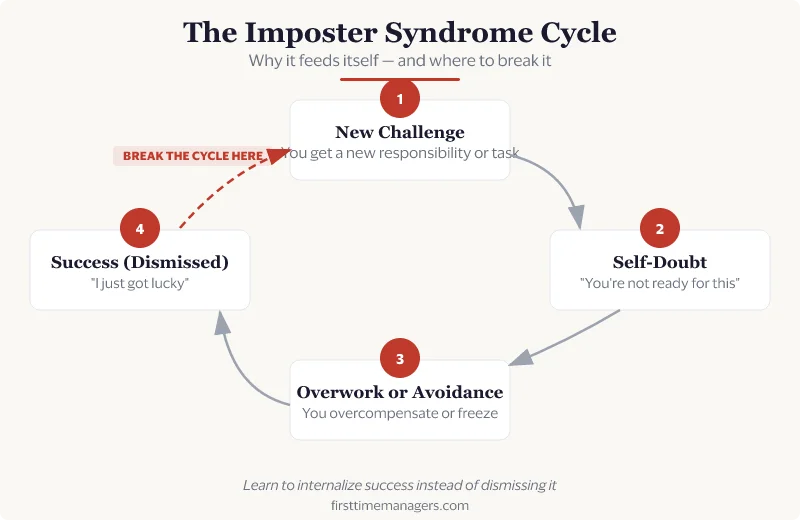
You’re not ready for this. You got lucky. Someone made a mistake promoting you.
If that sounds familiar, congratulations. You’re not broken. You’re a new manager.
What Imposter Syndrome Actually Is (And Isn’t)
Let’s get clear on what we’re talking about. Imposter syndrome isn’t a clinical diagnosis. It’s a pattern of thinking where you believe your success is undeserved — that you’ve fooled people into thinking you’re competent, and it’s only a matter of time before they discover the truth.
It’s not the same as being humble. Humble people know what they’re good at and don’t brag about it. Imposter syndrome makes you discount what you’re good at entirely.
It’s not the same as being new and learning. Everyone has a learning curve. Imposter syndrome tells you the learning curve is evidence that you don’t belong here.
And it’s not rare. Research suggests roughly 70% of people experience imposter feelings at some point at some point in their careers — feeling unqualified for management is far more normal than you think. Among new managers? I’d bet that number is closer to 100%.
Not sure where you stand? Take our free Imposter Syndrome Quiz for New Managers — 15 scenario-based questions that measure how self-doubt shows up across 5 dimensions. No email required.
If the imposter feeling is showing up before you take the role — when you’re still weighing whether to accept the promotion or apply for the manager job — the Am I Ready to Be a Manager? quiz is the right tool first. It measures readiness across 5 dimensions (people skills, communication, ownership, judgment, and identity) and tells you whether the doubt is grounded or just the standard pre-promotion noise that every competent person hears. Take that one, then come back here.
Why It Hits New Managers So Hard
There’s a reason imposter syndrome doesn’t just nudge new managers — it tackles them. Several things collide at once.
The identity shift is massive. Yesterday you were great at your job. Today your job is to help other people be great at theirs. Those are fundamentally different skills. You went from expert to beginner overnight, and your brain is screaming that something is wrong. It’s not. You’re just navigating one of the biggest transitions in your career.
Nobody trained you. Most new managers get a title change, a congratulations email, and zero instruction. You’re expected to figure it out through osmosis, which is absurd. But because nobody told you it’s hard, you assume it’s only hard for you. It’s not. It’s hard for everyone. They’re just not talking about it either.
You’re comparing yourself to the wrong people. Your predecessor had years to build those relationships. Your skip-level manager has a decade of experience. The other manager on your floor seems effortlessly confident. You’re comparing your first week to their thousandth. That comparison will destroy you if you let it. And if you’re managing someone older or more experienced than you, the comparison becomes even more corrosive.
The stakes feel enormous. When you were an individual contributor, a bad day meant a bad day. Now a bad day means you might be ruining someone else’s career, or tanking the team’s morale, or making a decision that can’t be undone. The weight of that responsibility amplifies every doubt.
You’re suddenly visible. Your team is watching you. Your boss is evaluating you. Every decision gets scrutinized. When you were heads-down doing the work, nobody noticed your uncertainty. Now it feels like it’s on display.
The Paradox Nobody Talks About
Here’s something I wish someone had told me in my first month as a manager.
The people who worry about being good enough are almost always the ones who care enough to become good. The truly incompetent managers I’ve worked with? They never questioned themselves. They charged in with unearned confidence, made a mess, and blamed everyone else.
The fact that you’re worried about doing a good job is not a sign that you can’t do a good job. It’s a sign that you take it seriously. That’s exactly the kind of person who should be managing people.
This doesn’t make the feeling go away. But it reframes it. The voice in your head isn’t evidence of your inadequacy. It’s evidence of your integrity.
The Triggers You’ll Recognize
Imposter syndrome doesn’t hum at a constant volume. It spikes. Knowing when to expect it helps you stop being ambushed by it.
Your first team meeting. You’re standing (or sitting on Zoom) in front of people who used to be your equals, and now you’re supposed to lead the conversation. The voice says: Who are you to run this meeting? This is especially brutal if you were promoted from within the team.
Your first tough decision. Someone needs to be told their project isn’t the priority. A deadline needs to be pushed. A conflict needs to be addressed. You’ve never done this before, and the voice says: You’re going to get this wrong.
The first time someone pushes back. You share a direction. A team member disagrees — publicly, maybe even sharply. And instead of seeing it as normal professional tension, the voice says: See? They don’t respect you. They know you’re faking it.
Your first one-on-one. You sit across from a direct report and realize you’re supposed to coach this person. The voice says: You can barely manage yourself. (For help with this specific moment, here’s my guide on how to run your first one-on-one meeting.)
When someone on your team knows more than you. This will happen constantly, and it should — you hired smart people. But the voice says: If they’re smarter than you, why are you in charge?
When you make a mistake. And you will. Everyone does. I’ve covered the most common ones new managers make. The difference is that imposter syndrome turns every mistake into confirmation of your worst fear: I told you so. You don’t belong here.
What Not to Do
When imposter syndrome is loud, your instincts will push you toward some very natural — and very destructive — responses. Watch out for these.
Don’t overcompensate with authority. Some new managers try to silence self-doubt by proving they’re in charge. They make unilateral decisions. They pull rank. They stop asking for input. This doesn’t quiet the voice — it just makes your team stop trusting you.
Don’t micromanage. Self-doubt in leadership roles often manifests as overcontrol. If you’re terrified of things going wrong on your watch, the temptation is to control everything. Check every email. Sit in on every call. Review every deliverable. This will burn you out and suffocate your team. It also sends a clear message: I don’t trust you to do your job. That’s the opposite of leadership.
Don’t pretend to know everything. New managers often feel like admitting “I don’t know” will expose them as a fraud. So they bluff. They give vague non-answers. They change the subject. Your team sees right through it. Honesty builds more credibility than fake confidence ever will.
Don’t withdraw. Some people deal with self-doubt by going quiet. They stop showing up in meetings, stop having conversations, stop making decisions. They figure if they stay invisible, nobody will notice they’re struggling. Your team needs you present — even imperfect, even uncertain.
Don’t wait until you feel ready. You will never feel ready. That’s not how management works. If you wait for the imposter feeling to pass before you start leading, you’ll be waiting forever.
What to Do Instead
Now the part that matters. These aren’t “confidence hacks.” They’re practical manager confidence building strategies that have worked for me and for dozens of managers I’ve coached. As Harvard Business Review’s guide on overcoming imposter syndrome emphasizes, the goal isn’t to eliminate self-doubt — it’s to lead effectively alongside it. These strategies don’t make imposter syndrome disappear. They make it manageable.
Name the feeling out loud
Not to your whole team. But to yourself. When the voice starts up, pause and say — literally, in your head or out loud — “This is imposter syndrome. This is a feeling, not a fact.”
That sounds almost too simple, but there’s real power in labeling emotions. When you name what’s happening, you create distance between the feeling and the reality. You move from “I’m a fraud” to “I’m experiencing a feeling of being a fraud.” Those are very different things.
Keep an evidence journal
Buy a notebook. Every Friday, spend five minutes writing down three things that went well that week and what your role was in making them happen.
Not big things. Small things count.
- “Tanya said my feedback on her presentation was helpful.”
- “I made the call to push the deadline and the client was relieved.”
- “I noticed David was quiet in the meeting and checked in with him afterward. He opened up about feeling overwhelmed.”
Imposter syndrome has a short memory for your wins and a long memory for your failures. The journal is a corrective. When the voice gets loud, you have written evidence that it’s wrong.
Find one person to be honest with
You need at least one relationship where you can say “I feel like I have no idea what I’m doing” and not be judged for it. This might be a peer manager in another department. A mentor outside the company. A friend who manages people. A coach if you have access to one.
I’ll be direct: this was the single most important thing I did in my first year as a manager. I had a friend — another new manager at a different company — and we had a standing call every other week. We just told each other the truth. “I had a terrible one-on-one today.” “I think my team thinks I’m incompetent.” “I cried in my car after work.”
It wasn’t therapy. It was just honesty. And it kept me sane.
You cannot carry the weight of management alone while also carrying the weight of pretending everything is fine. Find your person. And if the weight has been building for months and you’re starting to feel numb rather than anxious — that might not be imposter syndrome anymore. It might be burnout.
Separate “not knowing yet” from “not capable”
This distinction is everything. When the voice says “you don’t know how to handle this,” check whether that’s a permanent statement about your abilities or a temporary statement about your experience.
There’s a huge difference between:
- “I don’t know how to give negative feedback” (skill gap — learnable)
- “I’m not the kind of person who can give negative feedback” (identity belief — destructive)
Almost everything that scares you right now is the first kind. You don’t know yet. You haven’t learned yet. That’s not failure. That’s being new. And being new is temporary.
If you want a concrete starting point, your first 90 days plan is a good way to channel that “I don’t know enough” energy into actual progress. The companion piece for the longer arc is the pillar guide on leadership skills for new managers, which sorts the ten skills that close the “I don’t know yet” gap on a small team — self-awareness, listening, emotional regulation, style flexibility, coaching, decisions, strategy, influence, servant mindset, leading change. The two-gap protocol there tells you which two to work on now instead of trying to fix everything at once, which is itself a common imposter-driven mistake.
Stop performing confidence you don’t feel
Here’s a script that will serve you better than pretending:
“I haven’t dealt with this exact situation before, so here’s what I’m thinking. Let me walk you through my reasoning, and I’d genuinely like your input.”
That’s not weakness. That’s a leader who thinks clearly, communicates transparently, and values their team’s perspective. People don’t need you to have all the answers. They need you to be honest about the process of finding them.
Study — but set a limit
When imposter syndrome flares, the instinct is to read every management book, take every course, consume every podcast. Overcoming perfectionism at work often means accepting that you’ll learn more from action than from preparation. And learning is good. But there’s a point where “studying management” becomes a way to avoid doing management.
Read one book. Apply what you learned. Then read another. Don’t use learning as a hiding place.
Track what actually happens vs. what the voice predicted
The voice makes predictions. “This meeting is going to be a disaster.” “They’re going to lose respect for you.” “You’re going to get fired.”
Start writing down those predictions. Then write down what actually happened. Over time, you’ll build a record that proves the voice is a terrible forecaster. It predicts catastrophe, and what usually happens is… things are mostly fine. Sometimes messy. Rarely catastrophic.
My Own Story
I’ll tell you something I’ve never written about before, because I think it matters.
Three months into my first management role, I sat in a skip-level meeting with my boss’s boss. She asked me a straightforward question about my team’s capacity for an upcoming project. I knew the answer. I’d run the numbers that morning.
But when I opened my mouth, my mind went blank. Not blank as in “I forgot the number.” Blank as in “I suddenly don’t know why I’m in this room.” I stumbled through some version of an answer. She moved on. Nobody noticed.
I went back to my desk and spent the rest of the afternoon convinced I was going to be fired. I rewrote the answer I should have given about fifteen times. I composed a resignation letter in my head. I Googled “signs you’re not cut out for management.”
None of it was rational. None of it was connected to reality. My boss told me the next day that the skip-level had gone great. My team hit the project deadline with room to spare.
The voice lied. It lies constantly. The problem is that it sounds so much like you that you believe it.
That moment didn’t end my imposter syndrome. But it taught me something critical: the feeling and the reality are not the same thing. I felt like a disaster. The reality was that I was doing fine. Both things were true simultaneously — and I got to choose which one to act on.
The Long Game
I want to be honest with you about something. Imposter syndrome doesn’t fully go away. Not after your first year. Not after your fifth. I still get it occasionally — when I take on a new challenge, when I’m in a room with people I admire, when the stakes are high.
But it changes. It gets quieter. It loses its authority. You hear the voice and think “Oh, it’s you again” instead of spiraling into panic. You learn to lead alongside the doubt rather than waiting for the doubt to disappear.
The managers I respect most aren’t the ones who never felt like frauds. They’re the ones who felt like frauds and showed up anyway. Who ran the meeting with shaking hands. Who had the hard conversation with a dry mouth. Who made the decision without certainty and stood by it.
That’s not confidence. It’s something better. It’s courage — the kind of executive presence for new leaders that isn’t about polish, but about showing up honestly. And courage, unlike confidence, doesn’t require you to feel good. It only requires you to act despite feeling bad.
You’re not an imposter. You’re a new manager. Those feel identical right now. They’re not.
Keep showing up. The evidence will eventually drown out the voice.
One last honest question: if the doubt never quiets and you find yourself secretly wishing you could go back to doing the work instead of managing it, that is worth examining. The free Should I Go Back to Being an IC? self-assessment measures whether the pull is a bad month (fixable) or a real mismatch (worth acting on) across 5 dimensions: energy drain, identity loss, people fatigue, impact frustration, and escape vs. strategy. Not every manager should keep managing. Better to know early.
One thing that helps quiet the imposter voice: having the answer in front of you. The Manager’s Cheat Sheet Pack gives you 12 printable one-page frameworks — for meetings, feedback, difficult conversations, goals, and more. When self-doubt whispers “you don’t know what you’re doing,” a glance at the right card says otherwise. See all 12 cheat sheets →