You’re 28. Your direct report is 47. He’s been at the company for 14 years. You’ve been here for three. He has kids in college. You just signed your first lease.
And now, somehow, you’re his boss.
He was polite in the announcement meeting. Professional. But when you scheduled your first one-on-one, there was a pause before he said “sure.” Not hostile — just a beat too long. Enough to make you wonder: Does he resent me? Does he think I’m not qualified? Is this going to be a problem?
If you’re managing someone older than you, you’ve probably had some version of this moment. That quiet calculation in your head — How do I give this person feedback? How do I set expectations without sounding ridiculous? How do I lead someone who’s been doing this longer than I’ve been alive?
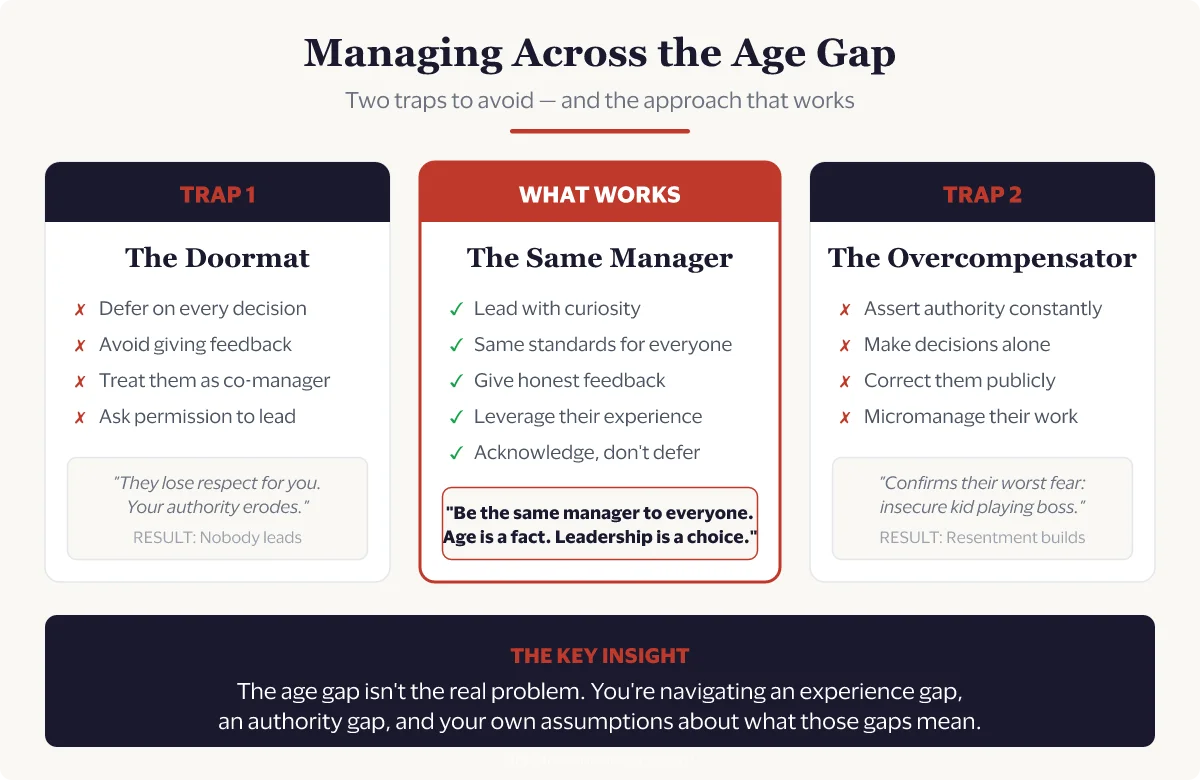
Here’s the truth: the age gap isn’t the real problem. What you’re actually navigating is an experience gap, an authority gap, and your own assumptions about what those gaps mean. Once you untangle those, managing someone older becomes surprisingly straightforward.
This Isn’t Unusual — It’s the New Normal
Let’s start with some context, because you might feel like you’re in a strange situation. You’re not.
The average age of a first-time manager in the U.S. is 30, according to research from DDI’s Global Leadership Forecast. But many people get promoted into management in their mid-to-late twenties — especially in tech, startups, and fast-growing companies. Meanwhile, people are working longer than ever. The result: managing someone older than you is now statistically normal, not the exception.
A Harvard Business Review study on multi-generational teams found that age-diverse teams actually outperform homogeneous ones — but only when the manager handles the dynamics well. When they don’t, age diversity becomes a source of tension instead of strength.
So this isn’t a weird problem you need to solve. It’s a leadership skill you need to develop. And like most management skills, it starts with how you think about it. (Managing Gen Z employees? That’s the other side of the multigenerational coin — different dynamics, different guide.)
What’s Actually Happening Under the Surface
Before we get to tactics, let’s name what’s going on — because most of the awkwardness comes from things that aren’t being said.
What you might be feeling:
- Imposter syndrome on steroids. The usual new manager self-doubt amplified by “who am I to manage someone with 20 years of experience?”
- Fear of being seen as arrogant. You don’t want to come across as the cocky kid who thinks they know everything.
- Reluctance to give feedback. How do you tell someone with decades of experience that their approach isn’t working?
- Overcompensation. Either being too deferential (undermining your own authority) or too assertive (overcompensating to prove you belong).
What they might be feeling:
- Ego bruise. Being managed by someone younger can feel like a signal that the company passed them over.
- Skepticism. Not about you personally — about whether someone with less experience can understand their work.
- Loss of status. They might have been the informal leader of the team before you arrived.
- Fear of irrelevance. In a fast-changing industry, being older can feel like a vulnerability. Your promotion might confirm that fear.
- Openness. Many experienced people genuinely enjoy mentoring and supporting younger leaders. Don’t assume the worst.
None of this is about you being bad at your job. It’s about a dynamic that’s uncomfortable for both sides. The good news: you’re the manager, which means you’re the one who can make it less uncomfortable.
Drop the “Age Thing” From Your Mental Model
The single most important mindset shift: stop thinking of them as “the older person on your team.”
The moment you frame someone primarily by their age, you start treating them differently. You soften your feedback. You avoid assigning them stretch projects. You over-explain things because you assume they’re not up to speed on new tools. Or you under-explain because you assume they know everything already.
Both are wrong. Both are patronizing. Both will damage the relationship.
Your job as a manager is the same regardless of who’s on your team: understand what each person needs to do their best work, remove obstacles, give honest feedback, and help them grow. A 47-year-old needs these things just as much as a 25-year-old — just maybe in different ways.
Practical shift: In your head, replace “my older direct report” with “my experienced direct report” or simply their name. It sounds small, but it changes how you approach every interaction.
Lead With Curiosity, Not Authority
The fastest way to earn respect from someone with more experience isn’t to prove how smart you are. It’s to prove how seriously you take their expertise.
In your first one-on-one, try something like:
“I want to be honest — you’ve been doing this a lot longer than I have. I’m not going to pretend I know everything about how this team works. What I’d love to understand is: what’s working well from your perspective? What’s frustrating? And what should I know that I probably don’t?”
This isn’t weakness. This is smart leadership. You’re doing three things at once:
- Acknowledging reality (they do have more experience in some areas)
- Showing respect (you value their perspective)
- Taking control of the conversation (you’re asking the questions — that’s a leadership move)
Research on harnessing the power of age diversity shows that when younger managers explicitly acknowledge the experience of older team members — without being subservient — it significantly reduces friction and increases collaboration.
The key phrase is “without being subservient.” You’re not asking permission to lead. You’re gathering intelligence so you can lead well.
Don’t Overcompensate (In Either Direction)
New managers dealing with age gaps tend to fall into one of two traps:
Trap 1: The Doormat
You’re so worried about seeming disrespectful that you defer to them on everything. You ask “what do you think?” before every decision. You avoid giving constructive feedback. You treat them like a co-manager instead of a direct report.
Why it backfires: They lose respect for you. The rest of the team notices you treat this person differently. Your authority erodes. And ironically, the person you’re deferring to often doesn’t want a weak manager — they want a good one.
Trap 2: The Overcompensator
You’re so worried about seeming weak that you go hard the other direction. You make decisions without consulting anyone. You assert authority at every opportunity. You correct them publicly. You over-manage their work to prove you’re in charge.
Why it backfires: It confirms their worst fear — that you’re an insecure kid playing boss. Nobody respects authority that has to be constantly announced. Real authority is quiet.
What to do instead
Be the same manager to everyone. Same level of respect, same expectations, same feedback standards. Building trust with your team doesn’t require treating people identically — it requires treating people fairly. And fair means: same standards, adapted to individual context.
If you need to delegate a project, delegate it the same way you would to anyone — clear outcomes, clear context, clear autonomy. Don’t micromanage because you’re anxious. Don’t abdicate because you’re intimidated.
Give Feedback the Same Way You Would to Anyone
This is where most young managers choke. You need to tell someone with 20 years of experience that their presentation was disorganized, or that they missed a deadline, or that their communication style is creating friction with the team.
Your brain screams: Who am I to tell THEM this?
Here’s the reframe: you’re not critiquing their career. You’re critiquing a specific behavior in a specific situation. That’s your job. If you avoid it, you’re failing them — because honest feedback is how people improve, regardless of age.
Use the same framework you’d use with anyone:
- Be specific. Not “your communication needs work” but “in yesterday’s client meeting, the proposal wasn’t structured in a way the client could follow.”
- Be timely. Don’t wait three months. The longer you wait, the more it feels like an ambush.
- Be direct, not brutal. “I want to flag something because I think it’s getting in the way of the impact you’re capable of” is honest and respectful.
- Ask for their perspective. “How did you see it?” — they might have context you’re missing.
Most experienced professionals have heard far harder feedback than anything you’re going to deliver. They’ve survived restructurings, layoffs, bad bosses, and market crashes. Your constructive feedback about a presentation? They can handle it. What they can’t handle — and what they’ll lose respect for — is a manager who’s too afraid to say anything.
Leverage Their Experience (Without Abdicating)
Having someone with deep experience on your team is an asset, not a threat. Use it — strategically.
Good ways to leverage experience:
- Ask them to mentor junior team members (recognition of their expertise)
- Include them early in strategic discussions (their pattern recognition is valuable)
- Ask for their input on decisions that benefit from institutional knowledge
- Let them own areas where their experience gives them a genuine edge
Bad ways to “leverage” experience:
- Letting them set the agenda because you don’t want to override them
- Defaulting to their judgment because you’re not confident in your own
- Assigning them only familiar, comfortable work (this is a subtle way of sidelining them)
- Treating them as a “co-manager” or implying they should have had the role
The distinction is simple: you’re including them because their perspective makes the team better, not because you’re afraid to lead without their approval.
When It’s Actually About Resistance — Not Age
Sometimes the issue isn’t just age dynamics. Sometimes someone is genuinely resistant to your leadership. They miss deadlines, undermine decisions, or subtly signal to the team that they don’t take you seriously.
This needs to be addressed — and the fact that they’re older doesn’t change that.
The approach is the same as any difficult conversation:
- Name the specific behavior (not “you don’t respect me” but “in the last two team meetings, you’ve contradicted the plan we agreed on in our one-on-one”)
- Explain the impact (“it creates confusion for the team about what direction we’re going”)
- Ask what’s going on (“I want to understand your perspective — is there something about the approach you disagree with?”)
- Set clear expectations going forward
If the behavior continues after a direct conversation, it’s a performance issue — not an age issue. Treat it accordingly. You’re not being disrespectful by holding someone to standards. You’re being disrespectful by NOT holding them to standards because of their age.
The Thing Nobody Tells You
Here’s what I wish someone had told me: most older employees don’t want to be your boss. They want to be valued.
They’ve seen dozens of managers come and go. They know the role is hard. Many of them didn’t want the management track — they chose to stay close to the work they love. What bothers them isn’t your age. It’s the possibility that you’ll overlook their expertise, make changes without understanding history, or treat them as a relic of how things used to be done.
Show them you won’t do that, and most of the awkwardness evaporates. Not all of it — some discomfort is structural and takes time to fade. But the foundation of a good working relationship?
It’s the same foundation as every management relationship: respect, clarity, and trust. Their age is a fact. How you manage is a choice.
Your First Move
If you’re reading this because you have someone older on your team and it feels awkward, here’s what to do this week:
- Schedule a one-on-one if you haven’t already. Use the questions from the “Lead With Curiosity” section above.
- Check your mental model. Are you thinking of them as “the older one” or as a professional with specific strengths, goals, and needs?
- Give feedback normally. If you’ve been sitting on something because you’re nervous about the age dynamic, say it this week. Use the framework above.
- Ask one genuine question about their experience: “What’s something you’ve learned in your career that you think I should know?” You’ll be surprised how much people open up when they feel their experience is respected — not feared.
The age gap only stays weird if you let it. Lead like a manager. Treat them like a professional. The rest sorts itself out.
Need quick-reference frameworks for your toughest management moments? The Manager’s Cheat Sheet Pack includes 12 printable one-page cards covering feedback, difficult conversations, recognition, performance reviews, and more — the exact tools you need when managing anyone, regardless of age. See all 12 cheat sheets →