Your first 1-on-1 meeting with a direct report might feel awkward. What do you talk about? How do you avoid making it a status update? What if they don’t open up? What if they open up too much?
I remember my first one. I walked in with a list of project updates to discuss. Thirty minutes of me asking “How’s the project going?” and them saying “Fine.” We both left feeling like we’d wasted our time.
It took me a few months to realize: a 1-on-1 isn’t a status meeting. It’s the most important 30 minutes of your week. It’s where trust is built, problems surface before they explode, and your people feel genuinely heard.
If you already run 1-on-1s but wonder whether they’re actually working, the Are Your 1-on-1s a Waste of Time? free self-assessment scores your meetings across 5 dimensions (agenda, depth, follow-through, relationship, employee value) in 4 minutes. Most managers score in the “Going Through the Motions” tier, which is fixable once you can see where it’s breaking.
Here’s how to do it right from the start.
Why 1-on-1s Matter More Than You Think
Let’s be blunt: if you’re not doing regular 1-on-1s, you’re managing blind.
Without them:
- Problems stay hidden until they become crises
- Your top performers feel invisible and start looking elsewhere
- Feedback becomes a once-a-year event instead of an ongoing conversation
- You make decisions about people based on assumptions instead of understanding
With them:
- You catch issues early, when they’re still easy to fix
- Your team feels valued and supported
- You build the kind of trust that survives hard times
- You actually know what’s going on — not just what people tell you in team meetings
The ROI of a weekly 30-minute 1-on-1 is staggering. It’s 26 hours per year per person. In return, you get retention, performance, trust, and early warning on every problem that matters.
The Basics: Getting the Logistics Right
Before we talk about what to say, let’s set up the container.
Frequency
Weekly. Non-negotiable. Every other week is the absolute minimum, and only for senior people who explicitly prefer it.
“But I have 8 direct reports — that’s 4 hours a week!”
Yes. And it’s the most valuable 4 hours you’ll spend. If 8 weekly 1-on-1s feel unsustainable, you might have too many direct reports (that’s a different conversation with your boss).
Duration
30 minutes minimum. Some conversations will take 15 minutes. Some will need 45. Schedule 30, and you’ll be right most of the time.
When to Schedule Them
- Same time, same day, every week. Consistency creates safety. Your team member knows: “Every Tuesday at 2 PM, I have my manager’s undivided attention.”
- Not first thing Monday (everyone’s overwhelmed) or last thing Friday (everyone’s checked out)
- Leave a buffer after. Some conversations run long. Don’t schedule a 1-on-1 right before an important meeting.
Where
- Private. A meeting room, a quiet corner, a walk. Never in the open office where others can overhear.
- Comfortable. Some people open up more over coffee than across a desk. Experiment.
- For remote teams: Camera on. It’s harder to build connection staring at a blank screen.
The Sacred Rule
Do not cancel 1-on-1s. Reschedule if you must, but never cancel. Every cancellation sends a message: “Something else is more important than you.” Cancel three in a row and you’ve effectively told that person they don’t matter.
If they want to cancel, that’s fine — it’s their meeting. But even then, check in: “Are you sure? Even 10 minutes is fine if you have something on your mind.”
The Structure: A Framework That Works
You don’t need a rigid script. But you do need a loose structure so the conversation doesn’t drift into 30 minutes of small talk or project updates.
Here’s an employee check-in meeting structure that works for most 1-on-1s:
1. Check-In (5 minutes)
Start with the human, not the work.
Questions to try:
- “How are you doing — really?”
- “How was your week?”
- “Anything on your mind before we start?”
The goal isn’t deep therapy. It’s a quick temperature check. You’re looking for signals: are they energized, tired, frustrated, excited? This context shapes the rest of the conversation.
What to watch for: If someone always says “fine” with flat energy, something might be off. Don’t push in the moment — but note it. If it becomes a pattern, gently address it: “I’ve noticed you seem a bit drained lately. Everything okay?“
2. Their Agenda (15 minutes)
This is the core of the meeting. And it’s their time, not yours.
The golden rule: Let them drive the agenda. As Julie Zhuo writes, the one-on-one belongs to your direct report, not to you. Before each meeting, ask them to come with topics. A shared document works great — they add items during the week, you review before the meeting.
Common topics they might bring:
- Blockers they need help with
- Ideas they want to bounce off you
- Frustrations or concerns
- Career development questions
- Feedback they want to share (yes, about you)
- Personal situations affecting work
Your job during this section:
- Listen more than you talk. Developing active listening skills for managers is one of the highest-leverage things you can do. Aim for a 70/30 split — them talking 70% of the time.
- Ask follow-up questions instead of jumping to solutions: “Tell me more about that.” “What have you tried so far?” “What do you think the right approach is?”
- Resist the urge to fix everything. Sometimes people need to be heard, not rescued. Ask: “Do you want advice, or do you just need to vent?”
- Take notes. Not a transcript — just key points and action items. It shows you’re paying attention, and you’ll need them for follow-up.
3. Your Agenda (5 minutes)
After their topics, you get a few minutes for yours.
Use this time for:
- Sharing context they need (team updates, company news, upcoming changes)
- Giving feedback — positive or constructive (see our guide on how to give feedback for the first time if you need a framework)
- Aligning on priorities for the coming week
- Asking about their workload: “Is the current load sustainable? Anything I should take off your plate?”
Keep this short. If you regularly need more than 5 minutes for your topics, you’re probably bringing things that belong in team meetings or async messages.
4. Action Items & Close (5 minutes)
End with clarity.
- “Let me make sure I’ve got this right — you’re going to [X] and I’m going to [Y]. Anything else?”
- “Is there anything we didn’t cover that you want to flag?”
- “How are you feeling about the week ahead?”
Write down the action items. Both yours and theirs. Follow through on yours before the next meeting. This is where trust is built — in the small commitments kept.
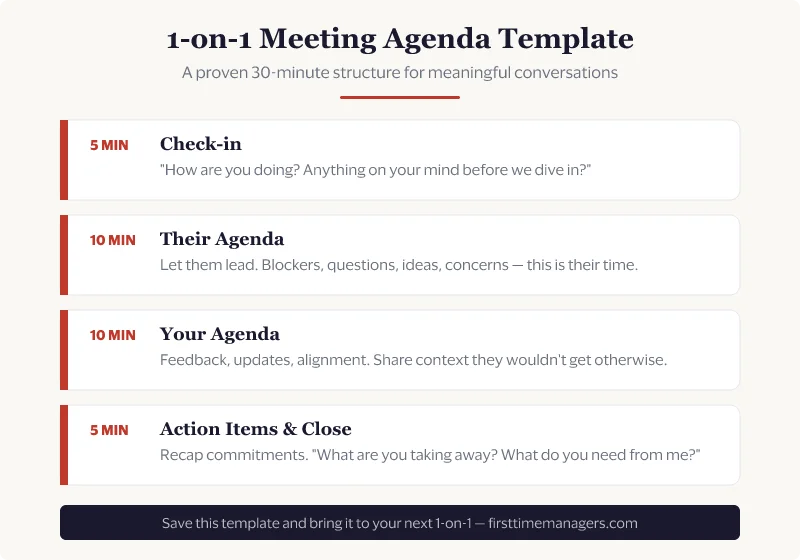
The 1-on-1 Template
Here’s a simple one-on-one meeting agenda template you can use. Create one per team member, add items throughout the week, review before each meeting. Google’s research on developing great managers confirms that a consistent structure like this leads to more productive conversations.
| Section | Owner | Notes |
|---|---|---|
| Check-in | Manager | How are you doing? Energy/mood check |
| Their topics | Team member | Blockers, ideas, concerns, career |
| Your topics | Manager | Feedback, context, alignment |
| Action items | Both | Who does what by when |
| Notes from last week | Both | Follow-up on previous commitments |
Sample Questions Bank
Keep this list handy for when conversations feel stuck. For a deeper dive, check out our 25 best one-on-one meeting questions for new managers.
About work:
- “What’s the most important thing on your plate right now?”
- “What’s blocking you?”
- “Is there anything you’d like to be working on that you’re not?”
- “What part of your work is most energizing? Most draining?”
About the team:
- “How’s collaboration going with the rest of the team?”
- “Is there anyone you think we should recognize for good work?”
- “Are there any dynamics on the team that concern you?”
About growth:
- “What skills do you want to develop this quarter?”
- “Where do you see yourself in a year?”
- “What kind of projects would stretch you in a good way?”
- “Is there anything I can do to better support your growth?”
About you (the manager):
- “What’s one thing I could do better?”
- “Am I giving you the right amount of context? Too much? Too little?”
- “Do you feel like you can be honest with me?”
When things seem off:
- “You seem quieter than usual — everything okay?”
- “I noticed you’ve seemed frustrated lately. Want to talk about it?”
- “Is there anything happening outside work that’s affecting you? No pressure to share — just want you to know I’m here.”
The 5 Biggest 1-on-1 Mistakes
Mistake 1: Turning It Into a Status Update
“How’s the project going? When will feature X be done? Can you send me the report?”
This is the most common mistake and the easiest to make. If your 1-on-1s sound like a standup meeting, you’re doing them wrong.
The fix: Status updates belong in standups, project tools, or async messages. If you need a project update, ask before the meeting or check the tracker. Reserve the 1-on-1 for the things that can’t happen anywhere else: trust-building, feedback, career development, and honest conversation.
Mistake 2: Doing All the Talking
If you’re talking more than 40% of the time, you’ve hijacked their meeting.
The fix: Ask a question. Then be quiet. Count to five silently if you need to. The silence feels uncomfortable, but it’s where the real answers live. People need a moment to think before sharing something honest.
Mistake 3: Not Following Through
You said “I’ll look into that” last week. You didn’t. Now they’re bringing it up again, and you have no update.
The fix: Write down every commitment you make. Before each 1-on-1, review your notes from last week. If you couldn’t complete something, be honest: “I haven’t gotten to this yet. It’s on my list for this week.” That’s infinitely better than pretending you forgot.
Mistake 4: Only Having 1-on-1s When There’s a Problem
Some managers cancel 1-on-1s when things are “going well” and only schedule them when there’s an issue to discuss.
The fix: 1-on-1s during good times build the trust you need during bad times. If you only meet when something’s wrong, the meeting itself becomes a stress trigger. Your team member sees “1-on-1 with Manager” on their calendar and their stomach drops.
Mistake 5: Having No Structure at All
“So… what do you want to talk about?” followed by 30 minutes of rambling conversation that goes nowhere.
The fix: Use the framework above. Share it with your team member. Let them know the structure: “This is your meeting. Come with topics. I’ll have a few things too. We’ll end with action items.” Structure creates safety — people open up more when they know what to expect.
Advanced Moves: Once You’ve Got the Basics Down
The Walking 1-on-1
Some conversations flow better when you’re not sitting across a desk. Walking side by side reduces the formality and intensity. People share more freely when they don’t have to make constant eye contact.
Try it once a month. Some team members will love it. Others will prefer the structure of a meeting room. Both are fine.
The Career 1-on-1
Once a quarter, dedicate an entire 1-on-1 to career development. No current work discussion. Just:
- Where do you want to be in 1-3 years?
- What skills do you need to get there?
- What can I do to help?
- What opportunities should I look for on your behalf?
This conversation shows your team that you care about their future, not just their output. It’s a retention superpower — and one of the best ways to start building rapport with direct reports on a deeper level.
That quarterly rhythm sits next to one more meeting you will eventually need, and it is worth not confusing the two. A 1-on-1 cannot close a cycle. A goal with several owners, reviewed one person at a time, gives you several partial accounts and no shared conclusion, so the end of a quarter needs its own meeting: the people who owned the goals, plus whoever leads the team, and deliberately not an audience. Our sister site sets out how to run a goal review meeting at the end of a cycle, with a timed agenda and four questions to ask per goal.
The Skip-Level 1-on-1
If you manage managers, have occasional 1-on-1s with their direct reports. Not to undermine your managers — but to get an unfiltered view of how the team is really doing. Always tell the manager first, and frame it as “I want to stay connected to the team,” not “I’m checking up on you.”
The Silent Start
Try starting some 1-on-1s with 2 minutes of silent note-writing. Both of you write down what’s on your mind. Then share. This works surprisingly well for introverts and for people who struggle to articulate things on the spot.
Your First 1-on-1: A Quick-Start Script
If you’re about to have your very first 1-on-1 as a manager, here’s exactly what to say:
Opening:
“I want to start having regular 1-on-1s with everyone on the team. This is your meeting — it’s 30 minutes every week for us to talk about whatever’s on your mind. It’s not a status update. It’s for blockers, feedback, career stuff, or anything else you need.”
Setting expectations:
“I’d love it if you could come with a few topics each week. I’ll have some too. And we’ll end with action items so nothing falls through the cracks.”
Getting started:
“For today, I’d love to get to know how you’re doing. What’s going well for you right now? And what’s the most frustrating part of your work?”
Closing:
“Thanks for this. I’ll follow up on [your commitments]. Same time next week?”
That’s it. It doesn’t need to be perfect. It just needs to be consistent.
The best 1-on-1 is the one that happens every week. Start there. Everything else is refinement.
Your first 1-on-1 is done. Now build a system. The 1-on-1 Meeting Kit gives you everything for the meetings that come after — 50+ questions for every situation, an editable agenda to copy each week, a tracker for notes and action items, and a quick reference card. Get the Kit →
🚨 Something off with your best performer? Take the Am I About to Lose My Best Employee? quiz — 15 questions that measure flight risk across 5 dimensions including Relationship Erosion and Growth Stagnation. Catch it before the resignation email. Free, 4 minutes.
📖 Want to go deeper? Check out the top 5 books on one-on-one meetings — from asking better questions to building the psychological safety where real conversations happen.