You can have the best strategy, the clearest goals, and the most brilliant ideas. None of it matters if your team doesn’t trust you.
Trust is the invisible infrastructure of management. Without it, feedback feels like an attack. Delegation feels like dumping. Decisions feel like dictates. With it, even hard conversations feel safe, and even tough decisions get buy-in. In fact, neuroscience research shows that high-trust teams are 50% more productive. People in high-trust environments experience less stress, more energy, and greater engagement.
The problem? Trust isn’t something you can demand or assume. Especially when you’re new. Your team is watching you (every decision, every reaction, every conversation) and making judgments about whether you’re someone they can rely on.
This guide is about accelerating that process. Not with tricks or tactics, but with consistent behaviors that earn trust the only way it can be earned: over time, through actions.
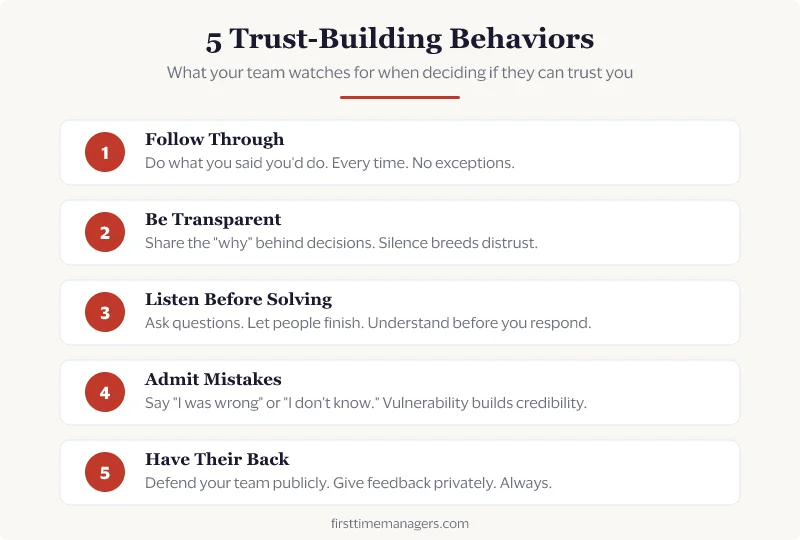
What Trust Actually Means in Management
As Lencioni’s research confirms, trust is the foundation of every effective team. Without it, everything else crumbles. Trust isn’t one thing. It’s a bundle of beliefs your team holds about you:
Competence trust: “My manager knows what they’re doing.” Can you make good decisions? Do you understand the work? Can you remove blockers and navigate the organization?
Character trust: “My manager is a good person.” Are you honest? Do you keep your word? Do you treat people fairly? Do you have good intentions?
Care trust: “My manager has my back.” Do you genuinely care about me as a person? Will you protect me? Do you invest in my growth?
You need all three. Competence without character is manipulation. Character without competence is a nice person who can’t help you. Care without either is sympathy that leads nowhere.
Trust runs in three directions, and you are probably working on one
Almost everything written for new managers treats trust as a downward problem: how do I get my team to trust me. That is the biggest piece, and it is where this guide spends most of its time. It is not the whole picture.
Downward is your team deciding whether you are reliable. It is built through the behaviors below.
Upward is your boss deciding whether you need watching. This one is quieter and easier to neglect, because your boss rarely tells you where you stand. It is built almost entirely by surfacing problems before they surface themselves. A manager who reports a slipping project in week two gets support. A manager whose boss discovers it in week six gets supervision, and getting out of supervision takes months. The mechanics are in the guide on managing up as a new manager.
Sideways is your peers deciding whether you are safe to depend on. Nobody assigns you this and no review measures it, but it determines whether other teams warn you about problems early or let you find out in a meeting.
The three interact more than people expect. A manager who is trusted downward and distrusted upward loses the ability to protect their team, because protection requires credibility with the person making the decisions. If you have limited energy, spend it downward first. Just do not assume the other two take care of themselves.
The Trust Accelerators: 7 Behaviors That Build Trust Fast
1. Do What You Say You’ll Do
This is the most important trust-building behavior. Full stop.
When you say “I’ll look into that,” look into it. When you promise an answer by Friday, deliver by Friday. When you commit to a change, make the change.
Every kept promise is a deposit in the trust bank. Every broken promise is a withdrawal that costs double.
Practical tips:
- Write down every commitment you make in a 1-on-1 or meeting
- Review your commitments daily
- If you can’t fulfill a commitment, proactively communicate: “I said I’d have an answer by today. I don’t yet. Here’s why, and I’ll have it by Wednesday.”
- Under-promise and over-deliver. Say “by end of week” and deliver Wednesday.
The cardinal sin: Saying “I’ll handle it” and then forgetting. Do this three times and your team will stop bringing you problems. Not because the problems stopped, but because they’ve stopped believing you’ll act on them.
2. Be Honest, Even When It’s Hard
Comfortable lies erode trust faster than uncomfortable truths.
- If you don’t know the answer: “I don’t know, but I’ll find out.”
- If you can’t share information: “I can’t talk about that yet, but I’ll share what I can when I can.” This kind of transparent communication leadership style builds more trust than false reassurances ever could.
- If a decision was made above you that your team won’t like: “I understand this is frustrating. Here’s the reasoning behind it, and here’s what I pushed back on.”
- If you made a mistake: “I got that wrong. Here’s what happened and what I’m doing differently.”
What not to do:
- Don’t pretend everything is fine when it’s not
- Don’t make promises you can’t keep to avoid an uncomfortable moment
- Don’t spin bad news into fake good news (your team isn’t stupid)
- Don’t say “I’ll try” when you mean “I won’t”
People can handle hard truths from someone they trust. They can’t handle discovering that their manager has been hiding things.
3. Listen More Than You Talk
In your first months especially, your ratio should be about 70% listening, 30% talking.
But not just any listening. Active, genuine listening. The kind where you’re trying to understand, not just waiting for your turn to speak.
What good listening looks like:
- Making eye contact and putting your phone away
- Asking follow-up questions: “Tell me more about that” or “What did you mean by…?”
- Paraphrasing to confirm understanding: “So what you’re saying is…”
- Not interrupting, even when you disagree
- Remembering what people told you and referencing it later
What bad listening looks like:
- Checking your phone or laptop while someone talks
- Jumping to solutions before they’ve finished explaining the problem
- Saying “I hear you” and then doing nothing
- Asking a question and then answering it yourself
The trust signal: When someone shares a concern in a 1-on-1, and you bring it up two weeks later with an update (“Hey, you mentioned X last time. I looked into it, and here’s what I found”), that’s when trust forms. It proves you actually listened.
4. Have Their Back
This means different things in different situations, but the principle is the same: when it matters, your team needs to know you’ll stand up for them.
When credit is due: Give it publicly and specifically. “This was Sarah’s idea. She led the research and built the recommendation.” Never take credit for your team’s work. Ever.
When blame comes down: Absorb it. If leadership is unhappy about a miss, you own it: “That’s on me. I should have [caught it / resourced it differently / escalated sooner].” Shield your team from political fallout.
When resources are tight: Fight for your team’s needs. They may not see the emails you send or the meetings where you advocate for headcount, budget, or tools, but they’ll feel the results.
When someone is being treated unfairly: Speak up. If another team is dumping work on yours, if a stakeholder is being unreasonable, if someone in leadership is making unfair demands, be the buffer.
The limit: Having someone’s back doesn’t mean excusing bad performance or ignoring problems. It means creating a safe environment where people can do their best work, and addressing issues privately and fairly.
5. Be Consistent
Nothing destroys trust faster than unpredictability. Manager credibility and consistency go hand in hand. If your team can’t predict how you’ll react, they’ll default to caution: hiding problems, avoiding risks, and telling you what you want to hear instead of what you need to hear.
Consistency means:
- Reacting to similar situations in similar ways
- Applying the same standards to everyone (including your favorites)
- Keeping the same priorities week to week (or clearly explaining when they change)
- Being the same person on good days and bad days
The test: If a team member described your management style to a new hire, would their description be consistent regardless of which team member you asked? If yes, you’re consistent. If different people would paint very different pictures, you have work to do.
Common consistency killers:
- Mood-dependent management (cheerful Monday, grumpy Tuesday)
- Different standards for different people
- Priorities that change with every meeting
- Saying one thing in 1-on-1s and another in team meetings
6. Show Vulnerability
Vulnerability-based leadership doesn’t mean oversharing your personal problems or announcing your insecurities in a team meeting. It means being human enough that people can connect with you.
Appropriate vulnerability:
- “This is new for me, and I’m still learning. I appreciate your patience.”
- “I made a mistake in how I handled that. Here’s what I should have done.”
- “I’m not sure about the right approach here. What do you think?”
- “That feedback stung, but you’re right. Thank you for telling me.”
Why it works: When you show that you’re not pretending to be perfect, you give others permission to be imperfect too. That creates psychological safety, the single strongest predictor of high-performing teams.
The balance: Be vulnerable about process (how you’re learning, what you’re struggling with professionally), not about whether you can do the job at all. “I’m figuring out the best way to run our planning process” is vulnerable. “I have no idea what I’m doing and I’m terrified” is alarming.
7. Invest in Their Growth
Nothing says “I care about you” like actively investing in someone’s development.
How to do it:
- Ask about career goals in your one-on-one meetings: “Where do you want to be in a year? How can I help you get there?”
- Give stretch assignments that develop new skills
- Share opportunities: conferences, training, projects on other teams
- Provide honest feedback that helps them improve (not just praise that makes them feel good)
- Advocate for their promotion or advancement when they’re ready
The trust payoff: When someone believes you genuinely care about their career, not just their output, they’ll go through walls for you. And they’ll be honest with you, because they trust your intentions.
Trust Killers: What to Absolutely Avoid
Certain behaviors destroy trust faster than you can build it. Avoid these at all costs:
Taking Credit for Someone Else’s Work
Even once. Even subtly. Even by omission (not correcting someone who gives you credit you don’t deserve). Your team will hear about it, and they’ll never forget.
Sharing Confidences
If someone tells you something personal in a 1-on-1, a family issue, a health concern, a career doubt, and you share it with others, you’ve permanently damaged that relationship and signaled to the entire team that private conversations aren’t safe.
Playing Favorites
Giving the best work, the most flexibility, or the most patience to certain people while holding others to a different standard. Everyone notices. Nobody says it to your face.
Making Promises You Can’t Keep
“I’ll get you that promotion.” “I’ll make sure you don’t have to work on that project.” “I’ll fix the process by next month.” If you’re not sure you can deliver, don’t promise. It’s better to say “I’ll try, but I can’t guarantee it” than to promise and fail.
Avoiding Accountability
Blaming your boss, other teams, “the system,” or circumstances for things that were within your control. Your team needs to see that you own your mistakes, not that you’re skilled at deflecting them.
Being Two-Faced
Saying one thing to your team and another to your boss. Agreeing with someone in private and contradicting them in public. This gets discovered eventually, and when it does, trust is gone.
Repairing Trust When It Breaks
It will break at some point. You’ll forget a commitment, make an unfair decision, or say the wrong thing. Here’s how to repair it:
Step 1: Acknowledge it specifically
“I realize I dropped the ball on [specific thing]. That wasn’t okay, and I understand why it’s frustrating.”
Don’t say “I’m sorry if you felt…” That’s not an apology. Own it directly.
Step 2: Explain without excusing
“Here’s what happened: [context]. That’s not an excuse, it’s just context so you understand.”
Step 3: Commit to change
“Here’s what I’m going to do differently: [specific action].”
Step 4: Follow through
This is the only part that actually matters. The apology opens the door. The changed behavior walks through it.
How long does it take to rebuild trust? Longer than you want. Trust repair after a leadership mistake follows a general rule: trust is built in drops and lost in buckets. A single trust violation can take weeks or months of consistent behavior to repair. Be patient with the process.
The Trust Timeline
Trust doesn’t happen overnight. Here’s a realistic timeline for what to expect:
| Phase | Timeframe | What’s Happening |
|---|---|---|
| Observation | Weeks 1-4 | Team is watching. Every action is data. Trust is neutral. |
| Testing | Weeks 4-8 | Team tests boundaries. Small conflicts arise. How you handle conflict between team members matters enormously. |
| Early trust | Months 2-3 | If you’ve been consistent, people start opening up. Real conversations happen. |
| Working trust | Months 3-6 | Team gives you benefit of the doubt. Feedback flows both ways. Hard conversations are possible. |
| Deep trust | Months 6-12+ | Team has your back as much as you have theirs. People take risks because they feel safe. |
You can accelerate this timeline with the behaviors above. But you can’t skip phases. Trust requires time plus consistent action.
How to Tell Whether It Is Actually Working
This is the question the timeline above cannot answer, because trust is not something people announce. Nobody walks into a 1-on-1 and says they have decided to trust you. You have to read it off behavior, and the signals are more specific than most managers realize.
The single best indicator is how early you hear bad news. On a low-trust team, problems reach you when they are no longer hideable. On a high-trust team, someone tells you in week one that the estimate was wrong. If the last three problems you learned about were already crises when you learned about them, that is not bad luck, it is a trust reading.
Four more signals worth watching:
Somebody disagrees with you in a group setting. Not aggressively. Just openly, in front of others. Teams that do this are not less deferential, they are more confident that disagreement is survivable.
People bring you half-formed thinking. “I’m not sure about this yet, but…” is a trust behavior. It means someone is willing to be seen mid-thought rather than only when polished, which is where most useful conversations start.
Someone tells you that something you did landed badly. This is the rarest of the five and the strongest. It requires believing that you will hear it as information rather than as insubordination.
Silence changes character. Early on, quiet in a meeting means people are waiting to see what you want. Later, quiet means people are thinking. You can usually feel the difference, and the shift is real.
The uncomfortable version of this test: none of the five signals are about people being warm toward you. Being liked and being trusted are different things, and it is entirely possible to have the first without the second. If your team is friendly but nothing difficult ever gets said out loud, read your team likes you, and that’s the problem next, because that is a specific and common trap.
The Daily Trust Habit
Every morning, ask yourself one question:
“What’s one thing I can do today to show my team they can count on me?”
Maybe it’s following up on something from a 1-on-1. Maybe it’s giving someone public credit. Maybe it’s being honest about a hard decision. Maybe it’s just showing up fully present in a meeting instead of multitasking.
One action per day. That’s it. Over weeks and months, these small deposits compound into something unshakeable.
If you want a fuller system for leading this way, servant leadership in practice turns the same posture into twelve concrete daily behaviors. Less philosophy, more reps.
Trust isn’t built in grand gestures. It’s built in the small, consistent, daily choices that show people who you really are. Start making those choices today, and the rest of management gets dramatically easier.
Where to Go From Here
Trust is the foundation, and this hub covers what gets built on top of it. Depending on where you are:
If the team is polite but nothing real gets said, start with psychological safety, which covers the conditions that make candor possible, and then your team likes you, and that’s the problem for the version of this that looks like a healthy team from the outside.
If trust exists individually but the team is not gelling as a unit, the gap is team dynamics rather than relationships. Team building for new managers covers shared context, rituals, and working agreements.
If people are doing the work but the energy has gone, recognition is usually the missing piece. The recognition guide covers the mechanics, and the quiet kind of recognition that actually works covers what to do when you have no budget for any of it.
If there is friction between specific people, go to handling conflict between team members without taking sides.
If the age gap is the awkward part, there are two guides for the two directions: managing Gen Z employees and managing someone older than you.
If the problem is bigger than your team, and the pattern looks structural rather than interpersonal, check it against the twelve signs of a toxic work environment before you spend another quarter trying to fix it from the inside.
If someone has already resigned, the 12 exit interview questions cover how to get past the polite version, and more usefully, the stay interview that would have surfaced the same information six months earlier. Trust determines which of the two conversations you get to have.
If you would rather read the source material, the five books on building team trust covers Lencioni, Edmondson, Brown, Covey and Scott, with an honest note on which one to read first depending on your situation.
Think someone on your team might be pulling away? Take the free Is My Employee Quiet Quitting? quiz: 15 scenarios across 5 dimensions that help you spot disengagement early. 4 minutes, no email required.
🚨 Your best performer hasn’t complained, but something feels off? Take the Am I About to Lose My Best Employee? assessment: 15 questions that measure flight risk across Recognition Gap, Growth Stagnation, Relationship Erosion, and more. Free, 4 minutes.
The pattern that quietly undoes all of it. The Am I Playing Favorites quiz catches the most common trust leak, the one nobody names out loud because from the inside it feels entirely fair.