You just got promoted. Everyone’s talking about how to manage your team: the 1-on-1s, the feedback, the delegation. But nobody mentions the relationship that will make or break your first year: the one with your boss.
Here’s the uncomfortable truth: your boss controls your budget, your headcount, your autonomy, and, let’s be honest, your job security. You can be brilliant with your team and still fail if you can’t manage up.
And yet, most first-time managers either ignore this relationship entirely (“my work will speak for itself”) or overcorrect into people-pleasing territory that destroys their credibility.
There’s a better way. It’s called managing up, and it’s a skill, not a personality trait.
What “managing up” actually means
Managing up is proactively building a productive working relationship with your boss. That’s it.
It is NOT:
- Sucking up, flattering, or telling your boss what they want to hear
- Playing politics or manipulating
- Doing your boss’s job for them
- Blindly agreeing with everything they say
It IS:
- Understanding what your boss needs and delivering it before they ask
- Communicating in the format and frequency they prefer
- Flagging problems early instead of hiding them
- Earning trust so you get autonomy, resources, and air cover
According to research from Florida International University published in Personnel Psychology, managers who actively manage up have stronger working relationships with their bosses and receive higher performance ratings. This isn’t soft stuff. It directly impacts your career trajectory.
Why it matters even more when you’re new
When you were an individual contributor, your boss mostly cared about your output. Did the code ship? Did the report get done? Simple.
Now you’re a manager, and the evaluation criteria have completely changed. Your boss needs to trust your judgment, not just your work ethic. They need to know you can handle ambiguity, make trade-offs, and not blow up the team.
The problem: they don’t know if you can do any of that yet. You’re unproven in this role. Every interaction in the first 90 days is a data point, and your boss is forming opinions fast.
That’s why managing up isn’t optional for first-time managers. It’s how you build credibility before you’ve had time to prove anything through results.
The expectations conversation (have it in week one)
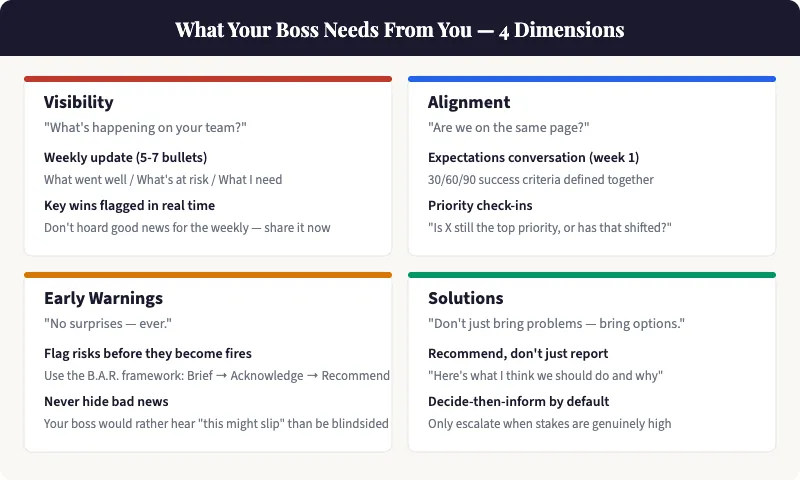
The single highest-leverage thing you can do is have an explicit expectations conversation with your boss. Not “let’s grab coffee sometime,” but a structured conversation where you ask specific questions.
Most new managers skip this because it feels awkward. Don’t. Your first 90 days set the trajectory for everything that follows, and this conversation is the foundation.
Questions to ask your boss:
- “What does success look like for me at 30, 60, and 90 days?”
- “What are the 2-3 things that matter most to you about how I run my team?”
- “How do you prefer to receive updates: email, Slack, 1-on-1s, shared doc?”
- “How often do you want to hear from me? Weekly? When there’s a problem?”
- “What’s the one thing the previous manager (or this team) struggled with that you’d like to see fixed?”
- “Is there anything I should absolutely NOT do in my first few months?”
- “When things go sideways, how do you want me to handle it: bring it to you immediately, try to fix it first, or something in between?”
Script for opening the conversation:
“I want to make sure we’re aligned from the start. I’d love 30 minutes this week to talk about your expectations for me and the team: what success looks like, how you prefer to communicate, and where the biggest opportunities are. Would that work?”
No boss will say no to this. It shows maturity, and it immediately signals that you’re thinking about the relationship, not just the tasks.
Learn your boss’s operating system
Every boss has an unwritten operating manual. The faster you decode it, the less friction you’ll have.
Readers vs. Listeners. Peter Drucker identified this distinction decades ago, and it’s still the most useful framework. Some bosses want a written briefing before a meeting so they can process it. Others want to talk it through live and find written docs useless. Ask which one your boss is, or watch their behavior and figure it out.
Big picture vs. details. Does your boss want to know the strategy or the execution steps? Some bosses say “just tell me the outcome” and get annoyed by details. Others feel anxious without knowing exactly how something will be done. Mismatching here wastes both of your time.
Decision involvement. Some bosses want to approve everything. Others want you to decide and inform. Clarify: “For decisions about [hiring / spending / changing processes], do you want me to bring you options, a recommendation, or just inform you after?”
Stress signals. Learn what your boss looks like when they’re overloaded. When they’re in back-to-back meetings and barely responding to Slack, that’s not the time to drop a 2,000-word strategy doc. Timing matters.
The weekly update habit
This is the single easiest managing-up tactic that most new managers overlook.
Send your boss a brief weekly update. Every Friday (or Monday morning). Same format every time. Takes 10 minutes to write, saves hours of status meetings and “just checking in” pings.
Format:
What went well this week:
- [2-3 bullets: wins, progress, milestones]
What’s at risk:
- [1-2 bullets: things that might go sideways, blockers]
What I need from you:
- [0-2 bullets: decisions, approvals, air cover]
That’s it. Three sections, 5-7 bullets total. Your boss now has complete visibility without having to chase you.
Why this works: it builds trust by removing surprise. If something goes wrong later, you can point back to the update where you flagged the risk. If things go well, your boss has a paper trail of your contributions (useful come performance review time).
How to deliver bad news without losing credibility
Bad news is inevitable. A project will slip, a hire won’t work out, a client will complain. The question isn’t whether it happens; it’s how you handle it.
New managers make two classic mistakes: (1) hiding bad news hoping it resolves itself, or (2) delivering bad news in a panicky, emotional way that makes the boss more worried about you than the problem.
The B.A.R. framework for delivering bad news:
B: Brief the situation. State the facts in 2-3 sentences. No editorializing, no excuses.
“The Q2 launch is going to miss the deadline by two weeks. We discovered a dependency on the data team that wasn’t in the original scope.”
A: Acknowledge the impact. Show you understand why this matters. This proves judgment.
“I know this affects the marketing campaign timeline and the board update. I’ve already talked to Sarah in marketing about adjusted dates.”
R: Recommend next steps. Never bring a problem without a proposed solution (or at least options). This is what separates a problem-reporter from a problem-solver.
“I see two options: we can ship a reduced-scope version on time, or ship the full version two weeks late. I recommend the reduced scope because [reason]. I’d like your input before I commit.”
Your boss can handle bad news. What they can’t handle is being surprised by bad news, especially if they hear it from someone else first.
How to push back on a bad idea (from your boss)
This is the thing that terrifies new managers the most. Your boss suggests something you think is wrong. Do you smile and nod? Or do you speak up and risk the relationship?
Neither. You do something more nuanced: you disagree by asking questions, not making statements.
Instead of: “I don’t think that will work.” Try: “I want to make sure I understand the goal here. What problem are we trying to solve with this approach?”
Instead of: “The team won’t like that.” Try: “How do you think the team will react? I’m thinking about [specific concern].”
Instead of: “We’ve tried that before and it failed.” Try: “We did something similar last year and ran into [specific issue]. Do you think this version addresses that, or should we adjust?”
The pattern: question, don’t declare. Questions invite dialogue. Declarations invite defensiveness.
And here’s the thing most new managers miss: your boss usually wants pushback. They just promoted you because they trusted your expertise. If you agree with everything, you’re not adding value. You’re just an expensive yes-person.
The key is pushing back on the idea, never on the person. And picking your battles. If it’s a minor decision, let it go. Save your credibility for the moments that actually matter.
When your former peers go above your head
If you were promoted from within your team, you’ll likely face this: a former peer bypasses you and takes a complaint or request directly to your boss.
This feels like a betrayal, but it’s usually not malicious. Your former colleague doesn’t yet see you as their manager. They still see you as a peer, and going to the “real” boss feels natural.
How to handle it:
- Talk to your boss first. Say: “If [name] comes to you directly with team issues, would you mind redirecting them to me? I want to make sure I’m able to support the team and build that trust.”
- Talk to the team member privately. No accusation: “I noticed you talked to [boss] about the project timeline. I totally get it, we’re all adjusting. Going forward, can you bring those things to me first? I want to make sure I can help, and I also need to show [boss] I’ve got this.”
- Don’t complain about it to your boss. It makes you look insecure. A single proactive conversation is enough.
The “squeezed in the middle” problem
Here’s the reality nobody warns you about: as a first-time manager, you’re simultaneously managing down (your team) and managing up (your boss), and their interests don’t always align.
Your boss wants faster delivery. Your team is burned out. Your boss wants to cut headcount. Your team needs more people. Your boss wants everyone in the office. Your team works better remote.
You are the translator, the buffer, and the negotiator. This is the job.
Rules for navigating the squeeze:
- Never throw your boss under the bus to your team. Even if you disagree with a decision, own it: “The team is shifting to [new thing],” not “My boss is making us do [new thing].” For a worked example of owning a decision you did not make, see what to do when your company installs monitoring software.
- Never throw your team under the bus to your boss. When a deliverable is late, say “We’re behind on this” not “My team dropped the ball.”
- Advocate with data, not emotion. If your team needs something from your boss, translate their frustration into business language: “If we don’t backfill this role, we’ll miss the Q3 target by 20%” is more persuasive than “My team is overwhelmed.”
- Pick the right battles. You won’t win every fight. Choose the ones that matter most to your team’s ability to do their work, and let the smaller things go.
This is one of the hardest parts of management, and it’s also where you start building real leadership identity beyond imposter syndrome.
When the Problem Is Actually Your Boss
Everything above assumes a reasonable boss who is simply busy and under-informed. Most are. But some of the time the constraint is genuinely on their side, and continuing to apply the tactics above harder will not fix it. Three patterns come up repeatedly, and each has a different response.
The absent boss. They do not reply, they cancel your 1-on-1s, and decisions sit for weeks. The instinct is to keep waiting for approval. Do not. Switch to what is sometimes called a decision deadline: “Unless I hear otherwise by Thursday, I’m going to proceed with X.” This is not passive aggression, it is a documented default that lets work continue, and most absent bosses are relieved by it. Send it in writing, keep the record, and start with low-stakes decisions so the pattern is established before you need it on something that matters.
The micromanager. They want to approve everything, including things well below their level. Fighting for autonomy directly rarely works, because micromanagement is usually driven by anxiety rather than by a view of your competence. Reduce the anxiety instead. Over-report before they ask, name what you are about to do in advance, and ask for the specific thing you want released: “Would you be comfortable if I approved these under two thousand dollars and included them in the Friday update?” Autonomy comes back in pieces, and you have to ask for the pieces by name.
The boss who is themselves in trouble. Their own position is shaky, their priorities change weekly, and they are managing upward far more than downward. This is the hardest one, because none of it is about you and none of it is yours to fix. Two rules. Keep your own written record of commitments and decisions, because their memory of what was agreed will be shaped by pressure you cannot see. And protect your team from the volatility rather than transmitting it: if priorities changed three times this month, your team needs to hear one direction from you, not three.
Knowing which situation you are actually in matters more than any script, and it is genuinely hard to judge from the inside. The Is Your Boss the Problem, Or Are You? assessment separates the part you can fix from the part that sits on their side, which is the difference between a productive conversation and a frustrating one. If the answer turns out to be that you are struggling and they do not know it, your boss doesn’t know you’re struggling has the scripts for saying so without it landing as an excuse.
When You Get a New Boss
At some point, often with little warning, the person you have spent months learning gets replaced. Everything you decoded about their operating system leaves with them, and your accumulated credit does not automatically transfer.
Treat it as week one again, and do it deliberately rather than waiting to be told. Ask for the expectations conversation in the first two weeks, using the same seven questions from earlier in this guide. Do not assume your existing arrangements survive: the decisions you were allowed to make alone, the update format, the meeting cadence, all of it reverts to undefined until you re-establish it.
Two specific traps. Do not lead with a defense of the previous regime, even if you agreed with it. A new boss hears “we’ve always done it this way” as resistance, and you spend credit you have not yet earned. And do not assume your track record is visible to them. Whatever you delivered under the old boss exists in a system the new one has not read. A short, factual summary of what your team owns, what it has shipped, and what is currently at risk is worth more in the first month than any amount of good work they did not see.
The upside is real and worth naming: a new boss is also a reset for anything that was not working. If the previous relationship had settled into micromanagement or neglect, you are not obliged to reproduce it.
5 mistakes new managers make with their boss
1. Going dark. You get buried in team problems and forget to update your boss. Silence makes bosses nervous. When they don’t hear from you, they assume the worst, and they start micromanaging to compensate.
2. Only bringing problems, never solutions. If every 1-on-1 with your boss is a litany of complaints, you’ll be seen as someone who can’t handle the job. Always pair problems with proposed solutions.
3. Saying yes to everything. Overcommitting to make your boss happy, then failing to deliver. It’s better to say “I can do A and B by Friday, but C would need to wait until next week. Which do you want me to prioritize?” Learn how to say no. This applies upward too.
4. Waiting for permission on everything. Asking your boss to decide things you should be deciding. This signals low confidence and wastes their time. Default to: decide, then inform, unless the stakes are genuinely high.
5. Not asking for feedback. Your boss probably won’t volunteer feedback unless there’s a problem. And if all you’re hearing is “good job” with no specifics, that’s not feedback, and that’s a warning sign. Proactively ask: “What’s one thing I could do differently to be more effective?” Once a month is enough. Modeling this behavior also makes it easier to give feedback to your own team.
Your managing-up action plan (first 30 days)
Week 1:
- Schedule the expectations conversation (30 min)
- Ask the 7 questions listed above
- Identify your boss’s communication preference (reader vs. listener, detail vs. big-picture)
Week 2:
- Send your first weekly update (Friday or Monday)
- Observe your boss’s stress signals and energy patterns
- Clarify decision-making boundaries (“What can I decide alone?”)
Week 3:
- Start adapting your communication to their style
- If promoted from within: have the “redirect to me” conversation with your boss
- Ask for first round of feedback: “Anything I should adjust?”
Week 4:
- Evaluate: Is the update format working? Adjust based on their reactions
- Set your own goals that align with what your boss cares about
- Have a 15-minute “how are we doing?” check-in on the relationship itself
Managing up is not a one-time conversation. It’s an ongoing practice. The good news: the managers who figure this out early get more autonomy, more resources, and more air cover than the ones who treat their boss like an obstacle to work around.
Your team needs you to manage down. Your career needs you to manage up. Both are the job.
Where to Go Deeper
Managing up is broad enough that the useful next step depends entirely on which part is currently costing you something.
- You are struggling and have not said so. The hardest upward conversation is the one where you admit something is not working. Your boss doesn’t know you’re struggling has the scripts for raising it without it landing as an excuse or as a resignation letter.
- The only feedback you get is “good job.” That is not feedback, and treating it as reassurance is a mistake. Your boss said good job covers what the empty compliment usually means and how to convert it into something you can act on.
- You need to ask for money and keep postponing it. Every month you delay costs a measurable amount, and the delay is rarely about timing. The raise you’re avoiding does the arithmetic and gives you the conversation.
- You want a reading list rather than articles. Five books on managing up, reviewed honestly, including which ones are worth skipping.
- You cannot tell whose problem this is. Start with the Is Your Boss the Problem, Or Are You? assessment before the next difficult conversation, not after it.