Your team thinks you’re doing great. Your projects are on track. Your one-on-ones are improving. But every time you walk out of a meeting with your boss, you feel like you’re speaking a different language.
They want updates you didn’t prepare. They change priorities without telling you why. They give you vague feedback that could mean anything. Or worse — they micromanage every decision while claiming to trust you.
You’ve read all the books about managing your team. Nobody told you that managing your boss would be the harder job.
These five books will change that. Each one tackles a different dimension of the upward relationship — from understanding what your boss actually needs, to pushing back without career suicide, to building the kind of trust that gets you autonomy, resources, and air cover when things go wrong.
What made the cut: Every book on this list (1) gives you frameworks you can use this week, not just theory, (2) is backed by real research or decades of practice, (3) is under 450 pages, and (4) addresses the specific challenge of navigating upward relationships at work.
1. Dare to Lead — Brené Brown
The best book for finding the courage to have honest conversations with your boss.

- Author: Brené Brown
- Published: 2018 | Pages: 320
- Rating: 4.2/5 (80,000+ ratings)
- View on Amazon
This might seem like an odd choice for a “managing up” list. It’s not a book about boss tactics or office politics. It’s a book about having the courage to be honest when it’s uncomfortable — which is exactly what managing up requires.
Why it made the list
Most new managers fail at managing up not because they lack skills, but because they lack courage. The courage to disagree when your boss is wrong. The courage to say “I need help” when you’re drowning. The courage to deliver bad news before it becomes a crisis.
Brown’s research on vulnerability in leadership is directly applicable to the upward relationship. Her framework for “rumbling with vulnerability” — having tough conversations where the outcome is uncertain — is exactly what you need when you’re sitting across from your boss thinking “I need to push back on this but I’m terrified.”
The section on “armored leadership” vs. “daring leadership” is particularly relevant. Most new managers armor up around their boss — they perform confidence, hide uncertainty, and avoid difficult topics. Brown shows why this backfires: your boss can see through the armor, and it destroys the trust you’re trying to build.
Best for you if…
You know what you should say to your boss but can’t bring yourself to say it. You default to people-pleasing upward because the vulnerability of disagreement feels too risky. You need someone to give you permission — backed by data — to be honest instead of strategic.
Key takeaway: “Daring leadership is about showing up when you can’t predict or control the outcome. It’s about choosing courage over comfort.”
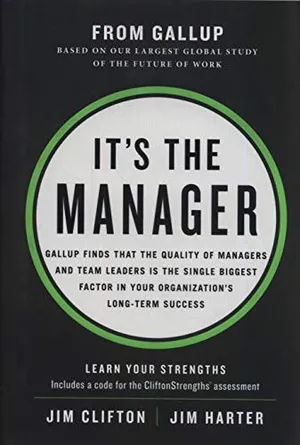
2. It’s the Manager — Jim Clifton & Jim Harter
The best book for understanding what your boss is dealing with (so you can actually help).
- Authors: Jim Clifton, Jim Harter (Gallup)
- Published: 2019 | Pages: 448
- Rating: 3.9/5 (600+ ratings)
- View on Amazon
This book is built on decades of Gallup research — the largest study of management and leadership ever conducted (over 2 million managers surveyed). It’s not specifically about managing up, but it gives you something more valuable: a deep understanding of how management actually works from the top down.
Why it made the list
Managing up effectively means understanding your boss’s world. What pressures are they under? What does their boss expect? What metrics are they measured on? Most new managers never think about this — they see their boss as a source of demands, not as another human navigating their own set of impossible expectations.
Clifton and Harter’s data reveals what separates great managers from mediocre ones — and when you understand that framework, you can start anticipating what your boss needs instead of just reacting to their requests. The chapter on “The Five Traits of Great Managers” is a playbook for understanding what your boss is trying (and possibly failing) to be.
The Gallup research on engagement is also eye-opening: 70% of the variance in team engagement is attributable to the manager. That means your boss’s boss is looking at your boss’s team engagement numbers. When you understand that, you can frame your conversations differently — not “I need more resources” but “here’s how this investment improves the team’s output.”
Best for you if…
You want to stop seeing your boss as the enemy and start seeing them as someone you can strategically support — which, counterintuitively, is the fastest way to get what you need from them. You want data-backed frameworks rather than opinion-based advice.
Key takeaway: “It’s the manager. The quality of managers and team leaders is the single biggest factor in your organization’s long-term success.”
3. HBR Guide to Managing Up and Across — Harvard Business Review
The most practical, no-nonsense handbook for navigating upward relationships.

- Author: Harvard Business Review
- Published: 2013 | Pages: 208
- Rating: 3.7/5 (700+ ratings)
- View on Amazon
If you want one book that covers all the specific situations you’ll face when managing up — and gives you a script for each one — this is it. No storytelling, no research deep-dives, just “here’s the situation, here’s what to do.”
Why it made the list
This book is organized as a collection of short, practical guides from Harvard Business Review’s best contributors. Each chapter tackles a specific managing-up challenge:
- How to present ideas to your boss in a way they’ll actually hear
- How to manage a boss who micromanages
- How to deliver bad news without destroying trust
- How to disagree with your boss constructively
- How to manage across (peer relationships, cross-functional politics)
- How to work with a boss whose style is completely different from yours
At 208 pages, it’s the shortest book on this list — and that’s a feature, not a bug. You don’t need to read it cover to cover. Find the chapter that matches your current problem, read the 15-page guide, and apply it Monday morning.
For new managers who just want to know “what do I do when my boss does X,” this is the reference manual. Keep it on your desk. It pairs perfectly with our guide on how to manage up as a new manager — the article gives you the philosophy, this book gives you the tactics.
Best for you if…
You have a specific problem with your boss right now and you want a quick, practical answer from a credible source. You’re not looking for a transformational leadership philosophy — you’re looking for a playbook you can use this week.
Key takeaway: “Managing up isn’t about being a sycophant or political operator. It’s about working effectively with people who have authority over you to get the best possible results.”
4. The Courage to Be Disliked — Ichiro Kishimi & Fumitake Koga
The best book for managers who say yes to their boss when they should say no.

- Authors: Ichiro Kishimi, Fumitake Koga
- Published: 2018 (English edition) | Pages: 288
- Rating: 3.9/5 (150,000+ ratings)
- View on Amazon
This is the most unconventional book on this list. It’s based on Adlerian psychology (Alfred Adler — the “third giant” of psychology alongside Freud and Jung) and it’s written as a dialogue between a philosopher and a young man. It’s Japanese, philosophical, and has nothing to do with management on the surface.
So why is it here? Because the number one reason managers fail at managing up is fear of being disliked.
Why it made the list
Adler’s core argument, as presented through this engaging dialogue, is that all problems are interpersonal relationship problems — and that the root of most unhappiness is the desire for approval from others. When applied to managing up, this is explosive:
- You don’t push back on your boss’s bad idea because you want their approval
- You say yes to everything because you fear disappointing them
- You hide problems because you want them to think you’re competent
- You absorb unfair workload because saying no might make them dislike you
Kishimi and Koga introduce the concept of “separation of tasks” — the idea that what your boss thinks of you is their task, not yours. Your task is to do good work and communicate honestly. Their reaction to that honesty is their responsibility, not something you can or should control.
This reframes the entire managing-up dynamic. Instead of “How do I manage my boss’s emotions?” the question becomes “How do I do my job with integrity and let my boss have their own reaction?”
For managers stuck in a people-pleasing pattern that’s driving them toward burnout, this book is a fire extinguisher.
Best for you if…
You intellectually know that you should push back on unreasonable requests, have honest conversations with your boss, and stop seeking approval — but emotionally you can’t do it. This book rewires the emotional pattern, not just the behavior.
Key takeaway: “The courage to be happy also includes the courage to be disliked. When you have gained that courage, your interpersonal relationships will all at once change into things of lightness.”
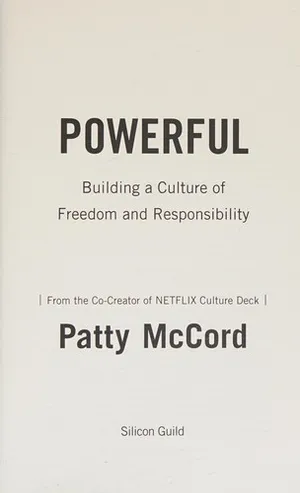
5. Powerful — Patty McCord
The best book for understanding what great managers look like from the boss’s perspective.
- Author: Patty McCord
- Published: 2018 | Pages: 228
- Rating: 4.1/5 (7,000+ ratings)
- View on Amazon
Patty McCord was the Chief Talent Officer at Netflix during its most explosive growth period. She co-authored the famous “Netflix Culture Deck” that Sheryl Sandberg called “the most important document ever to come out of Silicon Valley.” This book expands on those ideas.
Why it made the list
Powerful gives you something rare: the view from above. McCord explains what executives and senior leaders actually want from the managers below them — and it’s not what most people think.
They don’t want yes-people. They don’t want managers who shield them from bad news. They don’t want people who wait for permission. They want managers who:
- Understand the business context, not just their team’s bubble
- Debate ideas vigorously, then execute decisively once a decision is made
- Tell the truth about problems early, before they metastasize
- Make people decisions based on what the team needs, not on loyalty or comfort
- Challenge assumptions — including their boss’s assumptions
This is a masterclass in what “managing up” looks like at its best. Not political maneuvering. Not strategic flattery. Just rigorous honesty, deep business understanding, and the willingness to have the conversation nobody else wants to have.
The chapter on “radical honesty” in particular is relevant: McCord argues that the kindest thing you can do — for your team, your boss, and yourself — is tell the truth, even when it’s uncomfortable. Especially when it’s uncomfortable.
Best for you if…
You want to understand the perspective of senior leaders so you can communicate with your boss in their language. You’re ready to stop managing up defensively (“How do I survive my boss?”) and start managing up offensively (“How do I become indispensable to my boss?”).
Key takeaway: “The greatest team achievements are driven by everyone understanding that their prime directive is to make the business better.”
Comparison: Which One Should You Read First?
| Book | Best for | Time to read | Practical vs. philosophical |
|---|---|---|---|
| Dare to Lead | Finding courage to be honest | 8-10 hours | 60/40 philosophical |
| It’s the Manager | Understanding the big picture | 10-12 hours | 80/20 practical |
| HBR Guide | Specific tactical situations | 4-6 hours | 95/5 practical |
| Courage to Be Disliked | Breaking people-pleasing patterns | 6-8 hours | 30/70 philosophical |
| Powerful | Thinking like an executive | 5-7 hours | 70/30 practical |
If you’re in crisis mode (bad boss relationship right now): Start with the HBR Guide. It’s the fastest path to actionable tactics.
If you’re a people-pleaser who can’t say no: Start with The Courage to Be Disliked. Fix the mindset before the tactics.
If you want one well-rounded book: Start with Dare to Lead. It covers courage, vulnerability, and honest communication in a way that applies to managing both up and down.
If you want data, not feelings: Start with It’s the Manager. Gallup’s research gives you frameworks grounded in decades of evidence.
If you’re ambitious and want to think bigger: Start with Powerful. It reframes managing up from survival to strategic partnership.
The Book You Expected to Find Here
If you came looking for books on managing up, you probably expected Managing Up: How to Move Up, Win at Work, and Succeed with Any Type of Boss by Mary Abbajay (Wiley, 2018). It is the book that owns the phrase, and leaving it off a list like this one without saying why would be dodging the question. So here is the reasoning.
Abbajay’s book runs on one move: work out what kind of boss you have, then adapt to them instead of trying to change them. The first half sorts working styles into four types, Advancer, Energizer, Harmonizer and Evaluator, and shows how each one prefers to be given information. The second half is a catalog of difficult bosses, and it is unusually specific: micromanagers, ghosts, impulsives, narcissists, pushovers, best friends, workaholics, incompetents, seagulls and nitpickers. If your real problem is that you cannot name what you are dealing with, that catalog does something no book above does.
Two things kept it out of the five.
The readership is thinner than every book on this list. It holds 3.76 out of 5 from about 900 ratings on Goodreads, against 4.2 from more than 80,000 for Dare to Lead. Ratings are not a verdict on quality. But a book that has been in print since 2018 and still has a fraction of the readers of its alternatives is worth flagging before you give it an evening.
It answers the diagnostic question and stops there. Typing your boss is the easy half. The hard half arrives at nine on Monday morning, when you have to tell that micromanager their favorite project has slipped. Our five were chosen for the hard half: the nerve to say it (Brown), the context that makes it land (Clifton and Harter), the actual wording (HBR), permission to disappoint someone (Kishimi and Koga), and the standard you are being judged against (McCord).
Read it if your boss does something you cannot categorize and every framework you have tried has bounced off them. Start with the difficult-boss chapters and treat the personality types as background. Skip it if you already know exactly what your boss does and you need to know what to say about it, because that is what the five above are for, and it is what our guide to managing up, scripts included, was built around.
📖 Ready to put these ideas into practice? Read our complete guide on how to manage up as a new manager — with scripts for delivering bad news, pushing back on bad ideas, and building the trust that gets you autonomy.
🚨 Hiding your struggles from your boss? Read Your Boss Doesn’t Know You’re Struggling — And That’s Your Fault — the Signal Framework for asking for help without looking weak.
💬 Getting nothing but “good job” from your boss? That’s not feedback — it’s silence in a friendly wrapper. Read why vague praise should worry you and how to pull honest feedback from a boss who defaults to niceness.
🧭 Not sure whether the problem is your boss or you? Worth settling before you apply a single framework from these books, because managing up on the wrong diagnosis just adds friction. The is your boss the problem, or are you? quiz walks through 15 situations and tells you which of the two patterns you are actually in.