Your calendar reminder says “Performance Review — Jordan, 2:00 PM.” It’s 1:47 PM and you haven’t started preparing. You open a blank document. You open last quarter’s goals. You open Jordan’s Slack messages from the past three months, scrolling desperately for something concrete to say.
Sound familiar? You’re not the only one.
Performance reviews are one of those management responsibilities that everyone dreads and nobody teaches you how to do. Your company probably gave you a form, maybe a rating scale, and a deadline. What they didn’t give you is any guidance on how to have a conversation that actually changes someone’s trajectory.
Here’s the thing — a great performance review isn’t about filling out a form. It’s about having the most honest, useful career conversation your team member will have all year. And as a new manager, you have a surprising advantage: you don’t have years of bad habits to unlearn. You can start doing this right from the beginning.
Two free self-assessments pair well with this guide: if you’re debating whether someone is ready for the next level, run the Should I Promote This Employee? free decision tool before the review so you can answer “what’s next?” with confidence. If the review is heading toward underperformance territory, the Should I Put This Employee on a PIP? free decision tool helps you decide whether a formal plan is the right next step or whether coaching is still the higher-leverage move.
Why Performance Reviews Matter More Than You Think
Let’s be honest — most performance reviews are terrible. They’re a once-a-year formality where a manager reads from a script, the employee nods, and both parties leave feeling like they wasted an hour. Research from Gallup found that only 14% of employees strongly agree that their performance reviews inspire them to improve.
That’s not a problem with reviews themselves. It’s a problem with how most managers run them.
A well-run performance review does three things no other conversation can do:
-
It forces you to step back and see the full picture. Weekly one-on-ones are great for tactical stuff, but reviews are where you zoom out. Is this person growing? Stagnating? Burning out? You can’t see those patterns in a 30-minute check-in.
-
It gives your team member a dedicated space to hear where they stand. Most people spend their workdays guessing whether they’re doing a good job. That uncertainty is exhausting. A clear, honest review removes the guessing.
-
It creates a record. Not in a bureaucratic way — in a useful way. Six months from now, when you’re advocating for someone’s promotion or having a difficult conversation about underperformance, you’ll be glad you documented what you discussed today.
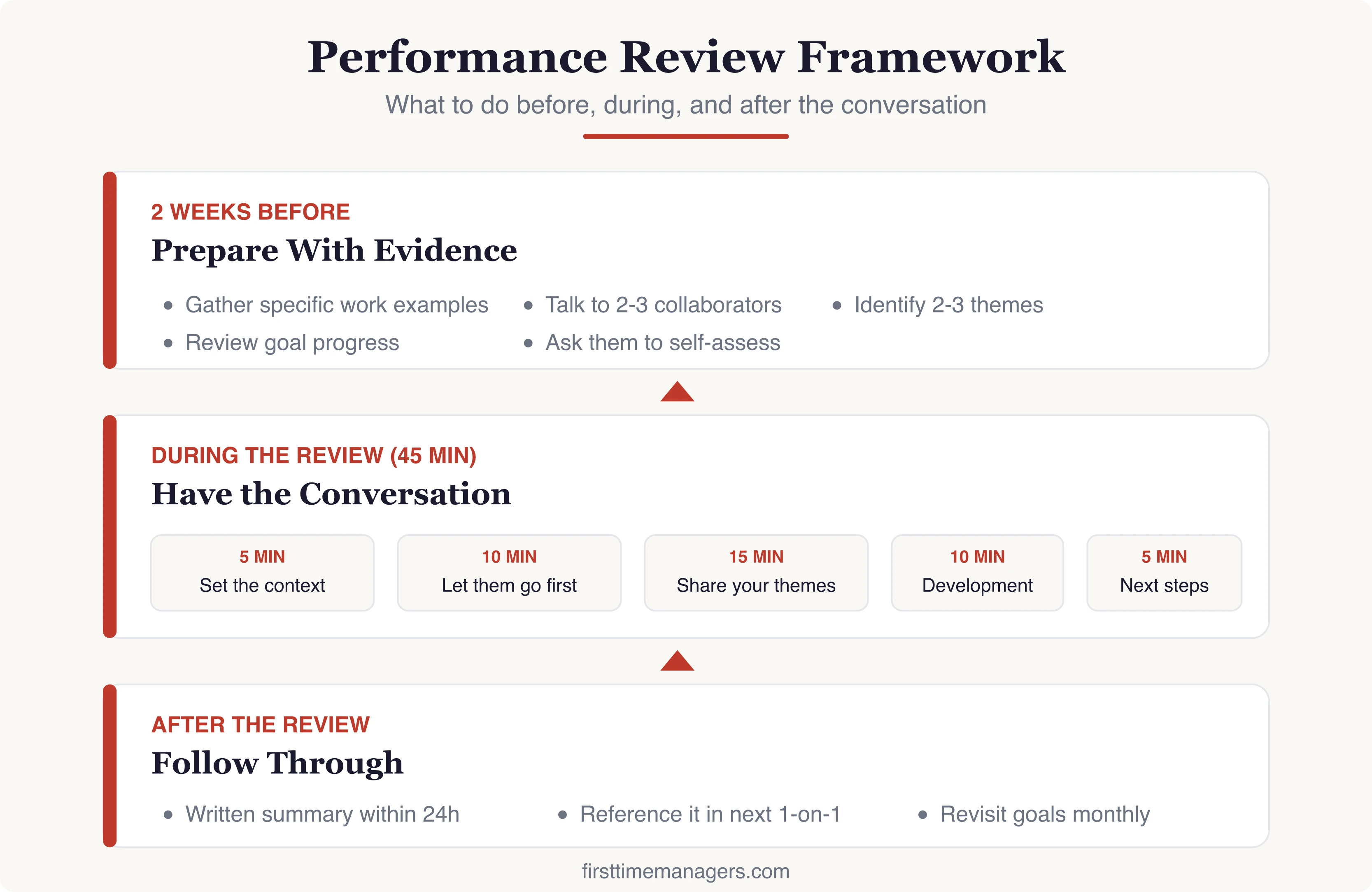
Before the Review: Preparation Is Everything
The difference between a forgettable review and a career-changing one comes down to preparation. If you wing it, you’ll default to vague generalities: “You’re doing great, keep it up.” That’s not helpful. That’s a greeting card.
Here’s exactly what to prepare:
1. Gather evidence (not opinions)
Your review should be built on specific examples, not feelings. Before you write anything, collect:
- Work outputs. What did this person actually deliver? Projects completed, problems solved, contributions made. Be specific — “led the migration to the new CRM” is evidence. “Good work ethic” is not.
- Feedback from others. Talk to 2-3 people who work closely with this person. Not a formal 360 review — just casual conversations. “Hey, I’m preparing for Jordan’s review. How has your experience been working with them this quarter?”
- Your own notes. This is why you should take notes during your one-on-ones. If you’ve been tracking themes, wins, and concerns in your 1-on-1s, writing the review becomes dramatically easier.
- Goal progress. Pull up whatever goals you set together — whether that was team goals you cascaded down or individual objectives. What was the target? What actually happened?
Pro tip: Start gathering evidence two weeks before the review, not two hours before. Set a calendar reminder. Future you will be grateful. And if you are staring at a blank review form, AI can help you turn your bullet points into a structured, professional review in minutes. For the full version of that workflow, including where the time savings actually come from and what you must never delegate to it, see AI for performance reviews.
2. Identify 2-3 themes
Don’t try to cover everything. Look at your evidence and find the two or three themes that matter most. Maybe it’s:
- Strong execution on core responsibilities, but avoids stretch projects
- Great collaboration with the team, but struggles with cross-functional stakeholders
- Exceeded the Q1 target, but the quality of documentation needs work
Themes give the conversation structure. Without them, you’ll ramble through a list of disconnected observations.
3. Prepare specific examples for each theme
For every piece of feedback — positive or constructive — have at least one concrete example ready. The SBI framework works perfectly here:
| Theme | Situation | Behavior | Impact |
|---|---|---|---|
| Strong execution | Q1 product launch | Jordan rewrote the testing protocol in 3 days when the old one failed | Launch stayed on schedule, saving ~2 weeks of delay |
| Avoids stretch work | Team offsite planning | When asked to lead the offsite, Jordan deferred to Sam without explanation | Missed an opportunity to build leadership skills and visibility |
| Cross-functional friction | Design handoff in March | Pushed back on design feedback in email instead of having a conversation | Design team felt dismissed; relationship took 3 weeks to repair |
Notice how specific this is. Jordan can’t argue with specifics. And more importantly, specifics help Jordan understand exactly what to do differently — which is the whole point.
4. Write a draft (but hold it loosely)
Write your assessment before the meeting, but don’t treat it as final. The review is a conversation, not a presentation. You might learn something during the discussion that changes your perspective. That’s a feature, not a bug.
5. Ask them to self-assess
The single most powerful thing you can do: ask your team member to write a brief self-assessment before the review. Give them prompts like:
- What are you most proud of from the past quarter?
- Where did you fall short of your own expectations?
- What would you like to focus on next quarter?
- What support do you need from me?
This does two things. First, it gives you insight into their self-awareness — do they see the same strengths and gaps you see? Second, it makes the conversation collaborative from the start. You’re not delivering a verdict. You’re comparing perspectives.
During the Review: The Conversation That Matters
You’ve prepared. You’ve got your themes, your examples, your draft. Now it’s time for the actual conversation.
Here’s a structure that works:
Open with context, not ratings (5 minutes)
Don’t start by reading the form. Start by acknowledging what this conversation is:
“I want this to be a genuine conversation about how things are going, where you’re growing, and how I can help. I’ve prepared some thoughts, but I also want to hear your perspective. This isn’t me delivering a verdict — it’s us figuring things out together.”
This framing matters enormously. It signals that you see the review as a two-way conversation, not a performance tribunal.
Let them go first (10 minutes)
If they wrote a self-assessment, start there:
“I read your self-assessment and there’s a lot I agree with. Walk me through what stood out most to you about this quarter.”
Letting them go first has a tactical benefit: if they already identify a gap you planned to raise, you don’t have to be the one to “break it to them.” You can simply agree and build on their observation. Harvard Business Review’s research on getting the most out of 360-degree reviews confirms that reviews where the employee speaks first produce higher satisfaction and stronger follow-through. That changes the entire dynamic from criticism to coaching.
Share your perspective (15 minutes)
Now walk through your themes. For each one:
- Name the theme. “One pattern I’ve noticed is your ability to deliver under pressure.”
- Give the specific example. “When the testing protocol failed during the launch, you rewrote it in three days without being asked.”
- Explain the impact. “That kept us on schedule and it didn’t go unnoticed by leadership.”
- Connect to the bigger picture. “This is exactly the kind of initiative that puts you in a strong position for more ownership.”
For constructive feedback, the same structure applies — but add a forward-looking element:
“One area I’d like to see you stretch is cross-functional communication. In the March design handoff, the email pushback created some friction. I think if you’d had a quick conversation instead, it would have landed differently. Going forward, when you disagree with a partner team, what would it look like to default to a conversation first?”
Notice the question at the end. You’re not just telling them what they did wrong. You’re inviting them to solve the problem with you.
Discuss development together (10 minutes)
This is the part most managers skip, and it’s the part your team member cares about most.
“Looking ahead, where do you want to grow? And what would make the biggest difference in getting you there?”
If you’ve been having regular one-on-ones, this shouldn’t be a surprise. But the performance review is where development goals become official. Write them down. Make them specific.
A bad development goal: “Improve leadership skills.” A good development goal: “Lead the Q3 cross-team project from kickoff to delivery, with a retrospective by October 15.”
Agree on next steps (5 minutes)
End with absolute clarity:
- What are the 2-3 goals for next quarter?
- What specific development focus are you both committing to?
- What does this person need from you to succeed?
- When will you check in on this? (Hint: don’t wait until the next formal review. Weekly one-on-ones are where you follow up.)
After the Review: Don’t Let It Die
Here’s where most managers fail. They have the conversation, fill out the form, and forget about it until the next review cycle. Six months later, the same feedback comes up because nothing changed.
Within 24 hours: Send a brief follow-up summarizing what you discussed — key strengths, areas for growth, agreed-upon goals, and next steps. This isn’t bureaucracy. It’s accountability.
In your next one-on-one: Reference the review. “Last week we talked about taking on more cross-functional projects. How are you thinking about that?” This signals that the review wasn’t just a formality.
Monthly: Revisit the development goal at least once a month. Are they making progress? Do they need help? Has the goal become irrelevant? Goals set in a review should evolve based on reality, not sit frozen in a document.
The Rating Scale Trap
Most companies use some version of a rating scale — “Exceeds Expectations,” “Meets Expectations,” “Below Expectations,” or a 1-5 numerical scale. These scales create more problems than they solve, but you probably don’t get to choose whether to use one.
This trap has a twin in the goal-setting world, and it is better documented there: teams adopt a scoring scale for goals, and within two quarters it is being read as a rating of the person. Niven and Lamorte treat keeping the two apart as part of the method itself, which is one reason their book is the reference title in our sister site’s review of the eight best OKR books.
If you must assign a rating, here’s how to handle it:
Don’t let the rating be a surprise. If someone is getting a “Below Expectations” rating, they should know things aren’t going well long before the review. If it’s a surprise, the failure isn’t theirs — it’s yours, for not giving feedback sooner.
Explain your reasoning. “I rated you ‘Meets Expectations’ because you delivered everything you committed to, on time and at quality. The reason it’s not ‘Exceeds’ is because exceeding expectations at this level means taking initiative beyond your defined scope — and that’s exactly what we should work on next quarter.”
Don’t let the rating overshadow the conversation. Some people fixate on the number or label. If that happens, redirect: “I understand the rating matters to you — and I’m happy to explain it in detail. But what I really want to make sure you take away from this conversation is the specific feedback and the growth plan, because that’s what will actually help your career.”
Your Performance Review Cheat Sheet
Here’s a quick reference for your first few reviews:
What to Do
| Before | During | After |
|---|---|---|
| Gather specific evidence for 2 weeks | Let them speak first | Send written summary within 24 hours |
| Talk to 2-3 collaborators | Use specific examples, not vague praise | Reference review in next 1-on-1 |
| Identify 2-3 clear themes | Balance strengths with growth areas | Revisit development goals monthly |
| Write a draft assessment | Agree on 2-3 goals for next quarter | Track progress, not just outcomes |
| Ask them to self-assess | End with clear next steps | Advocate for them based on what you documented |
What to Avoid
- The surprise bomb. Don’t raise a major issue for the first time during a review. That’s what ongoing feedback is for.
- The “everything is great” review. Even your best performer has room to grow. Skipping constructive feedback isn’t being kind — it’s being lazy.
- The recency bias. Don’t base the entire review on the last two weeks. This is why gathering evidence early matters.
- The comparison trap. “You’re not as strong in this area as Sam.” Never compare team members. Evaluate each person against their own goals and expectations.
- The monologue. If you’re talking more than 60% of the time, you’re doing it wrong. This is a conversation.
What If This Is Your First Review — And Theirs Too?
If you’re a first-time manager and you’ve only been leading this person for a few months, you might feel like you don’t have “enough” to say. That’s actually fine. Be honest about it:
“I’ve been your manager for three months, so this review covers a shorter period than usual. I want to share what I’ve observed so far, hear your perspective, and use this to set us up well for a full review next cycle.”
Honesty about your limited tenure builds trust. Making things up to fill a form does the opposite.
You might also inherit review responsibilities for someone else’s team. In that case, lean heavily on the self-assessment, talk to their previous manager if possible, and focus the conversation on the future: “I can’t fully evaluate the past six months because I wasn’t here. But I can absolutely make sure the next six months are set up for your success.”
When the Review Goes Badly
Sometimes, despite your best preparation, the conversation gets emotional. Maybe the person disagrees with your assessment. Maybe they cry. Maybe they get defensive or shut down.
If they disagree: Don’t argue. Listen. “Help me understand your perspective.” They might have context you’re missing. Or they might be in denial. Either way, you’ll learn more by listening than by defending your position.
If they get emotional: That’s normal. It means they care. Pause. Let them have a moment. Say something like: “Take your time. This is an important conversation and I want you to feel heard.” Don’t rush past the emotion to get back to your talking points.
If they shut down: They’re overwhelmed. Acknowledge it: “I can see this is a lot to process. How about we pause here, let this settle, and pick up the conversation tomorrow?” This isn’t giving up — it’s giving them the space to actually absorb what you’ve said.
In all three scenarios, the key is the same: stay calm, stay human, and remember that the goal is their growth, not their compliance.
The Review No One Talks About: Reviewing Yourself
Here’s a challenge: after your first round of performance reviews, do one for yourself. Ask yourself:
- How well did I prepare? Was I specific enough?
- Did I give feedback throughout the quarter, or did I save it all for the review?
- Did my team members seem surprised by anything I said? (If yes, that’s a problem.)
- What would I do differently next time?
The managers who get great at performance reviews are the ones who treat their own skills as reviewable too. That’s not just good management — it’s what separates the managers who keep growing from the ones who plateau.
Make It Count
Performance reviews have a bad reputation because most managers do them poorly. That’s your opportunity. If you’re the manager who actually prepares, who gives specific and honest feedback, who makes the conversation about growth instead of judgment — your team will notice. And they’ll work harder because of it.
You don’t need to be perfect. You need to be prepared, honest, and genuinely invested in the person sitting across from you.
That’s a review worth showing up for.
Need a system for setting the goals you’ll review? Most performance reviews fall flat because the goals were vague from the start. The Team Goal Setting Workbook gives you 14 worksheets to cascade, write, track, and review team goals — so when review time comes, you have real data to discuss. Get the Workbook →
Want better 1-on-1s between reviews? Your performance reviews are only as good as the conversations you have the other 51 weeks. The 1-on-1 Meeting Kit gives you a question bank, agenda template, meeting tracker, and quick reference card — everything you need to have conversations that make the annual review easy. Get the Kit →