You’ve set goals before. Probably at the start of every quarter. You wrote them down, put them in a doc, maybe even presented them in a team meeting. Everyone nodded. Then three months later, when someone asked what happened to Q2 Goal #3, the room went quiet.
This is the dirty secret of goal setting: everyone knows how to write goals. Almost nobody knows how to achieve them. And as a manager, the gap between setting and delivering isn’t just uncomfortable — it’s visible. Your boss sees it. Your team sees it. And the goals you set for others only work if people actually care about them enough to change their behavior.
I went through this cycle for longer than I’d like to admit. I read every article on SMART goals, OKRs, and KPIs. I made spreadsheets. I held alignment meetings. And still, at the end of most quarters, we’d hit maybe two out of five goals — and those two were the ones that would’ve happened anyway.
What finally changed wasn’t a better goal-setting template. It was understanding that setting goals is the easy part. Execution — the messy, daily, disciplined work of making progress when everything else is screaming for your attention — is where goals actually live or die. Research from MIT Sloan confirms that goal-setting systems focused on execution dramatically outperform those focused on specification.
Here are the five books that taught me the difference.
What made the cut: Every book on this list (1) goes beyond “set SMART goals” into actual execution and behavior change, (2) has been tested in real organizations, (3) gives you a framework you can implement with your team this month, and (4) is written by someone who managed real people, not just studied them.
1. Measure What Matters — John Doerr
The definitive book on OKRs — the goal system that runs Google, Intel, and the Gates Foundation.
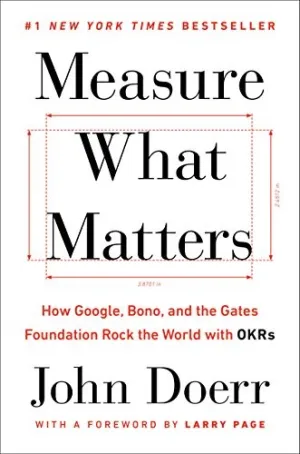
- Author: John Doerr (venture capitalist, early Google investor)
- Published: 2018 | Pages: 320
- Rating: 4.5/5 (60,000+ ratings)
- View on Amazon
John Doerr learned OKRs from Andy Grove at Intel in the 1970s, then brought them to Google in 1999 when it was a company of 40 people. This book tells that story — and dozens more — through the lens of one idea: Objectives and Key Results. An Objective is what you want to achieve. Key Results are how you’ll know you achieved it. That’s it.
Why it made the list
If you’re going to use one goal-setting framework as a new manager, this is the one. OKRs work because they force clarity. You can’t hide behind vague goals like “improve customer satisfaction” when you have to define exactly what “improved” means in measurable terms.
What Doerr does better than anyone else is show you how OKRs work at every scale — from Larry Page running Google to a small team lead trying to improve onboarding time. He also doesn’t shy away from the failures. There are stories of companies that set terrible OKRs, gamed their metrics, and learned the hard way that measuring the wrong thing is worse than measuring nothing.
For new managers, the chapter on alignment is essential. It explains how to connect your team’s goals to the company’s goals — and why setting your own goals as a manager requires understanding what your boss actually needs from you, not just what you think matters.
The book’s weakness: it’s a bit heavy on case studies and light on the “how to actually roll this out on Tuesday” guidance. Which is exactly why Radical Focus (#5 on this list) makes a great companion read.
Best for you if…
You want to understand the gold standard of goal-setting frameworks. You’re considering implementing OKRs with your team and need the full picture — the philosophy, the mechanics, and the pitfalls. This is the bible.
Key takeaway: “Ideas are easy. Execution is everything. It almost doesn’t matter what you know. It matters what you do with what you know.”
2. The 4 Disciplines of Execution — McChesney, Covey & Huling
The best book for actually getting things done when the day job keeps getting in the way.
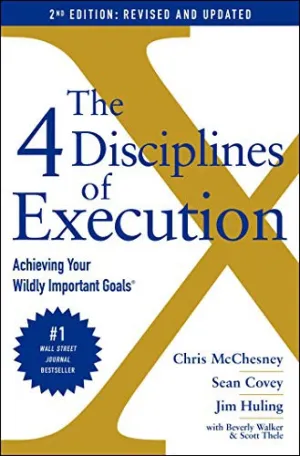
- Authors: Chris McChesney, Sean Covey, Jim Huling
- Published: 2021 (2.0 Edition) | Pages: 368
- Rating: 4.5/5 (8,000+ ratings)
- View on Amazon
Here’s the problem every manager faces: you have goals (the important stuff), and you have the “whirlwind” (the urgent stuff that fills every hour of every day — emails, meetings, fires, requests). The whirlwind always wins. Not because your team doesn’t care about the goals, but because the whirlwind is louder, more immediate, and never stops.
This book doesn’t pretend the whirlwind will go away. Instead, it gives you four disciplines for executing your goals inside the whirlwind.
Why it made the list
The four disciplines are deceptively simple:
- Focus on the Wildly Important — Pick 1-2 goals. Not 7. Not 12. One or two.
- Act on Lead Measures — Track the activities that drive the result, not just the result itself.
- Keep a Compelling Scoreboard — Make progress visible to everyone, every day.
- Create a Cadence of Accountability — Weekly commitments, publicly stated.
Discipline #2 changed how I manage. Most managers track lag measures — revenue, completion rate, customer satisfaction. Those are outcomes. By the time they move (or don’t), it’s too late. Lead measures are the upstream activities you control — number of outreach calls, hours spent on deep work, code reviews completed. When you shift your team’s focus from outcomes to behaviors, everything changes.
The weekly accountability meeting (Discipline #4) is the engine. It takes 20 minutes, it’s sacred, and it answers one question: “What are the one or two things I will do this week to move the needle on our wildly important goal?” That weekly rhythm is the difference between goals that live on a wall and goals that actually get done.
If time management is something your team struggles with, this book shows you how to protect goal-critical work from the noise.
Best for you if…
You’ve set goals before and they fizzled out by week three. You know the problem isn’t the goals themselves — it’s that daily work steamrolls them. You need a system that works alongside the chaos, not in a fantasy world where you have uninterrupted focus time.
Key takeaway: “People naturally play differently when they’re keeping score. The highest levels of performance always come from people who are emotionally engaged — and a visible scoreboard is what drives that engagement.”
3. Essentialism — Greg McKeown
The best book for the manager who’s drowning in goals and can’t focus on any of them.
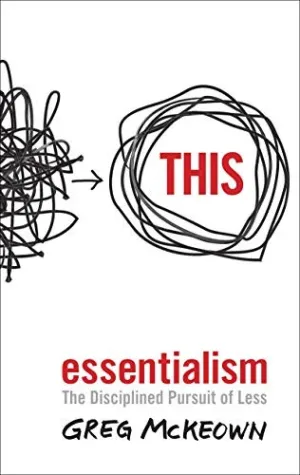
- Author: Greg McKeown
- Published: 2014 | Pages: 272
- Rating: 4.5/5 (30,000+ ratings)
- View on Amazon
This isn’t a goal-setting book in the traditional sense. It’s a book about un-setting goals. About doing less — dramatically less — so that the things you do commit to actually get done. McKeown’s thesis is that most managers are trapped in a cycle of undisciplined pursuit of more: more projects, more priorities, more meetings. And the result is that nothing gets the attention it deserves.
Why it made the list
New managers are especially vulnerable to the “more is more” trap. You want to prove yourself, so you say yes to everything. You set ambitious goals across ten areas because you’re terrified of being seen as unambitious. Your performance review lists a dozen objectives, each one diluted.
McKeown’s framework is a disciplined process for figuring out what matters most — and then eliminating everything else. Not deprioritizing. Not “putting on the backburner.” Eliminating.
The most useful exercise in the book: for every commitment on your plate, ask “If I didn’t already have this, how much would I fight to get it?” If the answer is anything less than “absolutely, yes” — it shouldn’t be there. This applies to your goals, your meetings, your projects, and especially the goals you set for your team.
The book also addresses something most goal-setting books ignore: the social pressure to be busy. In most organizations, the manager who has 15 priorities is seen as more committed than the one who has 3. McKeown argues — convincingly — that the opposite is true. The manager with 3 priorities actually achieves things.
Best for you if…
You have too many goals, not too few. You’re spread thin across so many priorities that none of them are progressing meaningfully. You need permission — backed by research and logic — to cut half your commitments and go deep on what’s left.
Key takeaway: “If you don’t prioritize your life, someone else will. The word priority came into the English language in the 1400s. It was singular. Only in the 1900s did we pluralize it — and begin to talk about ‘priorities.’ Illogically, we reasoned that by changing the word we could bend reality.”
4. Drive — Daniel H. Pink
The best book for understanding why your team isn’t motivated by the goals you’ve set.
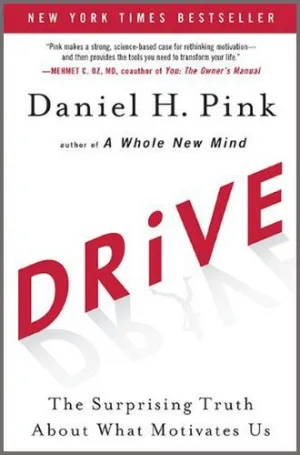
- Author: Daniel H. Pink
- Published: 2011 (Updated Edition) | Pages: 272
- Rating: 4.4/5 (25,000+ ratings)
- View on Amazon
You can set perfect OKRs, build a scoreboard, and hold weekly accountability meetings — and still fail. Because if your team doesn’t care about the goals, none of the systems matter. Pink’s book explains why people care about some goals and ignore others — and the answer isn’t what most managers think.
Why it made the list
Pink’s core argument, backed by decades of research from Edward Deci and Richard Ryan’s Self-Determination Theory, is that the three things that actually motivate people at work are:
- Autonomy — the desire to direct our own lives and work
- Mastery — the urge to get better at something that matters
- Purpose — the need to do what we do in service of something larger than ourselves
Notice what’s not on the list: bonuses, performance incentives, targets with consequences. Pink argues — with uncomfortable amounts of evidence — that extrinsic rewards (carrots and sticks) actually decrease performance on complex, creative tasks. The exact kind of tasks most knowledge workers do every day.
For new managers, this has immediate practical implications. If you set goals in a way that removes autonomy (dictating the how, not just the what), your team will comply but not commit. If the goals don’t connect to mastery (getting better at something meaningful), they feel like busywork. If there’s no purpose beyond “hit the number,” you’ll get the number — and nothing more.
This book is the answer to the question every manager has asked: “I set clear goals and my team still doesn’t seem motivated. What am I doing wrong?” You’re probably not doing anything wrong with the goals. You’re doing something wrong with the motivation architecture around them.
Best for you if…
You’ve noticed that your team does the minimum to “check the box” on goals but doesn’t go above and beyond. You’ve tried incentives, accountability, and consequences — and nothing seems to create genuine engagement. You need to understand what actually drives human motivation at work.
Key takeaway: “The secret to high performance and satisfaction — at work, at school, and at home — is the deeply human need to direct our own lives, to learn and create new things, and to do better by ourselves and our world.”
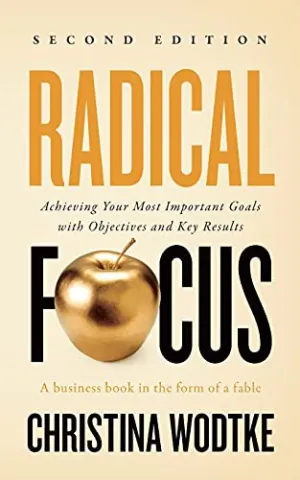
5. Radical Focus — Christina Wodtke
The best book for actually implementing OKRs with a small team on Monday morning.
- Author: Christina Wodtke
- Published: 2021 (2nd Edition) | Pages: 256
- Rating: 4.3/5 (2,000+ ratings)
- View on Amazon
If Measure What Matters is the OKR bible, Radical Focus is the OKR field manual. Where Doerr gives you the philosophy and the Google-scale case studies, Wodtke gives you the week-by-week, meeting-by-meeting playbook for a normal-sized team with a normal-sized budget and a normal amount of chaos.
Why it made the list
The first half of the book is a business fable (a startup trying to find product-market fit using OKRs), and the second half is a practical guide. I know — business fables are usually terrible. This one is surprisingly good because it shows exactly what goes wrong when teams implement OKRs badly: too many objectives, key results that are actually tasks, scoring that nobody understands, and the gradual slide from “this quarter’s focus” to “this quarter’s ignored document.”
Wodtke’s weekly cadence is the most actionable thing in the book:
- Monday: Review OKR progress (are we on track?), set weekly priorities (what moves the needle this week?), identify blockers
- Friday: Celebrate wins (what did we actually accomplish?), review what didn’t work
That’s it. No complex dashboards. No quarterly planning retreats. Just a rhythm of checking in, adjusting, and making progress visible. For a new manager who just wants to set team goals that work without building an enterprise-grade system, this is the book.
She also addresses a trap specific to new managers: setting OKRs that are actually task lists. “Ship feature X” isn’t a Key Result — it’s a task. “Increase user activation from 30% to 45%” is a Key Result. The distinction matters because tasks tell you what to do; key results tell you whether what you did worked.
Best for you if…
You’ve decided to try OKRs (or your company already uses them) and you need a practical, small-team implementation guide. You want something you can read in a weekend and start using next week. This is the most actionable book on this list.
Key takeaway: “An OKR is not a task list. A task list is a recipe for staying busy. An OKR is a commitment to making something different in the world. If your team’s OKRs look like a to-do list, you’re doing it wrong.”
Quick Comparison
| Book | Best For | Core Framework | Pages | Rating |
|---|---|---|---|---|
| Measure What Matters | Understanding OKRs fully | Objectives + Key Results | 320 | 4.5★ |
| The 4 Disciplines of Execution | Executing despite the “whirlwind” | Focus, Lead Measures, Scoreboard, Cadence | 368 | 4.5★ |
| Essentialism | Cutting goals to focus on what matters | The disciplined pursuit of less | 272 | 4.5★ |
| Drive | Understanding what motivates your team | Autonomy, Mastery, Purpose | 272 | 4.4★ |
| Radical Focus | Implementing OKRs with a small team | Weekly OKR rhythm + fable | 256 | 4.3★ |
Which One Should You Read First?
If you’re new to goal setting as a manager, start with Radical Focus. It’s the shortest, the most practical, and you’ll have something to try with your team by next Monday. Once you’ve been doing OKRs for a quarter and want the full picture, read Measure What Matters.
But here’s the real answer — it depends on your specific bottleneck:
- Don’t have a goal-setting framework yet? Start with Radical Focus (practical) or Measure What Matters (comprehensive).
- Set goals but never achieve them? Start with The 4 Disciplines of Execution. Your problem isn’t the goals — it’s the daily chaos.
- Have too many goals and can’t focus? Start with Essentialism. You need to cut before you can commit.
- Team hits targets but nobody seems to care? Start with Drive. Your motivation architecture is broken.
- Want the full OKR picture? Read Measure What Matters first, then Radical Focus for implementation.
Beyond Books: Goals Are a Practice, Not a Document
Every book on this list agrees on one thing: the goal-setting event (the quarterly planning meeting, the strategy offsite, the OKR workshop) matters far less than the goal-setting practice — the daily and weekly discipline of checking progress, adjusting course, and holding yourself accountable.
If the books have left you unsure which framework you are even supposed to be using, that confusion is worth resolving before you read any of them, because the three most common answers are not alternatives to each other: OKRs vs KPIs vs SMART goals explains what each one is actually for and how they stack.
Before the practice, a diagnostic. It is worth knowing whether the goals you already set are the kind that survive contact with a quarter, because rewriting a bad goal beats reviewing it weekly. The are your team goals setting you up to fail? quiz walks through the failure patterns these five authors keep naming independently. And since the weekly review below has to come out of a calendar that is presumably already full, the manager’s time budget calculator shows where your week actually goes, which is usually the reason the review never happens.
The five above are chosen for you: your habits, your quarter, your follow-through. If the problem is a level up, where four people have to mean the same thing by one goal in month three, the shelf reads differently. Our sister site reviews eight goal setting books for companies, including four that argue against the way most companies set goals at all.
Three ways to make this real:
-
Start with one goal, not five. Every author on this list warns against setting too many goals. Start with one objective for your team this quarter. Just one. If you nail it, add a second one next quarter. This is harder than it sounds — and more powerful than you expect.
-
Review weekly, not quarterly. Goals that get reviewed every 13 weeks are already dead by week 3. Build a 15-minute weekly check-in into your team rhythm. What did we commit to? What did we do? What’s blocking us? That cadence is the engine.
-
Connect goals to meaning. As Drive makes clear, goals that feel like compliance produce compliance-level effort. Before you roll out any goal, make sure you can answer: “Why does this matter to the people doing the work?” If you can’t, the goal needs reworking — not the team.
And if you want a structured plan for putting all of this into practice during your first three months as a manager — from the goals you set for yourself to the goals you set for your team — that’s exactly what the First 90 Days Playbook was built for. It gives you a week-by-week roadmap so you’re not guessing what to focus on.
Good luck. Set less. Execute more.