You’ve been a manager for three months. You’ve run meetings, had one-on-ones, put out fires, and generally kept things moving. But here’s the question nobody has asked you, and that’s starting to keep you up at night:
What are YOUR goals?
Not your team’s goals. Not the project deadlines. Not the vague “do great work” that your boss mentioned during your promotion conversation. YOUR goals. The ones that tell you whether you’re doing a good job. The ones that would go on a performance review, if anyone were actually planning to give you one.
If you’re waiting for someone to hand you a neat list of objectives… you might be waiting a long time.
Here’s the uncomfortable truth: most new managers never receive explicit goals. Your boss assumes you’ll figure it out. HR assumes your boss told you. And you assume that since nobody’s complaining, you must be doing okay. That silence isn’t confirmation. It’s a vacuum, and you need to fill it yourself.
If you are in your first 90 days specifically, the goals you set should look different from the ongoing personal goals covered below. Our companion guide on how to set goals in your first 90 days as a manager walks through the specific learning, visibility, and early-win goals that apply during the transition. Come back here once day 90 is behind you.
Why Nobody Gave You Goals (It’s Not Personal)
Before you spiral into thinking your boss doesn’t care about you, let’s name the actual reasons this happens:
Your boss is overwhelmed too. Middle managers are the most squeezed layer of any organization. Your boss is probably managing up, managing their own peers, and dealing with their own unclear goals. Setting clear objectives for each direct report takes time they may not have. It’s a failure of the system, not a reflection of your value.
The company doesn’t have a formal goal-setting process. Many organizations, especially smaller ones, fast-growing startups, and companies in transition, simply don’t have a structured OKR or goal-setting cadence. Nobody gets goals. It’s not just you.
You were promoted for doing great work, and everyone assumed you’d keep doing great work. The implicit expectation is: “Just keep doing what you were doing, but now also manage people.” Nobody stopped to define what “success” looks like in this fundamentally different role.
Your boss trusts you. Sometimes the lack of explicit goals is actually a sign of confidence. Your boss believes you’ll figure out the right priorities. The problem is that “trusting you to figure it out” and “leaving you completely directionless” look exactly the same from the outside.
Whatever the reason, the result is the same: you’re flying without instruments. That needs to change. And the good news is that you can change it yourself. (If you want to build a deeper foundation first, start with the top 5 books on goal setting and getting results, which give you the frameworks behind everything in this guide.)
Why This Is Actually an Opportunity
I know it feels like a problem. But here’s the reframe: managers who set their own goals often outperform those who have goals assigned to them.
Research on self-determination theory by Edward Deci and Richard Ryan at the University of Rochester has consistently shown that autonomy, meaning ownership over your work and direction, is one of the strongest drivers of motivation and performance. When you set your own goals, you’re not just checking a box. You’re exercising the kind of strategic thinking that separates good managers from great ones.
Think about it: your boss wants you to be the kind of manager who identifies what matters and drives toward it. By creating your own goals, you’re already demonstrating exactly that. You’re showing initiative. You’re showing strategic awareness. And you’re making your boss’s life easier, because they now have a direct report who doesn’t need to be micromanaged.
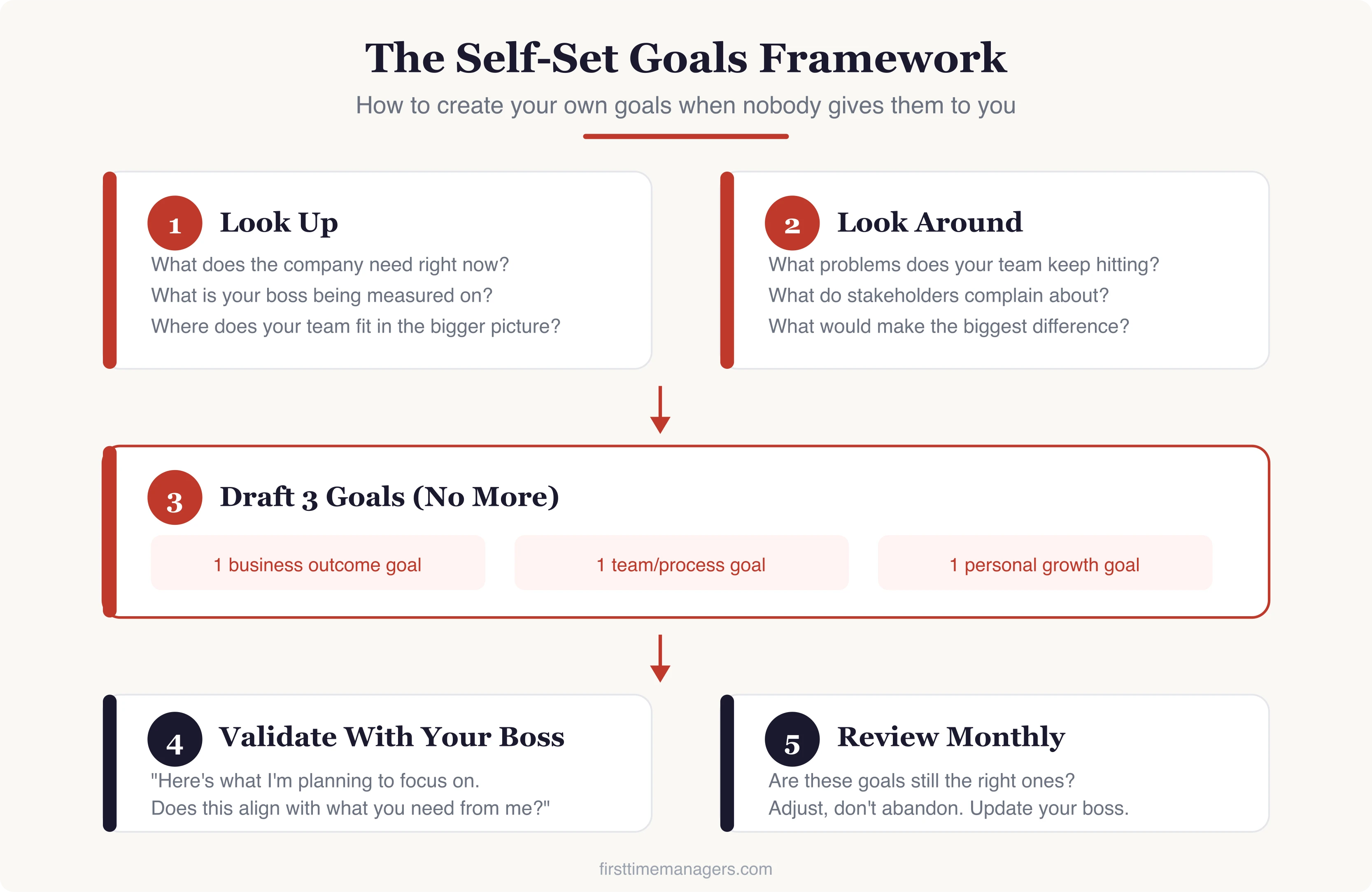
The 5-Step Framework for Setting Your Own Goals
Step 1: Look Up
Before you decide what you should focus on, understand what the organization needs. Ask yourself:
-
What are the company’s top 2-3 priorities this quarter/year? If you don’t know, find out. Read the all-hands slides. Ask your boss. Check the company wiki. The answer might be revenue growth, customer retention, product launch, cost reduction, or a dozen other things.
-
What is your boss being measured on? This is the single most useful question you can ask. If your boss is judged on customer satisfaction, and your team directly impacts customer satisfaction, you’ve just found your north star. Don’t be shy about asking: “What are your biggest priorities right now? How can my team help?”
-
Where does your team fit in the value chain? Your team exists to produce something: a product, a service, support, decisions, code, sales. What is the output that other parts of the organization depend on? That output is the starting point for your goals.
If you’ve been setting team goals already, you’ve done some of this thinking. The difference now is turning that lens on yourself.
Step 2: Look Around
Now zoom in on your immediate world:
-
What problems keep recurring? Missed deadlines? Low morale? Quality issues? Cross-team conflicts? The persistent problems are often the highest-value goals hiding in plain sight.
-
What do stakeholders complain about? Talk to the people who depend on your team’s work. Ask them: “What’s the one thing my team could do better that would make the biggest difference for you?” Their answer is probably a goal.
-
What’s broken that nobody has time to fix? Every team has legacy processes, workarounds, and duct-tape solutions that everyone tolerates. Fixing one of these can be a high-impact goal, and it shows you’re thinking beyond the day-to-day.
-
What does your team need from you that they’re not getting? Are you doing enough one-on-ones? Is feedback flowing? Are people growing? Your team’s experience of your management is a legitimate goal area.
Step 3: Draft Exactly 3 Goals
Here’s the rule: three goals, no more. Not five. Not eight. Three.
Why three? Because you’re a new manager. You’re still learning the basics: how to run meetings, give feedback, manage your time, and navigate the politics. If you pile on too many goals, you’ll either spread yourself too thin or ignore the goals entirely. Three goals give you enough focus to actually make progress.
Here’s the formula I recommend:
Goal 1: One business outcome goal. This is the goal your boss cares about most. It connects directly to what the team delivers. Revenue, product shipped, tickets resolved, deals closed, retention rate, time-to-market, something measurable that matters to the business.
Example: “Reduce average customer response time from 24 hours to 8 hours by end of Q2.”
Goal 2: One team or process goal. This is about making your team better, faster, or more sustainable. It might be about process improvement, reducing burnout, improving collaboration, or fixing something that’s been broken.
Example: “Implement weekly team retrospectives and reduce recurring blockers by 50%.”
Goal 3: One personal growth goal. This is about your own development as a manager. Be specific. “Be a better manager” isn’t a goal. What skill do you need to build?
Example: “Have at least one difficult feedback conversation per month using the SBI framework instead of avoiding it.”
How to Make Each Goal Actually Useful
A goal isn’t useful if it’s vague. Apply this quick test to each one:
| Question | If the answer is no… |
|---|---|
| Can I measure progress? | Add a number or milestone |
| Does it have a deadline? | Add one, even if it’s “by end of quarter” |
| Would my boss agree this matters? | Revisit Step 1 |
| Can I actually influence this outcome? | Pick something within your control |
| Will I remember this in 3 weeks? | Simplify the wording |
You don’t need to use formal OKR syntax or a complicated template. A simple sentence that passes all five questions is better than a perfectly formatted OKR that nobody looks at.
Step 4: Validate With Your Boss
This is the step most managers skip. Don’t skip it. As Harvard Business Review’s research on what great managers do daily emphasizes, the highest-performing managers communicate frequently and proactively, especially upward.
Once you’ve drafted your three goals, bring them to your boss. Not as a question (“What should my goals be?”) but as a proposal (“Here’s what I’m planning to focus on. Does this align with what you need from me?”).
This is a power move. Here’s the script:
“I’ve been thinking about what I should be focusing on this quarter. I drafted three goals: one around [business outcome], one around [team improvement], and one around [my own growth]. Can I walk you through them and get your input?”
Three things will happen:
-
Your boss will be impressed. Most direct reports never do this. You’ve just signaled that you think strategically, take ownership, and don’t need hand-holding.
-
You’ll get valuable calibration. Your boss might say “These are great” or they might redirect: “Actually, the biggest thing I need from you right now is X.” Both outcomes are useful. You either confirm your direction or course-correct early.
-
You’ll create accountability. Once your boss has seen and agreed to your goals, they become a shared expectation. This protects you, because when your performance review comes around, you have a documented conversation about what you were aiming for.
If your boss is the type who waves their hand and says “Yeah, that sounds fine” without really engaging, send a follow-up email. “Thanks for the chat. Here are the three goals I’m focusing on this quarter: [list them]. Let me know if anything changes.”
Now you have a paper trail.
Step 5: Review Monthly (Not Quarterly)
Goals that get set once and reviewed quarterly are goals that get forgotten. Review yours monthly, even if it’s just 15 minutes with yourself.
Ask these three questions:
-
Am I making progress? If yes, keep going. If no, why not? Is it a priority problem, a resource problem, or was the goal wrong?
-
Are these still the right goals? Things change. Your company’s priorities shift. A major project lands on your desk. A team member leaves. It’s okay to adjust your goals, just make sure you’re adjusting for good reasons, not because the goal got hard. John Doerr’s research on goal setting with OKRs shows that the best teams review and adjust goals regularly, treating them as living documents, not stone tablets.
-
Does my boss know where I stand? Proactive updates are one of the best managing up habits you can build. A quick “Here’s where I am on my three goals” in your next one-on-one takes 60 seconds and keeps you visible.
Real Examples: Self-Set Manager Goals
Here are examples for different types of teams, so you can see how the 3-goal formula works in practice:
Engineering team manager
- Business: Ship the v2.0 customer dashboard by June 30 with fewer than 5 critical bugs at launch.
- Team: Reduce PR review time from 3 days to 1 day by implementing a rotation schedule.
- Personal: Run my first skip-level meetings (meet with my team members’ direct reports) to understand ground-level blockers.
Customer support team manager
- Business: Increase customer satisfaction score from 78% to 85% by end of Q3.
- Team: Create a knowledge base that reduces repeat questions by 30%.
- Personal: Get comfortable having performance conversations, with at least one growth-focused conversation per team member per quarter.
Marketing team manager
- Business: Generate 500 qualified leads from content marketing this quarter (up from 320).
- Team: Implement a content calendar process so nothing ships without at least one peer review.
- Personal: Build a relationship with the sales team lead, with a monthly sync to align on lead quality.
Notice a pattern? The business goal has a clear number. The team goal improves how the team works. The personal goal addresses a specific skill or habit. None of them require a perfect system or a fancy tool, just clarity and follow-through.
Once you have done this for yourself, you will be doing it with each of your reports, and the mechanics are the same one level down. Employee goal setting covers that conversation, including how to keep it from turning into a performance review.
The Traps to Watch For
Trap 1: Setting goals nobody else knows about
If your goals live in your private notebook and nowhere else, they’re wishes, not goals. Share them with your boss. Share them with your team (at least the business and team goals). Transparency creates accountability.
Trap 2: Confusing activity with outcomes
“Hold weekly one-on-ones” is an activity. “Ensure every team member can articulate their top priority and has no unresolved blockers” is an outcome. Activities are things you do. Outcomes are results you produce. Set goals for outcomes; let activities be the means.
Trap 3: Picking “safe” goals you’d achieve anyway
The point of goal-setting isn’t to guarantee success. It’s to point yourself at something that stretches you. If you’re 95% certain you’ll hit the goal regardless, it’s not ambitious enough. Pick something that’s a genuine challenge, something that forces you to change how you work.
Trap 4: Ignoring the personal growth goal
New managers chronically under-invest in their own development. You set business goals because they’re visible. You set team goals because they feel responsible. But you skip the personal growth goal because it feels selfish or soft. It’s not. You can’t pour from an empty cup. Your growth IS your team’s growth, and a better manager produces a better team.
Trap 5: Never updating them
The world changes. Your goals should too. A goal you set in January might be irrelevant by March. That’s fine, so adjust it. The goal isn’t to hit 100% of your original targets. The goal is to always know what you’re aiming for.
What If Your Boss Rejects Your Goals?
It happens. You walk in with your three goals and your boss says “Actually, I need you focused on something completely different.”
This is not a failure. This is the system working. You just surfaced a misalignment that would have cost you months of wasted effort. You now know exactly what your boss wants. Set your goals around that.
If your boss gives you vague pushback (“Hmm, I’m not sure those are quite right, but I can’t tell you what they should be”), try this: “No problem. What’s the single most important thing you need from my team in the next 90 days?” Whatever they say, that’s your Goal #1. Build the other two around it.
The Bottom Line
Nobody is going to hand you a neat sheet of goals and say “Here’s how to be a great manager.” The best managers I know all figured out their own direction, and then made sure it aligned with what mattered.
The framework is simple:
- Look up (what does the organization need?)
- Look around (what does your team and its stakeholders need?)
- Draft 3 goals (one business, one team, one personal)
- Validate with your boss (proposal, not question)
- Review monthly (adjust, don’t abandon)
You don’t need permission to do this. You don’t need a goal-setting workshop, an HR process, or a fancy OKR tool. You need 30 minutes of focused thinking, a conversation with your boss, and the discipline to check in with yourself once a month.
The manager who says “Here are my goals, do they align with what you need?” is already outperforming 90% of managers who are still waiting to be told what to do.
Stop waiting. Start leading.