You sit down at your desk on week two, open a blank document, and type “Q2 Goals” at the top. Then you stare at the blinking cursor for twenty minutes. You have no idea what to write.
You know you’re supposed to set goals. Every leadership book says so. Your boss probably asked about them during your first meeting. But here’s the thing nobody tells you: the goals you set in your first 90 days look nothing like the goals you’ll set a year from now. And if you try to set “real” goals before you understand the landscape, you’ll either aim at the wrong target or freeze up completely.
I’ve seen both extremes. The new manager who announces three ambitious initiatives in week one, then quietly abandons all of them by month two. And the new manager who spends 90 days “getting settled” without committing to anything, then wonders why their boss is concerned about their progress.
There’s a middle path. And it starts with accepting that goal-setting for new managers is a phased process, not a one-time event.
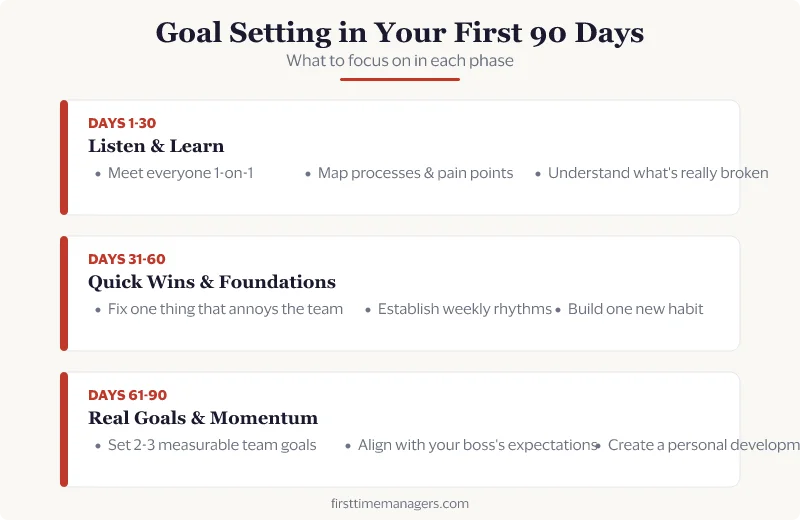
Why Your Goals Should Change Every 30 Days
Most goal-setting advice assumes you already know your environment. You know what’s broken, what matters, who does what, and what success looks like. As a new manager, you have none of that context.
Setting ambitious performance goals in week one is like drawing a detailed map of a city you’ve never visited. You might get lucky. But more likely, you’ll waste energy heading in the wrong direction.
Instead, think of your first 90 days in three phases, each with a different type of goal. If you’re evaluating structured approaches, Google’s research on what makes great managers is worth studying, but even that works best once you understand the landscape. Here’s how SMART goals for new managers should evolve:
- Days 1-30: Goals about understanding
- Days 31-60: Goals about small improvements
- Days 61-90: Goals about real direction
If you want the full week-by-week playbook for your first three months, our 90-day action plan lays it all out. What we’re doing here is zooming in specifically on how to set the right goals at the right time.
Phase 1: Days 1-30, Goals About Understanding
Your first month’s goals should feel almost embarrassingly simple. That’s how you know they’re right.
You’re not trying to fix anything yet. You’re trying to see clearly. The biggest mistake here is confusing activity with progress. Having fifteen meetings isn’t progress. Understanding what you learned in those meetings is.
Here are the kinds of goals that actually matter in month one:
Meet every person on your team one-on-one. Not a quick hallway chat, but a real sit-down conversation. If you’re not sure how to structure these, here’s a guide on running your first one-on-one meeting. Ask questions like:
“What’s the one thing about how this team works that you wish someone would fix?”
“What did my predecessor do well that I should keep doing?”
“What’s your biggest frustration right now, and how long has it been going on?”
Map the current state. By day 30, you should be able to answer these questions without looking anything up:
- What are the team’s active projects and who owns each one?
- What does the team’s workflow actually look like (not what the org chart says)?
- Where are the bottlenecks and recurring pain points?
- Who are the key stakeholders outside your team?
- What does your boss care about most?
Understand the team’s history. Every team has a story. Maybe they went through a reorg six months ago and morale is still recovering. Maybe the last manager micromanaged everyone and trust is low. Maybe there’s a star performer who almost quit. You need to know this context because it shapes what goals will actually work.
Build initial trust. This isn’t a checkbox. It’s a daily practice. Show up, listen more than you talk, follow through on small promises, and don’t pretend to know things you don’t. If you want a deeper dive on this, read how to build trust with your team.
Notice what’s not on this list: reorganizing the team, launching new processes, setting KPIs, or fixing the thing everyone’s been complaining about. You’ll get to all of that. But not yet.
Phase 2: Days 31-60, Goals About Small Improvements
By now you’ve listened. You’ve observed. You’ve heard the same complaints from three different people. You’re starting to see patterns.
Month two is about proving you listened by making small, visible improvements. These aren’t your big strategic goals, they’re quick wins that build credibility and momentum.
Fix one thing that annoys the team. You’ve heard the complaints. Pick the easiest one to fix and fix it. Maybe it’s a weekly status meeting that wastes everyone’s time. Maybe it’s an approval process with too many steps. Maybe it’s a shared document that’s completely out of date.
The specific fix matters less than the signal it sends: I heard you, and I’m going to do something about it.
Establish a recurring rhythm. If you haven’t already, this is the month to lock in weekly one-on-ones with each team member and a regular team meeting cadence. These aren’t just “nice to have,” they’re the operating system of your management practice.
A goal for this phase might be: “By day 60, I have a consistent weekly 1-on-1 with every direct report, and we’ve established a team meeting format that people actually find useful.”
Build one new habit. Pick a management practice you want to make automatic. Maybe it’s giving one piece of specific feedback every day. Maybe it’s spending the first 15 minutes of each morning reviewing your team’s priorities. Maybe it’s writing brief weekly updates for your boss.
The habit itself matters less than the discipline of choosing one thing and sticking to it.
Start managing up. Have a focused conversation with your boss about what you’ve learned in month one. This is critical. Don’t wait for them to ask. Come prepared with:
“Here’s what I’ve observed about the team in my first 30 days. Here are the patterns I’m seeing. Here’s what I’m planning to focus on next. Does this align with what you’re expecting?”
This conversation does two things: it shows your boss you’re being thoughtful, and it gives them a chance to course-correct before you go too far in any direction.
Phase 3: Days 61-90, Goals About Real Direction
Now you know enough to be dangerous, in a good way.
You understand the team. You’ve built some trust. You’ve demonstrated that you can observe, listen, and act. Month three is when you set the goals that actually define your first chapter as a manager.
Align with your boss on 2-3 team goals. Not five. Not seven. Two or three things the team will focus on for the next quarter. Aligning team goals with business objectives is what separates goals that get traction from goals that get forgotten. These should connect directly to what your boss and the organization care about, so think of it as cascading goals from leadership into your team’s day-to-day work. If your boss cares about reducing customer response time, one of your goals should relate to that.
The key word here is align. Don’t set goals in isolation and then present them as a fait accompli. Goal-setting is a conversation, not a declaration.
Try this framing: “Based on what I’ve learned and the priorities you’ve shared, here are the three goals I think we should focus on. I want to make sure these are the right ones before I take them to the team.”
Set one personal development goal. You’re learning a completely new skill set. Pick one area where you want to grow as a manager, not ten areas, one. Maybe it’s giving harder feedback. Maybe it’s running better meetings. Maybe it’s learning to delegate instead of doing everything yourself.
Write it down. Tell someone about it. That makes it real.
Create a 90-day summary for your boss. This doesn’t have to be a formal document, but it should capture: what you learned, what you changed, what goals you’re setting, and what support you need. This is managing up done right, proactively communicating your thinking instead of waiting to be asked.
One piece of timing nobody warns you about: if your first 90 days land in the fall, they will overlap with the company setting its goals for next year, and you will be expected to contribute to that while still finding your feet. It is worth knowing how that cycle works before you are in the room, and annual planning: setting company goals for next year walks through it from the company side.
How to Present Goals to Your Boss
Here’s something that took me years to figure out: your boss doesn’t just want you to execute goals, they want to see how you think.
When you present your goals, don’t just list them. Explain the reasoning. Show the connection between what you observed, what you concluded, and what you’re proposing.
A weak presentation sounds like this:
“My goals for next quarter are to improve team velocity by 15%, reduce bug count by 20%, and implement a new project management tool.”
A strong presentation sounds like this:
“In my first 90 days, I found that our biggest bottleneck isn’t individual speed, it’s handoff delays between design and engineering. I also noticed the team spends about 30% of sprint time on unplanned work because of unclear priorities. So my two goals are: first, reduce handoff time by implementing a shared review process. Second, work with product to create clearer sprint commitments so we can cut unplanned work in half. I’d like to revisit the tooling question in Q3 once these foundations are in place.”
See the difference? The second version shows thinking, not just ambition. It shows you understand the team, not just that you want to hit a number.
Common Traps to Avoid
After watching dozens of new managers set goals, including my own stumbling attempts, these are the traps I see most often:
Copying your predecessor’s goals. Their goals were based on their context, their relationships, and their understanding. You’re a different person inheriting a team that’s in a different place now. Start fresh.
Setting goals in isolation. If you set goals without input from your team or your boss, you’ll miss something important. Goals should be informed by what you’ve learned, validated with your boss, and at least partially shaped by your team’s input. And if your boss never gave you explicit goals? Here’s how to create your own.
Too many goals. If everything is a priority, nothing is. New managers often set six or eight goals because they feel pressure to demonstrate ambition. Two or three focused goals will always beat a long list of scattered ones.
Only setting metric goals. Numbers are easy to track, so new managers gravitate toward measurable performance targets. But some of your most important goals in the first 90 days are qualitative: building trust, establishing communication patterns, understanding the team. If you can’t put a number on it, that doesn’t mean it’s not a real goal. Research on goal specificity suggests that the type of goal matters as much as how ambitious it is.
Ignoring the human side. I’ve seen new managers create elaborate goal frameworks, whether using an OKR framework for teams or stacking KPIs and dashboards, and completely overlook that two team members aren’t speaking to each other, or that the team doesn’t trust leadership. The 10 most common mistakes new managers make includes a few more of these blind spots worth knowing about.
Your Goal-Setting Worksheet
Here’s a practical framework you can use right now. For each phase, write down your actual goals. I’ve included examples to get you started.
Days 1-30: Understanding Goals
| Goal | How I’ll Know It’s Done |
|---|---|
| Complete 1-on-1s with every team member | I can describe each person’s strengths, frustrations, and working style |
| Map current projects and ownership | I have a written document I could hand to someone and they’d understand our work |
| Understand boss’s top 3 priorities | I’ve confirmed these directly with my boss and written them down |
| Identify the team’s top 3 pain points | Multiple people have confirmed the same issues independently |
| Learn the team’s recent history | I understand the last 6-12 months of context: changes, wins, losses |
Days 31-60: Quick Win Goals
| Goal | How I’ll Know It’s Done |
|---|---|
| Fix one recurring frustration | The team acknowledges the improvement without me prompting them |
| Establish weekly 1-on-1 rhythm | I’ve held at least 3 rounds of 1-on-1s and have a consistent schedule |
| Build one management habit | I’ve done the habit consistently for at least 2 weeks |
| Share observations with my boss | I’ve had a structured conversation about what I’ve learned and my planned direction |
| Start giving regular feedback | I’ve given specific, timely feedback to at least 3 team members |
Days 61-90: Direction Goals
| Goal | How I’ll Know It’s Done |
|---|---|
| Set 2-3 team goals aligned with boss | Goals are written, boss-approved, and communicated to the team |
| Choose one personal development focus | I’ve identified it, told my boss about it, and have a plan to practice |
| Create a 90-day summary | I’ve shared it with my boss and had a conversation about next steps |
| Establish team goal-tracking rhythm | The team knows what we’re working toward and how we’ll measure progress |
Use this as a starting point, not a rigid template. Your version should reflect what you’ve actually learned about your team in your context.
The Goal Behind the Goals
Here’s what I want you to take away from all of this.
The real goal of your first 90 days isn’t to set perfect goals. It’s to build the foundation that makes everything else possible: understanding your team, earning their trust, and learning what actually matters in your specific situation.
Goals you set from that foundation will be sharper, more relevant, and more achievable than anything you could have dreamed up on day one. And when your boss sees that your goals come from genuine understanding rather than guesswork, they’ll trust your judgment in a way that no amount of ambition could earn.
You don’t need to have it all figured out by day 90. You need to be pointed in the right direction with a clear head and a team that believes you’re worth following.
That’s a goal worth setting.
Need a week-by-week structure for these goals? The First 90 Days Playbook maps out exactly what to focus on each week, with editable goal-setting worksheets, reflection prompts, and quick-reference cards. Get the Playbook →