You’re five weeks into your new role. Every Monday at 10 AM, your team gathers in a conference room (or a Zoom call) for a “team meeting.” You open with “So, any updates?” Three people talk for twenty minutes about things that could have been a Slack message. Two people check their phones. One person who actually has something important to discuss runs out of time.
Sound familiar?
A study cited in Harvard Business Review found that 71% of senior managers said meetings are unproductive and inefficient. And yet the average manager spends over 23 hours per week in meetings, up from fewer than 10 hours in the 1960s, according to research published in Harvard Business Review.
If you want a real number on what that recurring Monday meeting is actually costing your team in payroll, run the Meeting Cost calculator. Plug in headcount, average salary, and meeting length, and the output is almost always uncomfortable. Most managers find that a single recurring weekly meeting costs more per year than a senior hire’s base salary. The math is the first step toward cancelling the meetings that do not earn it.
Here’s the problem: nobody teaches you how to run a meeting. They just put one on your calendar and expect you to figure it out. You inherited a recurring invite from your predecessor, and now it’s your meeting, but you’re not sure what it’s for. If you are early enough that the whole calendar still feels like someone else’s, the first 90 days action plan puts the meeting audit in week six for a reason, and running it before you understand the team tends to backfire.
This guide is about fixing that. Not your first team meeting, and that’s a separate conversation. This is about the ongoing team meetings you’ll run every week or every two weeks for as long as you manage this team. The ones that either become the most valuable hour of your team’s week or the hour they secretly wish they could skip.
Why Your Team Meetings Feel Pointless
Before we fix the structure, let’s name the real reasons team meetings fail:
No clear purpose. “Team sync” is not a purpose. “Status update” is barely a purpose. If you can’t finish the sentence “By the end of this meeting, we will have ___,” the meeting doesn’t have a reason to exist.
They default to status updates. This is the #1 trap for new managers. You go around the room: “Alex, what are you working on? Sam, what are you working on?” Everyone reports. Nobody listens. It takes 30 minutes and accomplishes nothing that a shared document couldn’t do better.
The wrong people are there. Your weekly team meeting probably has every member of your team in it. But not every topic is relevant to every person. When half the room has no stake in the discussion, they check out, and who can blame them?
One person dominates. Usually the loudest person or the most senior person. Everyone else defers. You end up with a meeting that represents one perspective, not the team’s perspective.
No decisions, no follow-through. The meeting ends. People disperse. Nothing changes. Nobody remembers what was agreed. Next week, you have the same conversation again.
If any of these sound like your Monday at 10 AM, keep reading.
The Three Types of Team Meetings You’ll Actually Need
Not all team meetings are the same. One of the biggest mistakes new managers make is trying to cram everything into one weekly hour. Here’s a better framework:
1. The Weekly Tactical (30 minutes, every week)
Purpose: Keep the team aligned on what’s happening this week.
This is short, focused, and action-oriented. No deep dives. No brainstorming. Just: what’s on fire, what needs coordination, what’s blocked.
When to use it: Every team needs some version of this. It replaces the “going around the room for updates” meeting, but with structure.
2. The Strategic Discussion (60 minutes, biweekly or monthly)
Purpose: Make decisions about direction, priorities, or problems that affect the whole team.
This is where you dig into the hard stuff. Should we change our approach to X? How do we handle the new requirement from leadership? What’s our plan for next quarter?
When to use it: When there’s a real decision to make or a complex problem to solve. Don’t hold this meeting if there’s nothing strategic to discuss. Cancel it and give everyone the hour back.
3. The Retrospective (45 minutes, monthly or end-of-project)
Purpose: Learn from what happened so you can do better next time.
What went well? What didn’t? What should we change? This is the meeting where your team builds psychological safety, because you’re explicitly asking for honesty about what’s broken.
When to use it: After a project, a sprint, a quarter, or whenever something significant happened (good or bad). Research from Google’s Project Aristotle found that the highest-performing teams aren’t the ones with the most talent. They’re the ones where people feel safe to speak up and learn from failures.
The key insight: You probably need all three at different cadences. What you almost certainly don’t need is one long weekly meeting trying to do all three at once.
How to Run a Weekly Tactical Meeting That Doesn’t Suck
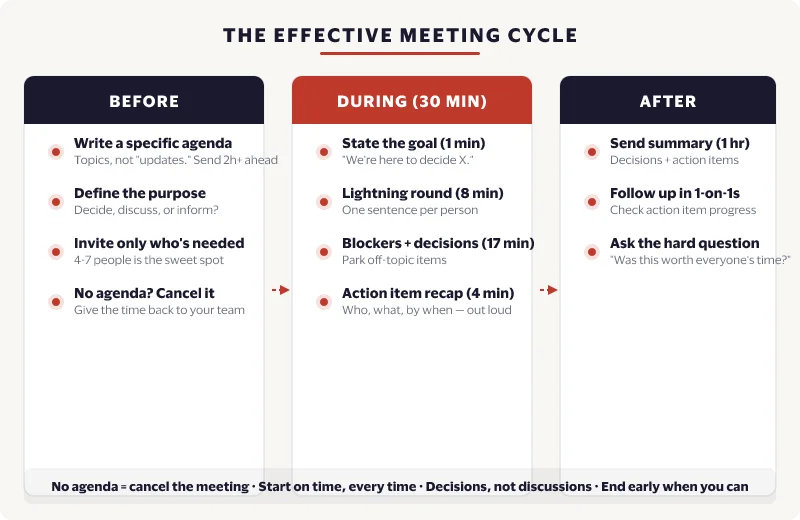
This is the meeting you’ll run most often, so let’s get it right. Here’s a structure that works in 30 minutes:
Before the Meeting (5 minutes of your time)
Write an agenda. It doesn’t need to be long. Three to five bullet points. Send it at least two hours before the meeting, ideally the night before.
A good agenda looks like this:
Monday Team Sync, April 14
- Lightning round: one sentence each on biggest priority this week (10 min)
- Blocked: the API dependency for Project Atlas (5 min)
- Decision needed: which vendor for the new tool (10 min)
- Action item review from last week (5 min)
A bad agenda looks like this:
Team Meeting
- Updates
- Discussion
- AOB
The difference? Specificity. A specific agenda tells people what to prepare and whether they need to be there. A vague agenda tells them nothing.
The no-agenda rule: If you can’t write an agenda by the morning of the meeting, cancel it. Send a message: “Nothing urgent this week, I’m giving everyone the 30 minutes back. Message me if anything comes up.” Your team will love you for it.
During the Meeting (30 minutes)
0:00: State the goal (1 minute). “Today we need to decide on the vendor and unblock the API dependency. Let’s start.”
Not “How was everyone’s weekend?” Not “Before we begin, let me share something.” One sentence. Go.
0:01: Lightning round (8 minutes). Each person shares one sentence: their #1 priority this week. Not a status report. Not a monologue. One sentence. If you have six people, this takes six minutes. Use a timer if you need to.
The lightning round isn’t about the content. It’s about visibility. It ensures everyone knows what everyone else is focused on, which prevents surprises and surfaces coordination needs.
0:09: Blockers and decisions (17 minutes). This is the meat of the meeting. Take the specific items from your agenda and work through them. For each one:
- Whoever owns the item describes the situation (2 minutes max)
- The group discusses or asks clarifying questions (3-5 minutes)
- You make a decision or assign a next step
If a discussion starts going deep and involves only two or three people, park it: “This is important, but it’s a conversation between you and Alex. Can you two sort it out after this meeting and report back?”
This is the skill that separates good meeting leaders from bad ones: knowing when a topic belongs in the room and when it belongs in a sidebar.
0:26: Action item recap (4 minutes). Before anyone leaves, read out the decisions and action items: “Alex is following up with the vendor by Wednesday. Sam is scheduling the API discussion with the backend team. Jordan, you’ll send the draft proposal by Thursday. Did I miss anything?”
This step takes two minutes and saves you hours of “Wait, I thought you were doing that?” conversations later.
After the Meeting (5 minutes of your time)
Send a summary within one hour. Not a transcript. A summary. Three sections:
- Decisions made: what was decided and why
- Action items: who is doing what by when
- Parked items: topics we’ll revisit next time
Send this in whatever channel your team uses: Slack, email, a shared doc. It doesn’t matter where, as long as everyone can find it later.
Follow up on action items. In your one-on-ones during the week, check in: “You were going to send the draft by Thursday. How’s that going?” This closes the loop. Without follow-up, action items from meetings die silently.
The Seven Rules of Meetings That Actually Work
After watching dozens of team meetings, good ones and painful ones, here are the patterns that separate the two:
Rule 1: Start on time, every time
If the meeting is at 10:00, start talking at 10:00. Not 10:03 when everyone has trickled in. Not 10:05 after small talk.
This feels rude the first time. It’s not. It’s respectful to the people who showed up on time. After two weeks of starting without them, the late arrivals will start arriving on time.
Rule 2: The right people, not all the people
Every person in the meeting should be able to answer: “Why am I here?” If they can’t, they shouldn’t be.
Amazon famously uses the two-pizza rule, if you can’t feed the attendees with two pizzas, the group is too large. For most team meetings, 4-7 people is the sweet spot. Above that, people start hiding.
If someone doesn’t need to be in the meeting but needs to know what happened, that’s what the summary is for.
Rule 3: Decisions, not discussions
A meeting that ends with “Let’s think about it more” has failed. Every meeting should produce at least one decision, even if the decision is “We need more data, and Alex will gather it by Friday.”
Before a discussion starts, clarify: “Are we deciding this today, or are we gathering input?” If you’re gathering input, set a deadline for when the decision will happen.
Rule 4: One conversation at a time
No side conversations. No Slack threads during the meeting. When someone is talking, everyone listens.
This is especially important in hybrid meetings, where the people on video tend to have side chats while the people in the room are talking. If you’re running hybrid meetings, make this an explicit rule.
Rule 5: The parking lot is real
When someone raises something off-topic, don’t ignore it, that feels dismissive. Instead: “Great point. That’s not on today’s agenda, but I’m adding it to the parking lot. We’ll either cover it next week or handle it async.”
Keep a visible list. Actually follow up. The parking lot only works if people trust that parked items don’t disappear.
Rule 6: End early when you can
If you’re done in 22 minutes, stop. Don’t fill the remaining 8 minutes with padding. Say: “We covered everything. Eight minutes back. See you next week.”
Ending early is a gift. It builds goodwill and signals that you respect people’s time. It also trains your team to be efficient. They’ll realize that focused meetings get rewarded with free time.
Rule 7: Cancel meetings that don’t need to happen
This is the hardest one. As a new manager, canceling a meeting feels like admitting you don’t have enough to discuss. It’s actually the opposite. It shows you’re thoughtful about how your team spends its time.
If you find yourself canceling the meeting more than half the time, change the cadence. Switch from weekly to biweekly. Not every team needs a meeting every week.
How to Handle Common Meeting Problems
”One person always dominates the discussion”
This is your job to manage. Techniques:
- Direct calls: “Alex, you’ve given us a lot to think about. Sam, what’s your take?” Name the quiet people. Don’t let them hide.
- Round-robin for important decisions: “Before we decide, I want to hear from everyone. Let’s go around.” This forces participation.
- Pre-meeting input: For big decisions, ask people to write their thoughts before the meeting. This helps introverts who need time to think, and it prevents the first speaker from anchoring the conversation.
”Nobody says anything”
Usually one of three problems:
- The team doesn’t feel safe to speak up → work on building trust outside of meetings
- The topics aren’t relevant to them → fix the attendee list or the agenda
- They’re used to a manager who didn’t actually want input → explicitly ask and visibly act on what they say
The fix for all three is the same: ask specific questions to specific people. Not “Any thoughts?” (silence). Instead: “Jordan, you’ve worked on something similar before. What do you think we’re missing?"
"Meetings always run over time”
You’re trying to cover too much. Cut the agenda. Move discussions to async. And enforce time limits per topic: “We have five minutes on this. If we need more time, we’ll schedule a separate session.”
The first time you cut a conversation short, it feels awkward. The tenth time, your team will thank you for it.
”People keep checking their phones”
This is a symptom, not the problem. People check phones when they’re bored, and they’re bored because the meeting isn’t relevant to them or isn’t well-structured.
Fix the relevance and the structure first. If someone is still on their phone after that, address it privately in a one-on-one: “I noticed you’ve been disengaged in team meetings. Is there something we should change?"
"Remote and hybrid meetings feel chaotic”
Hybrid is the hardest format. The people in the room naturally dominate while the remote folks struggle to jump in. Some rules that help:
- Everyone on camera, always. Even if some people are in the same room.
- Chat is part of the meeting. Encourage remote attendees to type comments or reactions so they don’t have to fight for airtime.
- Name people to speak. Don’t ask “Any questions from the remote team?” That puts the burden on them. Instead: “Jordan, you’re on video. What do you think?”
- Rotate who leads. Let remote team members facilitate some meetings. This shifts the power dynamic.
If you’re managing a fully remote team, read our guide on remote one-on-one meetings, many of the same principles apply to team meetings. And if the meetings are chaotic because the team keeps rediscovering things in them that should have been written down weeks ago, the problem is upstream: our guide to managing remote teams covers why context stops traveling once the corridor disappears.
The Meeting You Inherited
Almost nothing above applies cleanly to the situation most new managers are actually in, which is that you did not design any of these meetings. You inherited a calendar. Somebody set that Monday invite up two years ago, that person has left, and nobody remembers what problem it was solving.
The instinct is to cancel it in week one. Resist that for a couple of weeks, for the same reason you hold off on other early changes: a meeting that looks pointless from the outside is sometimes doing invisible work. It may be the only time two functions talk to each other. It may be where one quiet person raises things they will not put in writing. Cancel it and you find out what it was for by watching what breaks, which is an expensive way to learn.
Run this instead, and it takes one cycle:
- Attend twice without changing anything. Watch who speaks, who never does, and what actually gets decided rather than discussed.
- Ask three people separately, not in the meeting: “What would you lose if this meeting disappeared?” The answers tend to be short and unanimous in one direction or the other, and they are more honest one to one.
- Then act on what you heard. Kill it, halve it, change who attends, or keep it and give it a stated purpose it never had.
Whatever you decide, say why out loud. “I’m cancelling Monday’s meeting because everything in it is already in the tracker, and I’d rather give you the hour back” takes ten seconds and prevents the interpretation that the new manager is cancelling things to look decisive. This is also the cheapest early credibility you will ever buy, because giving people an hour back is the rare change that requires nothing from them.
Name who decides, before you need to
One thing worth fixing in any meeting you take over, inherited or not: most stalled meetings are not stalled on information, they are stalled because nobody established who has the call.
Say it at the point the discussion starts, not after it has gone twenty minutes: “This one is mine to decide and I want your input first,” or “This one is Priya’s call, we’re here to give her what she needs,” or, occasionally, “We’re deciding this together and we’re not leaving without an answer.” All three are legitimate. Leaving it unstated is what produces the meeting that ends with everyone agreeing to think about it.
The version to avoid is the fake consensus, where you have already decided and you run a discussion anyway to make people feel consulted. Teams identify this quickly, and it costs more trust than simply announcing the decision would have.
The Meeting Audit: Fix What You’ve Got
Before you redesign your entire meeting calendar, audit what exists. Here’s a quick framework you can do in 15 minutes:
| Meeting | Purpose | Frequency | Duration | Who attends | Still needed? |
|---|---|---|---|---|---|
| Monday team sync | Status updates | Weekly | 60 min | Whole team (8 people) | Yes, but needs restructuring |
| Sprint planning | Plan next sprint | Biweekly | 90 min | Whole team | Yes |
| ”Quick sync” with Alex | Unclear | Weekly | 30 min | Just you and Alex | Merge into 1-on-1 |
| Friday wrap-up | ”What we did this week” | Weekly | 30 min | Whole team | Probably not, replace with async update |
For each meeting, ask:
- What decision or outcome does this meeting produce?
- Could we accomplish the same thing async (Slack, email, shared doc)?
- Does everyone who attends need to be there?
- Is the frequency right, or could we do this biweekly?
If you’re spending too much time in meetings, this audit is the fastest way to reclaim hours every week. Most new managers who do this find that they can cut 20-30% of their meeting load without losing anything.
Your Meeting Leader Cheat Sheet
Here’s a quick reference for your first few weeks of running better meetings:
Before:
- Write a specific agenda (not “updates,” actual topics)
- Send it 2+ hours ahead
- Decide: are we deciding, discussing, or informing?
- Invite only who needs to be there
During:
- Start on time. State the goal in one sentence
- One conversation at a time. Park off-topic items
- Call on quiet people by name. Manage the loud ones
- End with: decisions made, action items, owners, deadlines
After:
- Send written summary within 1 hour
- Follow up on action items in 1-on-1s
- Ask yourself: “Was this meeting worth everyone’s time?”
Start This Week
You don’t need to overhaul everything at once. Here’s what to do for your next team meeting:
- Write a real agenda with 3-5 specific items. Send it tonight.
- Start on time. Literally look at the clock and start talking at the scheduled minute.
- End with a recap: decisions and action items, read out loud.
- Send the summary within an hour.
That’s it. Four changes. They’ll transform the meeting.
Once the structure works, you can add texture: a five-minute opener goes a long way toward making Monday’s meeting feel human. There is a whole section of quick, no-budget openers in the catalog of 50 team building activities that don’t make people cringe.
And here’s the thing that took me a while to learn: your team’s opinion of your meetings is your team’s opinion of your leadership. A well-run meeting signals clarity, respect for their time, and competence. A chaotic one signals the opposite. Every Monday at 10 AM is an audition. Make it count.