Your first 90 days as a manager is the most observed, most judged, and most consequential stretch of your career. Most people know this instinctively. Almost nobody plans for it.
If you get these first 90 days right, you coast through year one on momentum. If you get them wrong, you spend the next 18 months digging out of a hole you created in weeks. And the mistakes are almost always the same ones: acting too fast to prove competence, skipping the relationships, building strategy before you understand the context, and letting your boss fill in the gaps with their own assumptions.
Research from Michael Watkins, who spent 20 years studying leadership transitions at Harvard Business School, found that nearly half of all executive transitions end in failure or disappointment within 18 months. The #1 driver is not capability. It is the transition itself. The skills that got you promoted are not the same skills that will make the transition work.
Here are the five books that actually prepare you for this specific moment. Every one of them is written for the transition, not for management in general. Every one gives you a framework you can apply this week.
What made the cut: Every book on this list (1) is specifically about transitions into a new role, not general management, (2) gives you a concrete framework you can use in the first 30 days, (3) is backed by research or decades of practice, and (4) is under 320 pages because you do not have time to read a textbook right now.
1. The First 90 Days, by Michael D. Watkins
The definitive book on leadership transitions. If you read one book about your first 90 days, this is it.
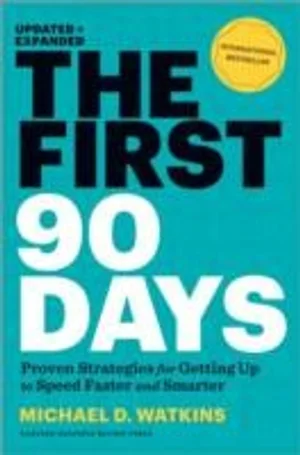
- Author: Michael D. Watkins (Harvard Business School, IMD)
- Published: 2013 (Updated and Expanded Edition) | Pages: 304
- Rating: 4.5/5 (15,000+ ratings)
- View on Amazon
This is the book that defined the category. Watkins coined the term “transition” as a discipline worth studying, and his framework is so widely adopted that most Fortune 500 companies now run their own version of it internally. If you do nothing else in your first week, buy this and read the first three chapters.
Why it made the list
The book answers the question every new manager is silently asking: “What do I actually do first?” Watkins gives you a 10-task framework, but the real value is the diagnostic. Before you act, he walks you through a matrix of transition types (STARS: Startup, Turnaround, Accelerated growth, Realignment, Sustaining success). Your strategy in a turnaround is the opposite of your strategy in a sustaining-success situation. Most new managers apply the same generic playbook to every situation and get burned.
The “breakeven point” concept alone is worth the price. Watkins argues that every new leader starts in a value deficit (they cost more than they produce) and the goal of the first 90 days is to cross the line into net value creation. That framing changes how you prioritize. You stop trying to do everything. You start asking: what is the single action that moves me across the breakeven line?
The book is also honest about political reality. Watkins dedicates full chapters to securing early wins, negotiating with your new boss, and building strategic relationships across the organization. Most first-time managers underinvest in these and wonder why their good work does not translate into credibility. Our guide on your first 90 days action plan is directly built on the Watkins framework.
Best for you if…
You are in your first 30 days of a new management role and you need a structured framework, not more abstract advice. You want to know what to do Monday morning, not just what to believe in general. This book gives you a concrete playbook for the specific situation you are in.
Key takeaway: “The actions you take during your first three months in a new job will largely determine whether you succeed or fail. Transitions are periods of opportunity, a chance to start afresh and make needed changes. But they are also periods of acute vulnerability.”
2. From Bud to Boss, by Kevin Eikenberry & Guy Harris
The best book for anyone promoted into managing their former peers.

- Authors: Kevin Eikenberry, Guy Harris
- Published: 2011 | Pages: 304
- Rating: 4.4/5 (600+ ratings)
- View on Amazon
Internal promotion is the most emotionally complex transition in management. Yesterday you were grabbing lunch with the team. Today you decide their performance reviews. Eikenberry and Harris wrote the definitive book on this specific scenario, and if that is your situation, no other book on this list will help you more.
Why it made the list
The book is structured around a core tension: you have to build credibility as a manager without destroying the trust you built as a peer. Most advice about this is shallow (“be firm but fair”). Eikenberry and Harris go deeper. They walk you through the specific early conversations you need to have with each person on the team, the moments when old social patterns will pull you back into peer territory, and the practical ways to reset expectations without being condescending.
The “six challenges” framework is the most useful part of the book: Challenge 1 is shifting from doing to delegating; Challenge 2 is shifting from team member to team leader; Challenge 3 is building credibility without over-asserting authority; Challenge 4 is dealing with former peers who become difficult; Challenge 5 is managing your own transition as a person; Challenge 6 is developing leadership habits. Each challenge comes with diagnostic questions and specific actions.
What I appreciate most: the authors are honest about the emotional cost. They name the loneliness, the second-guessing, the awkward moments at Friday happy hour. Most books pretend the transition is purely intellectual. This one admits it is also personal. Our article on yesterday colleague, today boss, now what builds on similar ground.
Best for you if…
You were promoted from within. Your team includes people who used to be your peers, mentors, or friends. You are trying to figure out how to become their boss without losing who you are or who they are to you. This is the book that was written for exactly this situation.
Key takeaway: “You are not the same person you were a week ago. The faster you accept that, the faster your team will accept it with you. Until you shift, they cannot.”
3. You’re in Charge, Now What?, by Thomas Neff & James Citrin
The most structured 8-task framework for taking charge of any new role, at any level.

- Authors: Thomas J. Neff, James M. Citrin
- Published: 2006 | Pages: 304
- Rating: 4.3/5 (400+ ratings)
- View on Amazon
Neff and Citrin ran the CEO search practice at Spencer Stuart for decades, which means they have interviewed and placed hundreds of executives into new roles. This book is the distilled pattern they saw in every successful transition (and every failed one). It is written for executives, but the eight-task framework works at any level.
Why it made the list
The eight tasks are deceptively simple: (1) Prepare yourself during countdown, (2) Align expectations, (3) Shape management team, (4) Craft strategic agenda, (5) Start transforming culture, (6) Manage your board, (7) Communicate, (8) Avoid common pitfalls. What makes them powerful is the order. Most new managers skip to task 4 or 5 and wonder why nothing sticks. Neff and Citrin show why the sequence matters.
Task 2 (“align expectations”) is where most of the book’s real value sits. Neff and Citrin walk you through the explicit conversations to have with your boss, your peers, and your direct reports in the first 30 days. They provide actual question banks and sample dialogue. If you have ever wondered “what are we even supposed to talk about in my first 1-on-1 with my new boss,” this book answers that.
The “common pitfalls” chapter should be read twice. They identify 10 specific mistakes that derail otherwise competent leaders: moving too fast, trying to fix everything, relying on your old network, confusing motion for progress, etc. Each comes with a real executive case study of someone who made the mistake and what it cost them. The pattern recognition value is enormous. This aligns closely with our new manager checklist for your first week.
Best for you if…
You are about to step into a role that is larger or more complex than anything you have done before. You want a structured, sequential checklist more than you want philosophy. You think in terms of frameworks, not narratives. This book delivers both, but the framework is the core value.
Key takeaway: “The biggest mistake new leaders make is thinking the job is about the strategy. The job is about the people who will execute the strategy. If you win the people in the first 90 days, strategy becomes possible. If you do not, no strategy will save you.”
4. The New Manager’s 100-Day Action Plan, by George Bradt, Jayme Check & Jorge Pedraza
The most practical, week-by-week playbook. Read this if you want a literal checklist to work through.

- Authors: George Bradt, Jayme Check, Jorge Pedraza
- Published: 2016 (Revised 4th Edition) | Pages: 320
- Rating: 4.3/5 (500+ ratings)
- View on Amazon
If Watkins is the theory, Bradt is the workbook. The authors have coached over 400 executives through transitions, and this book distills the actual checklists, templates, and meeting agendas they give their clients. It is not a beautiful book. It is a useful one.
Why it made the list
The book is organized around the “Total Onboarding Program” model: Fuzzy Front End (before day 1), Day 1 through Day 30, Day 31 through Day 70, Day 71 through Day 100. For each phase, you get specific actions, checklists, and templates. The Day 1 chapter alone includes a 30-item checklist of things to say, people to meet, and questions to ask. Whether or not you follow it exactly, it forces you to think about things you would otherwise forget.
The “5 Cs of context” framework (Customers, Collaborators, Capabilities, Competitors, Conditions) is one of the cleanest diagnostic tools I have seen for understanding a new organization. In your first two weeks, if you can give clear answers to all 5 Cs, you know you are absorbing the right things. If you cannot, you know what questions to ask.
What makes this book different from the others on the list is the focus on alignment. Bradt argues that most transitions fail because the leader aligns well with their direct reports and their boss but misses the peer group, and that misalignment surfaces three months later as political damage you cannot repair. The chapter on stakeholder mapping is worth the price alone. Our guide on how to introduce yourself as a new manager uses a similar stakeholder-first approach.
Best for you if…
You want a literal checklist, not a philosophy. You are time-constrained and need to start moving this week. You prefer a template you can customize over a principle you have to apply. This is the book you want on your desk, not on your bookshelf.
Key takeaway: “Leaders who treat onboarding as something that happens to them have worse outcomes than leaders who treat it as a project they run. You are the project manager of your own transition. Act like it.”
5. Act Like a Leader, Think Like a Leader, by Herminia Ibarra
The best book for understanding that becoming a manager is an identity shift, not just a skills shift.

- Author: Herminia Ibarra (London Business School, INSEAD)
- Published: 2015 | Pages: 224
- Rating: 4.4/5 (1,500+ ratings)
- View on Amazon
Ibarra is one of the few academics who studies leadership identity, not just leadership behavior. This book is her 20-year synthesis, and it tackles the question that every other book on this list dances around: what does it actually feel like to become a manager, and why does it feel so uncomfortable at first?
Why it made the list
Ibarra’s core thesis is counterintuitive: you do not think your way into a new leadership role, you act your way in. Most people (especially introverts and people promoted for technical skill) believe they need to feel ready, understand the role, and develop a clear self-concept before they can lead. Ibarra’s research shows the opposite. Identity follows behavior. You become a leader by doing leader things, even when they feel awkward or inauthentic.
The “outsight” concept is a quiet revolution for most readers. Ibarra argues that we rely too much on “insight” (thinking, reflecting, understanding ourselves) when making leadership transitions. What actually drives the shift is outsight: new experiences, new relationships, new projects, new behaviors. If you are stuck trying to feel like a manager before you act like one, you will stay stuck. If you start acting like one, your identity catches up within 60 to 90 days.
The chapter on networking is the most practical in the book. Ibarra shows that new managers consistently under-invest in “strategic” relationships (people across the organization, people above them, people outside the team) because those relationships feel less authentic than the operational ones. But those are exactly the relationships that determine whether you can get anything done. The imposter syndrome chapter is also essential. It reframes the uncomfortable feelings of the first 90 days as evidence that growth is happening, not evidence that you are failing. This pairs well with our guide on imposter syndrome for new managers.
Best for you if…
You have read other transition books and the tactical advice has not landed. The real question you are wrestling with is not “what do I do?” but “who am I supposed to be now?” This book goes where the others do not. It works on the identity layer, which is where most real transitions actually happen.
Key takeaway: “Acting like a leader before you feel like one is not fakery. It is the only known mechanism for becoming one.”
Quick Comparison
| Book | Best For | Core Framework | Pages | Rating |
|---|---|---|---|---|
| The First 90 Days | The definitive framework | STARS Model + 10 Tasks | 304 | 4.5★ |
| From Bud to Boss | Promoted from within | 6 Challenges | 304 | 4.4★ |
| You’re in Charge, Now What? | Structured 8-task plan | 8 Tasks in sequence | 304 | 4.3★ |
| The New Manager’s 100-Day Action Plan | Literal weekly checklist | 5 Cs + 100-Day phases | 320 | 4.3★ |
| Act Like a Leader, Think Like a Leader | Identity transition | Outsight + Experimentation | 224 | 4.4★ |
Which One Should You Read First?
If I had to pick one, it would be The First 90 Days by Watkins. Full stop. It is the category-defining book for a reason, and every other book on this list is in conversation with it. You will reference the STARS framework for the rest of your career.
But here is the honest version: it depends on where you are stuck.
- Just got the job and do not know where to start? Start with The First 90 Days. The STARS diagnostic will change what you prioritize in week one.
- Managing your former peers? Start with From Bud to Boss. Nothing else on this list speaks directly to that situation.
- Want a literal week-by-week checklist? Start with The New Manager’s 100-Day Action Plan. Open it on day one and work through it.
- Moving into a bigger role and want a sequenced plan? Start with You’re in Charge, Now What? The 8-task order is the value.
- Struggling with whether you actually belong in the role? Start with Act Like a Leader. It addresses the identity shift the others assume you have already made.
And if you want a ready-to-use 13-week playbook with worksheets, 1-on-1 templates, early-wins planners, and a structured 30/60/90 review framework, take a look at our First 90 Days Playbook. It is the practical companion to the frameworks in these five books, designed to be worked through week by week while you are in the role.
Beyond Books: The Transition Is the Teacher
Reading about your first 90 days while you are in them is like reading about skiing while you are on the slope. Useful, but only if you are willing to fall down.
Research from DDI tracking thousands of leadership transitions found that the number one predictor of a successful first 90 days was not intelligence, experience, or even preparation. It was the ability to listen deliberately and adjust quickly. The managers who succeeded did not come in with the best plan. They came in with the best questions and updated their plan weekly based on what they learned.
Three things that actually move the needle, independent of any book:
-
Ask the five questions, weekly. What is going well? What is not? What should I start doing? What should I stop doing? What should I be doing differently? Ask these to your boss, your team, and yourself every Friday. The compounding effect over 12 weeks is enormous. Our article on first 90 days action plan builds this into a weekly rhythm.
-
Find one early win, visibly. The biggest predictor of credibility at day 60 is whether you delivered one concrete, visible improvement in the first 45 days. Not five things. One. Ship it, name it, and make sure your boss knows about it.
-
Take the self-assessment. Most new managers do not know they are drifting until it is too late to easily course-correct. Our free Are You Winning Your First 90 Days? quiz walks you through 15 scenarios across the five dimensions that matter most. Run it at day 30 and day 60. The delta tells you whether the compounding is positive or negative.
Your first 90 days will be the most disoriented, self-critical, and quietly exhilarating stretch of your career. That is the job. The goal is not to feel ready. The goal is to act deliberately enough that you earn the right to still be here in month four. These five books will give you the frameworks, but the work is yours.
Good luck. And remember: the fact that you are reading about this at all means you are already further ahead than most managers ever get.
If your reading shelf needs to extend past the first 90 days into the full year-one identity shift, our top 5 books for first-time managers is the canonical broader list — the five books that cover the whole transition (identity, trust, feedback, decisions), not just the entry sprint. The two lists pair well: this one for the first 90 days, that one for the months that follow.