Your first week as a manager sets the tone for everything that follows. Get it right, and you build momentum that carries you through the hard months ahead. Get it wrong, and you spend months digging out of a hole. HBR’s advice for new managers underscores just how much these early days shape long-term outcomes.
The problem? Nobody tells you what “get it right” actually looks like. Your first day as manager — what to do, who to talk to, what to prioritize — is a blur of back-to-back meetings, awkward introductions, and a growing sense that you should be doing something but you’re not sure what. (If the introductions part is what’s stressing you out, we have a full guide on how to introduce yourself as a new manager with ready-to-use scripts.) If you’re looking for the big picture first, start with our first-time manager’s complete guide and then come back here for the day-by-day breakdown.
This checklist fixes that. Think of it as your new manager onboarding process — fifteen concrete actions, organized by day. Print it out, tape it to your monitor, and check them off one by one.
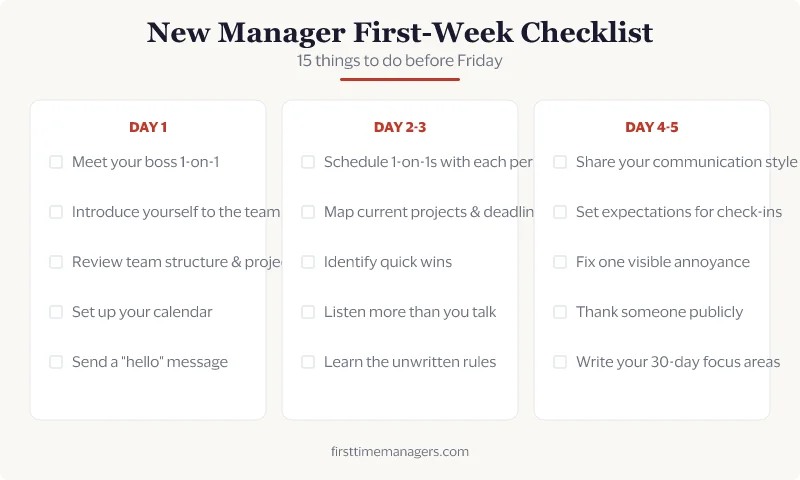
Monday: Orient Yourself
1. Meet with your boss first thing
Before anything else, get aligned with the person who put you in this role.
Ask:
- “What are the top 3 things you want me to focus on in the first 30 days?”
- “What does success look like for me at 90 days?”
- “What should I know about the team that isn’t obvious?”
- “How do you prefer to communicate? How often do you want updates?”
- “Is there anything urgent I need to handle immediately?”
Write down the answers. You’ll refer back to them constantly.
2. Get access to everything
Sounds basic, but nothing kills momentum like not being able to log in.
- Email groups and distribution lists
- Project management tools (Jira, Asana, Trello, etc.)
- Communication channels (Slack, Teams — including private team channels)
- Shared drives and documentation
- HR systems (if you need to approve time off, expenses, etc.)
- Calendar access for your direct reports (optional but useful)
Make a list of what you need. Ask your boss or IT to set it up today.
3. Review the landscape
Before you talk to anyone on the team, spend an hour getting the lay of the land:
- Read the team’s current goals and OKRs
- Look at active projects and their status
- Check the team calendar — what meetings exist? What’s the rhythm?
- Review any recent team communications (emails, Slack history)
- Look at the org chart — who does your team work with?
You’re not trying to master everything. You’re building context so your conversations this week are informed, not clueless.
Tuesday: Connect with Your Team
4. Send a brief introduction message
Meeting your new team for the first time — whether in person or via message — is a moment that matters. If you haven’t already, send a short message to your team. Keep it warm, honest, and low-pressure.
“Hi everyone — I’m excited to be joining the team as your manager. I know transitions can feel uncertain, and I want to be upfront: my first priority is to listen, learn, and understand how things work before making any changes.
I’ll be scheduling 1-on-1s with each of you this week. These aren’t performance conversations — I just want to get to know you, hear what’s going well, and learn what I can help with.
My door (or DMs) is always open. Looking forward to working with you.”
5. Schedule 1-on-1s with every direct report
This week. All of them. Non-negotiable.
Block 30 minutes each. If you have more than 6-7 reports, start today and finish by Thursday. These are the most important meetings of your entire first week.
6. Start having 1-on-1s
Use this script for your first round:
Opening:
“Thanks for meeting with me. I’m here to listen — I want to understand the team, the work, and how I can be useful to you.”
Questions to ask:
- “What are you working on right now, and how’s it going?”
- “What’s the best thing about working on this team?”
- “What’s the most frustrating part?”
- “What should I absolutely not change?”
- “How do you prefer to receive feedback — direct, in writing, in the moment?”
- “Is there anything you wish your previous manager had done differently?”
- “What’s one thing I can do for you right now?”
Take notes. Patterns will emerge across conversations. Those patterns are your roadmap.
Wednesday: Understand the Work
7. Map the team’s current projects
Create a simple document — even a spreadsheet works:
| Project | Owner | Status | Deadline | Risks / Blockers |
|---|---|---|---|---|
Fill this in from your 1-on-1s and project tools. You need to know what’s in flight, who’s responsible, and where things might go sideways.
8. Identify the key stakeholders
Your team doesn’t work in isolation. Who are the people outside your team that matter most?
- Other team leads your team collaborates with
- Key clients or customers
- Senior leadership who cares about your team’s output
- Shared service teams (design, QA, legal, finance)
Make a list and plan to introduce yourself to the top 3-5 this week or next. A simple email or 15-minute coffee works:
“Hi, I’m [name], the new manager of [team]. I’d love to grab 15 minutes to understand how our teams work together and how I can support that.”
9. Attend existing team meetings as an observer
If there’s a standup, a sprint review, or a weekly sync — attend but don’t run it yet. Watch the dynamics:
- Who talks? Who stays quiet?
- Is the meeting productive or performative?
- How does the team interact? Is there energy or fatigue?
- What topics come up repeatedly?
Understanding team dynamics quickly is one of your biggest advantages in week one — patterns you spot now will inform every decision you make in the months ahead. Google’s research on developing great managers found that the best managers invest early in understanding how their teams actually function.
Take mental notes. Don’t make changes to meetings in week one.
Thursday: Start Building Habits
10. Set up your recurring 1-on-1s
You’ve had introductory 1-on-1s. Now schedule the ongoing ones.
- Weekly, 30 minutes, same time each week
- Ask each person: “What day and time works best for you?”
- Put them in the calendar as recurring events
- Mark them as non-negotiable in your mind
This is the single highest-ROI management habit. Start it in week one and never stop.
11. Create your management system
You need a lightweight system to track what matters. Nothing fancy — just something that prevents things from falling through the cracks.
At minimum, set up:
- A notes doc per team member — for 1-on-1 topics, feedback observations, career goals
- A running to-do list — things you committed to doing for your team
- A “things I’ve noticed” doc — observations, patterns, ideas. Don’t act on them yet, just capture them.
A notebook, a Google Doc, or a Notion page — the format doesn’t matter. The habit matters.
12. Block focus time on your calendar
Your calendar is about to fill up with meetings. Protect at least 3-4 hours per week of uninterrupted thinking time. You’ll need it for:
- Preparing for 1-on-1s
- Reflecting on what you’re learning
- Planning ahead instead of just reacting
- Reading and responding to things that need thought, not speed
If you don’t block it now, it’ll never appear on its own.
Friday: Reflect and Plan
13. Review your notes from the week
Set aside 30 minutes on Friday afternoon to review everything you’ve heard and observed.
Look for patterns:
- What did multiple people mention as a frustration?
- What did multiple people say is working well?
- Where are the biggest risks in current projects?
- Who seems engaged? Who seems checked out?
- What surprised you?
Write a brief summary for yourself: “Here’s what I learned this week.” You’ll be glad you did this when you look back in 30 days.
14. Send a week-one update to your boss
Keep it short — 5-10 bullet points:
- What you did this week (1-on-1s completed, stakeholders met, etc.)
- What you’ve learned so far (top-level observations)
- Any immediate concerns or risks
- Your plan for next week
This does two things: it keeps your boss informed (managing up), and it forces you to organize your own thinking.
15. Take a breath
You survived your first week. That’s not nothing.
The temptation is to work through the weekend, catching up on everything you didn’t get to. Don’t. You need to recharge.
Before you log off:
- Write down the three things you want to accomplish next week
- Close the laptop
- Do something that’s not work
The Week-One Cheat Sheet
| Day | Focus | Key Actions |
|---|---|---|
| Monday | Orient | Boss meeting, get access, review landscape |
| Tuesday | Connect | Intro message, schedule & start 1-on-1s |
| Wednesday | Understand | Map projects, identify stakeholders, observe meetings |
| Thursday | Build habits | Set up recurring 1-on-1s, create management system, block focus time |
| Friday | Reflect | Review notes, update boss, plan next week |
What Comes Next
Your first week builds the foundation. Your second week deepens it. By week three, you’ll start seeing opportunities. By week four, you’ll make your first moves. For a complete week-by-week roadmap through month three, continue with our first 90 days as a manager action plan.
But all of that rests on what happens this week: the conversations you have, the trust you begin building, and the habits you establish.
You don’t need to have all the answers this week. You just need to ask the right questions and actually listen to the answers. Everything else follows from there.
Week one done — now what? The First 90 Days Playbook picks up right where this checklist ends. It’s an editable, week-by-week workbook that takes you through all 12 weeks — with checkboxes, reflection prompts, and quick-reference cards you can keep on your desk. Get the Playbook →