You’ve got the title. You’ve got the calendar invite. Now you need to stand in front of your team — or sit across from each person one by one — and say something that makes them think: “Okay, this might actually be fine.”
No pressure.
Here’s the truth: most new managers overthink their introduction or barely think about it at all. They either deliver a corporate monologue that nobody remembers, or they wing it and say something they regret by lunch. Neither works.
Your introduction isn’t a speech. It’s a signal. It tells your team who you are, what you value, and — most importantly — whether they can trust you. Research from the Center for Creative Leadership found that 60% of first-time managers never received any training for the role. That means your team already expects you to stumble. A good introduction doesn’t prove you have all the answers — it shows you’re taking this seriously.
Here’s how to introduce yourself in every situation you’ll face in your first week.
Before you say a word
Don’t walk into your first meeting cold. Spend 15 minutes answering three questions for yourself:
1. What do I want them to know about me? Not your resume. Pick two or three things about how you work: “I value honesty over politeness.” “I’d rather hear bad news early than late.” “I’m a listener first, talker second.”
2. What do I want to know about them? You’ll learn more by asking than by talking. Prepare two or three genuine questions you’ll ask each person.
3. What am I NOT going to promise? This is the most important one. New managers tend to over-promise in their first week because they want to be liked. “I’m going to fix everything” or “Nothing will change” — both are lies. Know your boundaries before you open your mouth.
Write these down. Not to read from — to anchor yourself when nerves take over.
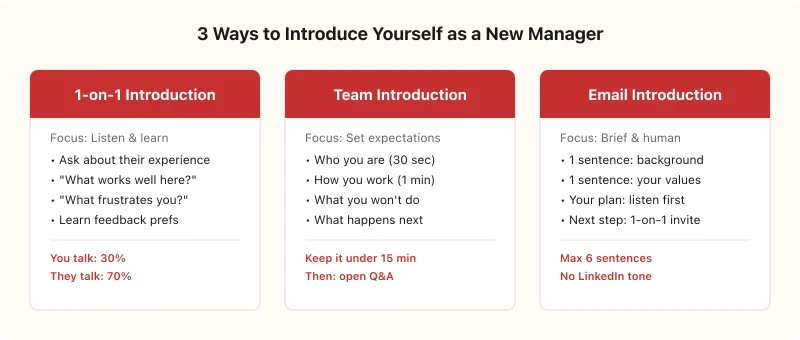
The 1-on-1 introduction
Your first 1-on-1 with each team member is the highest-leverage conversation of your first week. Research from INSEAD involving 7,000 employees found that structured one-on-one conversations are one of the most effective ways to build psychological safety from day one.
This isn’t a status update. It’s not an interview. It’s a conversation where you’re mostly listening.
A script that works:
“Hey [name], I wanted to take some time to introduce myself properly. I’m not here to make big changes in week one — I’m here to understand how things work and how I can support you. I’d love to hear about your role, what’s going well, and what’s frustrating. But first — is there anything you want to ask me?”
Then ask these three questions:
- “What’s the one thing that works really well on this team that I should absolutely not mess with?” — This shows respect for what exists.
- “What’s one thing that frustrates you about how things work right now?” — This gives them permission to be honest early.
- “How do you prefer to get feedback — directly, in writing, in the moment, or in a 1-on-1?” — This shows you’ll adapt to them, not the other way around.
What NOT to do in your first 1-on-1:
- Don’t take your laptop. Take a notebook or nothing at all.
- Don’t talk for more than 30% of the time. This is their meeting.
- Don’t make promises you can’t keep. “I’ll look into that” is fine. “I’ll fix that” is dangerous.
- Don’t ask “So, what do you do here?” — you should already know their role. Ask about their experience, not their job description.
If you want a deeper framework for running these conversations, read our guide on how to run your first 1-on-1 meeting.
Want a system for your entire first 13 weeks — not just day one? The First 90 Days Playbook gives you an editable, week-by-week workbook with fill-in prompts, reflection exercises, and 6 quick-reference cards you can keep on your desk. Get the Playbook →
The team introduction
At some point in your first week, you’ll need to address everyone together. This might be a formal meeting or five minutes at the start of an existing standup. Either way, keep it short. Fifteen minutes maximum.
The structure:
- Who you are (30 seconds) — background, not resume
- Why you’re here (30 seconds) — what excites you about this team
- How you work (1 minute) — two or three principles
- What you’re NOT going to do (30 seconds) — set expectations
- What happens next (30 seconds) — practical next steps
- Open it up (remaining time) — questions from them
Here are three versions depending on your situation:
Version A: You were promoted from within
This is the hardest one. Yesterday you were their peer. Today you’re their boss. Acknowledge it directly — don’t pretend it’s not weird.
“So, this is a little strange. Last week I was sitting where you’re sitting. I don’t have all the answers about how this is going to work — I’m figuring it out. What I do know is that I’m not going to pretend I’m suddenly a different person. I value the same things I did before: honest conversations, doing good work, and not wasting each other’s time. The biggest thing that’s changing is that my job is now to make sure you have what you need to do great work. I’m going to set up 1-on-1s with each of you this week. No agenda — I just want to listen.”
For a deeper guide on this specific transition, read Yesterday You Were Their Colleague, Today You’re Their Boss.
Version B: You were hired from outside
You’re the unknown quantity. People are wondering if you’re going to “clean house” or “bring your own people.” Address the anxiety.
“I’m [name], and I’m excited to be here. I know that when a new manager shows up from outside, the first question is ‘what’s going to change?’ So let me be direct: I’m not here to change things in week one. I’m here to learn. I’ve managed teams before, but I haven’t managed this team — and that means my first job is to understand how you work, what’s going well, and where I can actually help. I’ll be scheduling 1-on-1s with everyone this week. Please be honest with me — I’d rather hear hard truths early than easy answers that fall apart later.”
Version C: You’re taking over a difficult situation
Maybe the last manager was fired. Maybe the team is struggling. Maybe morale is low. Don’t sugarcoat it, but don’t dwell on it either.
“I know the last few months haven’t been easy for this team. I’m not going to pretend I understand everything that happened — I don’t. What I can tell you is what I’m focused on: making sure you have clarity on priorities, making sure you feel heard, and rebuilding trust one conversation at a time. I’m not going to rush into big changes. I am going to listen. And if something needs to change, I’ll tell you why before it happens. Let’s start with 1-on-1s this week.”
Whichever version you use, the structure of your first team meeting matters just as much as what you say.
The email introduction
Sometimes you need to introduce yourself before you meet everyone — especially with remote teams, cross-functional stakeholders, or if you start mid-week and the team meeting isn’t until Monday.
Keep it short. Nobody reads long emails from someone they haven’t met yet.
If the whole team is remote and you have never met any of them, the first written note carries more weight than usual, because it arrives before any other impression of you. Our guide to taking over a remote team you have never met has a version that starts with what you will not change.
Template: To your team
Subject: Quick intro — [Your Name], your new [title]
Hi team,
I’m [name], and I’m joining as your [title] starting [date]. I wanted to introduce myself before we meet in person.
A little about me: [one sentence about background — keep it human, not a LinkedIn summary]. [One sentence about what you value as a manager — e.g., “I believe the best teams are built on honest conversations and clear expectations.”]
I’m going to spend my first couple of weeks listening and learning. I’ll be setting up 1-on-1s with each of you — no agenda, just a chance to hear your perspective on how things are going.
Looking forward to working together.
[Name]
Template: To stakeholders or cross-functional partners
Subject: Intro — [Your Name], new [title] for [team name]
Hi [name],
I’m [name], the new [title] for [team]. I understand you work closely with the team on [area], and I wanted to introduce myself.
I’m spending my first few weeks getting up to speed. I’d love to grab 20 minutes with you in the next week or two to understand how our teams work together and where I can be most useful.
Would [suggest two times] work for you?
[Name]
The upward introduction
Your relationship with your boss might be the most important one you build in your first week. McKinsey research shows that the manager relationship is the number-one factor in employee job satisfaction — and that applies to your relationship with your boss too.
If you haven’t had a proper sit-down with your manager yet, request one. Here’s what to cover:
Ask these questions:
- “What does success look like for me in the first 90 days?”
- “What’s the one thing you’d want me to prioritize?”
- “How do you prefer to communicate — Slack, email, weekly check-ins?”
- “Is there anything about the team I should know that isn’t obvious from the outside?”
Share these things:
- How you plan to spend your first two weeks (listening, 1-on-1s, learning)
- That you’ll send a brief weekly update so they’re never surprised
- One or two things about your management style
Don’t do this:
- Don’t promise deliverables in week one
- Don’t badmouth the previous manager (even if your boss does)
- Don’t ask for permission for everything — ask for priorities and then execute
For a complete framework on your first 13 weeks, check out the first 90 days action plan.
5 things to never say in your introduction
No matter who you’re talking to — your team, your boss, or stakeholders — avoid these:
1. “I’m going to change a lot of things around here.” Even if it’s true, saying it on day one guarantees resistance. People hear: “Everything you’ve been doing is wrong.”
2. “I know this is a big adjustment for everyone.” This sounds empathetic but actually makes it worse. You’re highlighting the discomfort instead of reducing it.
3. “I have an open-door policy.” Nobody believes this. Instead, show openness by asking real questions and actually listening to the answers.
4. “I used to manage a team at [impressive company], so…” Nobody cares where you came from. They care what you’ll do here. Drop the resume and talk about values.
5. “Don’t worry, nothing is going to change.” This is almost always a lie, and your team knows it. Something already changed — they have a new manager. Acknowledge reality instead of avoiding it.
The one rule that matters
Every script, template, and example above follows one principle: listen more than you talk.
Your first week isn’t about making an impression. It’s about creating space for people to tell you the truth. The managers who stumble hardest are the ones who walk in talking. The ones who earn trust fastest are the ones who walk in asking.
If you’re feeling the imposter syndrome creep in — that’s normal. You don’t need to have everything figured out. You just need to show that you care enough to listen before you act.
You’ll have plenty of time to make decisions. Week one is for building the foundation of trust that makes those decisions stick.
And if you want a structured, week-by-week guide for everything that comes after the introduction — the new manager first-week checklist is a good next step.
Your introduction is just the beginning. The First 90 Days Playbook picks up right where your first week ends — with an editable, week-by-week workbook, checkboxes, fill-in prompts, reflection exercises, and 6 quick-reference cards. Everything you need to go from “new manager” to “confident leader” in 13 weeks. Get the Playbook →