One day you’re grabbing coffee with your teammates, complaining about the same deadlines, sharing the same frustrations. The next day, you’re the person they’re complaining about.
Nobody warns you how lonely that shift feels.
The promotion email goes out. People congratulate you. Some genuinely, some with a thin smile that says “Why you and not me?” You sit at the same desk, in the same office, with the same people, but everything is different. The group chat feels off-limits. Lunch conversations get quieter when you walk up. Someone makes a joke about you being “management” now, and you laugh, but it stings a little.
This is the hardest transition in management. Not because the work is complicated, but because the relationships are. Being promoted to manager over friends introduces a set of first-time supervisor challenges that no amount of technical skill prepares you for. It is one specific opening variant of a larger shift, and if you want the whole picture, the first-time manager’s complete guide covers the skills underneath it and the order to learn them in. This article stays on the part that makes internal promotion its own problem: the people already knew you.
I went through it. Most promoted-from-within managers do. As Harvard Business Review’s guide to managing former peers makes clear, this awkwardness is universal, and navigable. Here’s what I learned about surviving it with your sanity, your relationships, and your authority intact.
The First Week: What’s Actually Happening
Let’s name what’s going on beneath the surface, because understanding it makes everything easier.
For you:
- Identity crisis. You’re not sure who you are anymore: contributor or leader?
- Guilt. Especially if you were promoted over someone who wanted the role.
- Fear. What if you’re not good enough? What if people resent you?
- Loss. You’re grieving the simplicity of your old role and your old relationships.
For your team:
- Uncertainty. Will you change? Will you treat them differently? Will you be fair?
- Testing. They’re watching every move, every decision, every conversation for signals.
- Jealousy (maybe). If someone else wanted the role, they’re processing disappointment.
- Hope (maybe). Some people are genuinely excited. They trust you and believe things will improve.
All of this is normal. All of it is happening simultaneously. And none of it gets talked about openly, which is exactly why you need to address it.
The Conversation You Need to Have
Within your first week, have an honest conversation with your team. Not a “here’s my vision” speech. A human conversation. (Need scripts? See our guide on how to introduce yourself as a new manager, with examples for the promoted-from-within situation.) This is how you start earning respect as new boss, not through declarations, but through vulnerability. Research on HBR’s advice for new managers navigating unfamiliar territory confirms that early transparency is what separates successful transitions from failed ones.
Here’s what to say (adapt it to your style):
“I want to acknowledge something obvious: this is a weird situation. Last week I was your peer, and now I’m your manager. That’s an adjustment for all of us, including me.
A few things I want you to know:
I’m not going to pretend nothing changed. The dynamic is different now, and that’s okay.
I’m still the same person. My values haven’t changed. But my responsibilities have, and I take them seriously.
I’m going to make mistakes. When I do, I need you to tell me. Directly. I promise I can handle it.
My goal is to make this team better. Not to control it, not to prove myself, just to help us do great work together.
If you have concerns, doubts, or frustrations about this change, my door is open. I’d rather hear it from you than have it fester.”
This conversation does something powerful: it names the elephant in the room. Everyone is thinking about the weirdness of the transition. When you acknowledge it openly, you give people permission to relax.
The Friendship Question
This is the one everyone asks and nobody gives a straight answer on. So I will.
Can you still be friends with your former peers?
The honest answer: it depends on what you mean by “friends.”
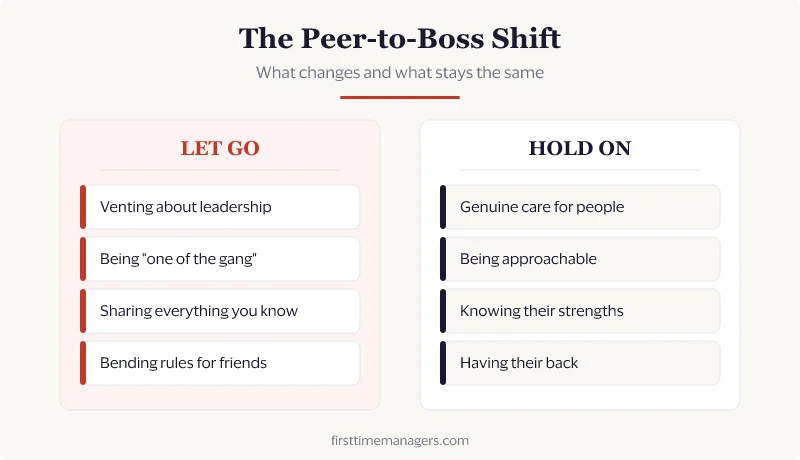
What you can keep:
- Genuine warmth and care for each other
- Knowing about each other’s lives outside work
- Having lunch together (with the whole team, not exclusive)
- Being someone they trust and respect
What you need to let go:
- Venting about company leadership or other teams
- Sharing confidential information (performance data, salary info, upcoming changes)
- Bending rules or lowering standards because “we’re friends”
- Being the person they gossip with about colleagues
- After-work hangouts where you’re the only manager (it creates an in-group)
The hardest part: Some friendships will naturally cool. Not because anyone did anything wrong, but because the dynamic has changed. A friend who now has influence over your career, your performance review, and your daily work life is a different kind of relationship.
This hurts. I won’t pretend it doesn’t. You might feel isolated, too “management” for your old crew, too new for the management circle. That loneliness is real, and it’s one of the least discussed aspects of being promoted from within.
What helps:
- Build relationships with peer managers. They understand what you’re going through.
- Find a mentor outside your team. Someone you can be completely honest with.
- Accept the transition instead of fighting it. The faster you accept that the relationship has evolved, the faster you’ll find a new equilibrium.
The Person Who Wanted Your Job
There might be someone on your team who applied for the same role. Who expected to get it. Who is now reporting to you. Or maybe it’s not about the role: maybe they’re simply older and more experienced than you, and the dynamic feels off.
This is delicate. Here’s how to handle it:
Have a private conversation early
Don’t wait for resentment to build. Approach them within the first few days:
“I know you were interested in this role, and I want you to know I respect that. I value your experience on this team, and I want to find ways to give you opportunities to grow. I’d love to hear what you’re hoping for and how I can support you.”
Don’t overcompensate
The temptation is to give them special treatment, the best projects, more autonomy, fewer demands, out of guilt or to win them over. Don’t. It’s unfair to the rest of the team, and they’ll see through it.
This cuts both ways, and the version that trips up promoted-from-within managers most often is the opposite one: quietly favoring the friends you kept. Almost nobody believes they do this, and most teams can name the favorite within a month. The Am I Playing Favorites? assessment is worth ten minutes here, because this is the single fairness problem that internal promotion creates and external hiring does not.
Don’t take it personally
If they’re cold, distant, or passive-aggressive for a while, that’s them processing. Give them space. Continue to be fair, professional, and genuinely supportive. Most people come around. Some don’t, and that’s okay too.
Watch for undermining
There’s a difference between “processing disappointment” and “actively undermining your authority.” If someone is publicly questioning your decisions, going around you to your boss, or poisoning team morale, that’s a conversation about behavior, not feelings.
“I understand this transition is difficult, and I want to give you space to adjust. But when [specific behavior], it affects the team. I need us to be aligned, even if we don’t agree on everything. Can we talk about how to make this work?”
Setting Boundaries Without Being Cold
The biggest fear for promoted-from-within managers: “If I set boundaries, people will think I’ve changed. That the power went to my head.”
Here’s the truth: you need to change. Not who you are, but how you operate. Setting boundaries with former coworkers is essential, and it requires boundaries.
Boundary 1: Confidentiality
You now have access to information you didn’t have before. Salaries, performance issues, upcoming layoffs, strategic plans. You cannot share this.
When a former peer says “Come on, tell me what’s really going on,” the answer is: “I can’t share that. I know it’s frustrating, and I’m sorry.”
Boundary 2: Equal treatment
If your best friend is on your team, they get the same treatment as everyone else. Same expectations, same feedback, same opportunities. If you can’t do this, one of you needs to move teams.
Boundary 3: Decision-making
You used to make decisions by consensus with your peers. Now some decisions are yours alone. You should still seek input, but you can’t always wait for unanimous agreement.
The key to exercising authority without alienating team members is explaining your reasoning. When someone pushes back: “I hear your concern, and I’ve considered it. I’ve decided to go with [X] because [reason]. I need your support on this, even if you’d do it differently.”
Boundary 4: Emotional dumping
Your team used to vent to you as a peer. They still might: about work, about leadership, about each other. You need to redirect:
- About work frustrations: “I hear you. Let’s talk about what we can actually change.”
- About leadership: “I understand the frustration. Let me see what I can find out.” (Don’t join in.)
- About each other: “I appreciate you telling me. Have you talked to them directly about this?”
When You Now Manage the Person Who Trained You
There is a version of this that stings differently from the friendship problem, and it comes up constantly in internal promotions: one of your reports taught you the job. They answered your questions in your first month, they reviewed your early work, they were the person you went to when you were stuck.
Now you set their goals and write their review.
The instinct is to keep deferring. You ask their permission in the phrasing of your requests, you check decisions with them that you would not check with anyone else, and you avoid giving them feedback because it feels like a student correcting a teacher. This is understandable and it is also the single fastest way to make the arrangement unworkable, because the rest of the team can see who is actually running things.
The opposite instinct is worse. Overcorrecting into unnecessary displays of authority, deciding things without asking precisely because you want to prove you can, reads as insecurity to everyone including them.
What works is naming the reversal once, plainly, and then behaving normally:
“You taught me most of what I know here, and that is not going to stop being true. What is changing is that I’m accountable for the team’s direction now. I’m still going to ask for your read on things, and sometimes I’m going to decide differently. I wanted to say that out loud rather than have it be weird.”
Then follow through on both halves. Actually ask their opinion, because their experience did not evaporate when the org chart changed, and asking is not deference, it is using the most knowledgeable person in the room. And actually decide differently when you think differently, at least once, early, on something that does not matter much. A first small disagreement handled calmly resets the relationship far more effectively than any conversation about it.
One thing to watch for: mentors sometimes struggle with this more than they let on, particularly if they were passed over for the role themselves. If that applies, the conversation in the previous section is the one to have first. And if the friction turns out to be about seniority rather than mentorship specifically, managing someone older than you covers that adjacent problem, which has a different cause and a different fix.
The First 30 Days: A Survival Guide
The order matters more than the list. Some of these problems get harder every week you leave them, and some can wait a month. If you are not sure which is which on your team, the Just Promoted Over Your Peers? quiz takes three minutes and puts your first three moves in order, with the words to use.
Week 1: Acknowledge and listen
- Have the team conversation (see above)
- Schedule 1-on-1s with every team member
- Talk to the person who wanted your job (if applicable)
- Listen 90%, talk 10%
Week 2: Establish new norms
- Start weekly 1-on-1s
- Clarify your communication preferences: “Here’s how to reach me, here’s my response time, here’s when I’m available”
- Begin separating your old tasks from your new responsibilities
- Delegate your old work (this is hard, do it anyway)
Week 3: Prove consistency
- Follow through on every commitment from Week 1 and 2
- Give your first piece of positive feedback to someone (publicly, in a team meeting)
- Make one small decision that shows you’re leading, not just occupying a seat
- Continue listening in 1-on-1s, look for patterns
Week 4: Address what needs addressing
- If there are performance issues or team dynamics problems, start having those difficult conversations
- Share what you’ve learned with the team: “Here’s what I’ve observed, here’s what I plan to focus on”
- Ask for feedback: “How has this first month been for you? What can I do better?”
What Nobody Tells You
It gets better. The awkwardness fades. New routines form. People adjust. You find your footing.
Some relationships will change permanently. And that’s a loss worth grieving. Don’t pretend it doesn’t matter.
Your former peers will test you. Not maliciously, just naturally. They’ll push boundaries to see if you enforce them. Be consistent, and they’ll stop testing.
You’ll miss your old job. There will be days when you want to close your laptop, stop managing people, and just do the work again. That’s normal. It usually passes, and when it doesn’t, it’s worth examining whether management is really what you want.
The people who struggle most with your promotion are usually struggling with something else. Their reaction to you isn’t really about you. Give them grace.
You were chosen for a reason. On the days when impostor syndrome is loudest, remember: someone who knows the team, knows the work, and knows you, decided you were the right person. Trust that.
The Two Things That Matter Most
If you take nothing else from this article, take these two principles:
1. Be the same person, with new responsibilities. Don’t become someone you’re not. Don’t suddenly start using corporate jargon or acting distant. Your authenticity is your greatest asset. Let it coexist with the authority of your new role.
2. Be fair above all else. Fairness is the currency of trust. If your team believes you treat everyone equally, even your friends, even the person who resents you, even the person who makes your job harder, they’ll follow you anywhere. For a deeper look at this, read our guide on how to build trust with your team as the new boss.
The transition from peer to boss is messy, emotional, and uncomfortable. There’s no way around that. But there’s a way through it, and you’ve already started by thinking about how to do it right.
If you want company on the harder weeks ahead, the books that helped most new managers through this exact transition are in our top 5 books for first-time managers, five reads that cover the identity shift, the trust work, the feedback craft, and the decision cadence of the new role. Not 25 titles. Five that managers who survived year one keep recommending.
If six months in the role has you quietly wondering whether you should go back to being an IC, that instinct deserves a structured read, not a gut call. The free Should I Go Back to Being an IC? self-assessment walks through 15 scenarios across energy drain, identity loss, people fatigue, impact frustration, and escape vs. strategy. For some managers, the answer is “yes, and here is how to do it well.” For others, it is “you are having a bad month, not a bad match.” Better to know which.