I used to think I was bad at delegating.
I had read three books on it. (Probably the same three on most first-time manager reading lists.) I had the RACI chart printed. I could recite the “authority levels” framework word for word. I knew, intellectually, that my job as a manager was to teach the work, not to do it.
And yet, every Thursday night around 9pm, there I was. Finishing something a direct report had submitted. Redoing a slide deck that was 90% there. Writing the email I had asked them to draft because “it would just be faster this time.” Logging off at 11. Waking up resentful. Repeating the cycle on Friday.
I didn’t have a delegation problem. I had an identity problem. It just took me 18 months to figure out the difference.
If you are earlier than that and still assembling the basics, the first-time manager’s complete guide lays out where delegation sits in the sequence, and the short version is that it comes third, after trust and after feedback. This article is about why it stalls even when you know all of that.
Here is what I finally learned: delegation is not a skill you develop. It is an addiction you quit. And if you are the kind of manager who got the job because you were the best individual contributor on the team, you are almost certainly hooked on something the business school case studies never name out loud.
You are addicted to being the hero.
What “hero addiction” actually is
The hero is the person who saves the day. Who stays late. Who catches the mistake right before it ships. Who is reliably the one with the answer, the fix, the recovery. For most of your career before this management role, being the hero was the entire deal. It was how you got recognized, how you got promoted, and, somewhere in the process, how you quietly started to define yourself.
Then you got this job. And nobody warned you that the role you just got is the first role where being the hero is not just unnecessary. It is disqualifying.
A hero has to be indispensable. A manager has to become increasingly dispensable as the team grows. Those two directions are not compatible. You cannot be both. And the shift from one to the other feels, in your body, like giving up the thing that made you worth something.
That is not a delegation problem. That is a grief problem. And you cannot talk yourself out of grief by reading another framework.
The 4 identity needs that keep you doing the work
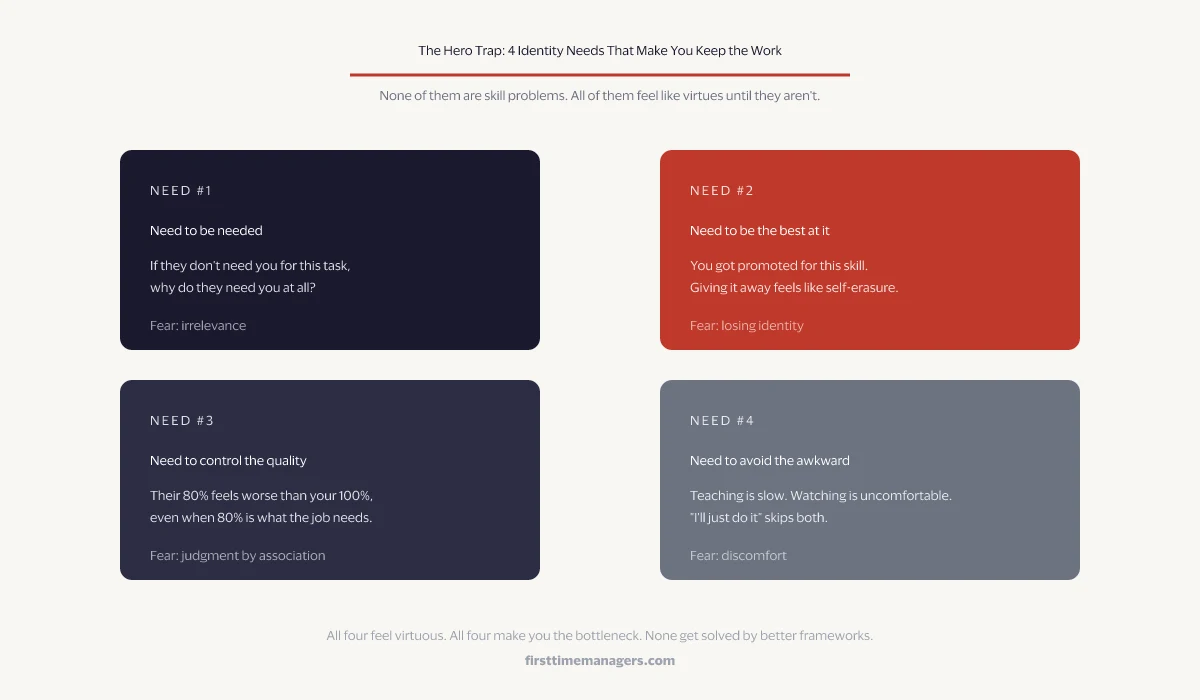
If you have ever used our Delegation ROI calculator and walked away agreeing with the math but still kept the task on your plate, you were not defeated by the numbers. You were defeated by one of these four needs. All four feel virtuous. None of them are.
1. The need to be needed
If they do not need you for this task, why do they need you at all? This is the fear that sits underneath most “I’ll just do it” moments. You are quietly testing whether you still matter. Every time you pick up the work, you are collecting evidence that you are still essential. Every time you do not, you have to sit with the possibility that the team could operate without you.
Here is the thing: the team can operate without you. That is the job. Your value as a manager is not proved by their dependence on you. It is proved by their ability to thrive without you. The hero’s metric is “what did I catch this week?” The manager’s metric is “what did the team catch without me?” Those are nearly opposite.
2. The need to be the best at it
You got promoted for this specific skill. Maybe it was writing. Maybe it was closing deals. Maybe it was the code. Whatever it was, that skill is woven into your professional identity. Handing it to someone else feels like handing over a piece of yourself.
The uncomfortable truth: you are supposed to stop being the best at it. Your job has changed. The value you create now is measured by what your team produces, not by what flows from your keyboard. Every hour you spend protecting your old expertise is an hour you are not developing your new one. And the new expertise (judgment, coaching, systems thinking, stakeholder navigation) compounds much faster than the old one because you have more surface area to practice on.
3. The need to control quality
Their 80% feels worse than your 100%. Even when 80% is exactly what the job needs. Even when the customer cannot tell the difference. Even when your 100% is partly neurosis dressed up as craft.
This one masquerades as standards. It is mostly ego. You are not protecting the work. You are protecting your association with the work. “If this goes out with my name on it…” Except, here is the secret: nothing has your name on it anymore. The team’s output is your output. Letting their 80% ship is not lowering your standard. It is realizing that “your standard” was a story you told yourself to justify not teaching anyone.
Our article on 10 mistakes every first-time manager makes covers the standards-as-control trap in more depth. It is one of the big ones.
4. The need to avoid the awkward
Teaching is slow. Watching someone do something poorly is uncomfortable. Correcting without crushing takes real skill. The first three or four times you hand a task to someone, every minute will feel longer than it should. It will be excruciating. You will fantasize about taking it back.
“I’ll just do it” is the path that skips all of that. It is the shortcut that costs you the next 18 months of your management career. Most managers who never learn to delegate did not fail at the technique. They just could not tolerate the 30 hours of discomfort that the technique requires up front. They chose 3 years of resentment over 30 hours of awkwardness. Nobody sets out to make that trade, but nearly everybody makes it by default.
Why the word “addicted” matters
I know “addicted” sounds dramatic for a management essay. Bear with me. The reason it fits is that the behavior meets the clinical criteria in every important way.
You keep doing the thing even when you know it is hurting you. You work weekends. You resent your team. You feel exhausted and underused at the same time. You read this essay nodding and still, next week, you will stay late finishing something you should have handed off.
The reward is immediate. The cost is delayed. Picking up the task feels good right now (problem solved, validation earned). The cost (burnout, bottleneck, team that never develops) shows up six months later, slowly, and never gets traced back to the decision.
You develop rationalizations that protect the behavior. “It’s faster this way.” “They don’t have the context yet.” “This one is high-stakes.” Every rationalization contains a grain of truth, which is why the addiction is so durable. If all four needs were easy to see through, you would have quit already.
Stopping feels worse than continuing, even when you know stopping is better. This is the hallmark. The math says delegate. Your body says no. You feel the pull toward picking it back up. That pull is not a skill gap. That is the addiction.
Once you see it this way, the problem becomes much simpler, and much harder. Simpler because you know what you are actually dealing with. Harder because skills can be taught. Addictions have to be quit.
The 3 moves that actually break the pattern
You cannot frameworks your way out of this. I have tried. What has actually worked, for me and for every manager I have talked to who has broken through, comes down to three things. None of them are tactical. All of them are emotional.
Move 1: Name what you are protecting
The next time you feel the pull to take a task back, stop and ask: “which of the four needs is this right now?” Not in a self-flagellating way. In a diagnostic way. Is it the need to be needed? The need to be the best at it? The need to protect quality? The need to avoid the awkward?
Most of the time, you will know within 10 seconds. The moment you can name it, its grip loosens. It is hard to be unconsciously driven by a need you have consciously labeled. You can still act on it, but you do so with your eyes open. That is the beginning of everything.
Move 2: Let one thing ship at 80%
Not a high-stakes thing. Not a board presentation. Something real, but non-catastrophic. Let it go. Do not fix it. Do not add the missing sentence. Do not polish it. Just let it out the door.
Then watch what happens. In my experience, about 95% of the time, nothing does. The world does not end. The customer does not complain. Your boss does not mention it. The 80% was, in fact, sufficient for the job. This is not a pleasant discovery. It is disorienting. It forces you to admit that much of what you called “standards” was really “my preferences dressed up in a suit.”
That disorientation is the cure. You cannot think your way to it. You have to live through it. Our guide on how to delegate as a new manager walks through the specific mechanics of doing this safely.
Move 3: Find a new scoreboard
The hero’s scoreboard was easy to read: what did I produce this week? The manager’s scoreboard has to be different, and you have to build it yourself because nobody will hand it to you.
My current scoreboard has four questions I ask every Friday:
- What did someone on my team do this week that I would have insisted on doing myself a year ago?
- What decision did they make without me that I would previously have felt I needed to weigh in on?
- Who on my team grew visibly this week, and what specifically caused the growth?
- What did I spend time on that only I could have done?
If I can answer those four questions with specifics, it was a good week. Even if I produced almost nothing myself. Especially then. That reframe is the hardest part of the shift, and it is the whole shift at the same time.
If you want a structured way to make these kinds of delegation calls, the how to delegate as a new manager guide walks through the decision and the briefing. The “I’ll just do it myself” cost calculator puts a number on what hero mode has already cost, and most managers underestimate by 5-10x because they only count the hours, not the foregone management leverage or the team development debt. The Delegation ROI calculator shows when the upfront teaching time actually pays back, and the Manager Leverage calculator gives you the harder mirror: it measures whether you are operating as a multiplier (team output ÷ your enabling time) or quietly behaving as a bottleneck. The hero pattern shows up across all three. None of them will cure the addiction, but they give the new behavior somewhere to land.
What changes when you stop
I’m not going to pretend this is a clean, uplifting ending. Quitting the hero addiction is genuinely hard, and for the first few months it feels worse than the addiction did. You will feel less useful. You will feel more idle. You will look at your calendar on Tuesday and wonder if you are actually doing anything. That wondering is the transition.
But on the other side: your team actually develops. Decisions get made without you. Problems get solved without you. The work stays high quality, often higher, because people doing their own work with their own judgment bring a commitment that your cleanup never could. And you, slowly, start to believe that your value does not rest on your indispensability.
The most important moment is when you realize your team can operate a full week without you needing to intervene. For the hero, that is the worst moment possible. For the manager, that is the job working as designed.
There is a whole book about the version of this that happens at company scale, written by a nuclear submarine captain who replaced asking permission with stating intent. It sits on our sister site’s list of eight execution books, next to the one that explains why a team can be busy all quarter and finish almost nothing.
This topic is closely connected to imposter syndrome and to burnout prevention. All three have the same root: you are trying to earn your place by being indispensable, and the attempt is exactly what makes you vulnerable. Stopping is how you actually become safe.
You do not have a delegation problem. You never did. You have a role you did not fully accept. The good news is that you can accept it now, one task at a time, by being slightly more honest than you were yesterday about what you are protecting and what it is costing you.
The team you want to be leading needs you to stop being the hero. Not because your heroism is not valuable. Because it is the thing standing between them and becoming the team you think they already are.