You know you should recognize your team. Every management book says so. Every leadership podcast says so. So you try. You type “Great job, team!” in Slack after a big push. You say “Thanks for staying late” to someone in passing. You end a meeting with “Really solid work this week, everyone.”
And nothing happens. No shift in energy. No visible impact. Just polite nods and people going back to their screens.
The problem isn’t that recognition doesn’t work. The problem is that vague recognition is barely better than no recognition at all. “Good job” is the participation trophy of management — technically positive, practically meaningless.
I spent my first few months as a manager either forgetting to recognize people entirely or saying things so generic they could have been auto-generated by an HR chatbot. It wasn’t until someone on my team told me — during an exit interview, no less — that she never felt like her work was noticed that I realized I’d been doing it wrong the whole time.
This guide is the fix. Specific formulas, concrete scripts, and a framework you can start using today.
Why Recognition Feels Weird When You’re New
Let’s name the awkwardness, because pretending it doesn’t exist doesn’t help.
You were peers five minutes ago. Praising someone who used to sit next to you at the same level feels patronizing. Who are you to tell them they did a good job? You were doing the same work last month.
You don’t want to play favorites. If you recognize Sarah publicly, will Marcus think you value his contributions less? Will people start competing for your attention instead of focusing on the work?
You’re too busy putting out fires. When you’re drowning in meetings, escalations, and your own learning curve, stopping to notice good work feels like a luxury. There’s always something more urgent.
You’re not sure what “good” looks like yet. How can you recognize excellent work when you’re still figuring out what baseline performance even means in your new role?
All of these are real. None of them are reasons to skip recognition. They’re reasons to be intentional about how you do it — which is exactly what we’re going to cover.
The Science: Why It Matters More Than You Think
This section is going to be short because you don’t need a literature review. You need proof that this is worth your time.
Employees who don’t feel adequately recognized are twice as likely to say they’ll quit in the next year. Recognition is one of the lowest-cost, highest-impact tools a manager has — and yet SHRM research consistently shows it’s one of the most underused. Not because managers don’t care, but because they don’t know how to do it well.
If you want to put a number on what under-recognition is currently costing your team — turnover risk reduction, productivity uplift, departures prevented — the Recognition ROI calculator does the math in about three minutes. The headline finding holds even when the program cost is zero. Specific, free recognition delivers roughly 80% of the ROI of paid programs.
That’s the gap. You care. You just need a system.
The Recognition Formula: What + Why + Impact
Here’s the framework that turns empty praise into something people actually remember.
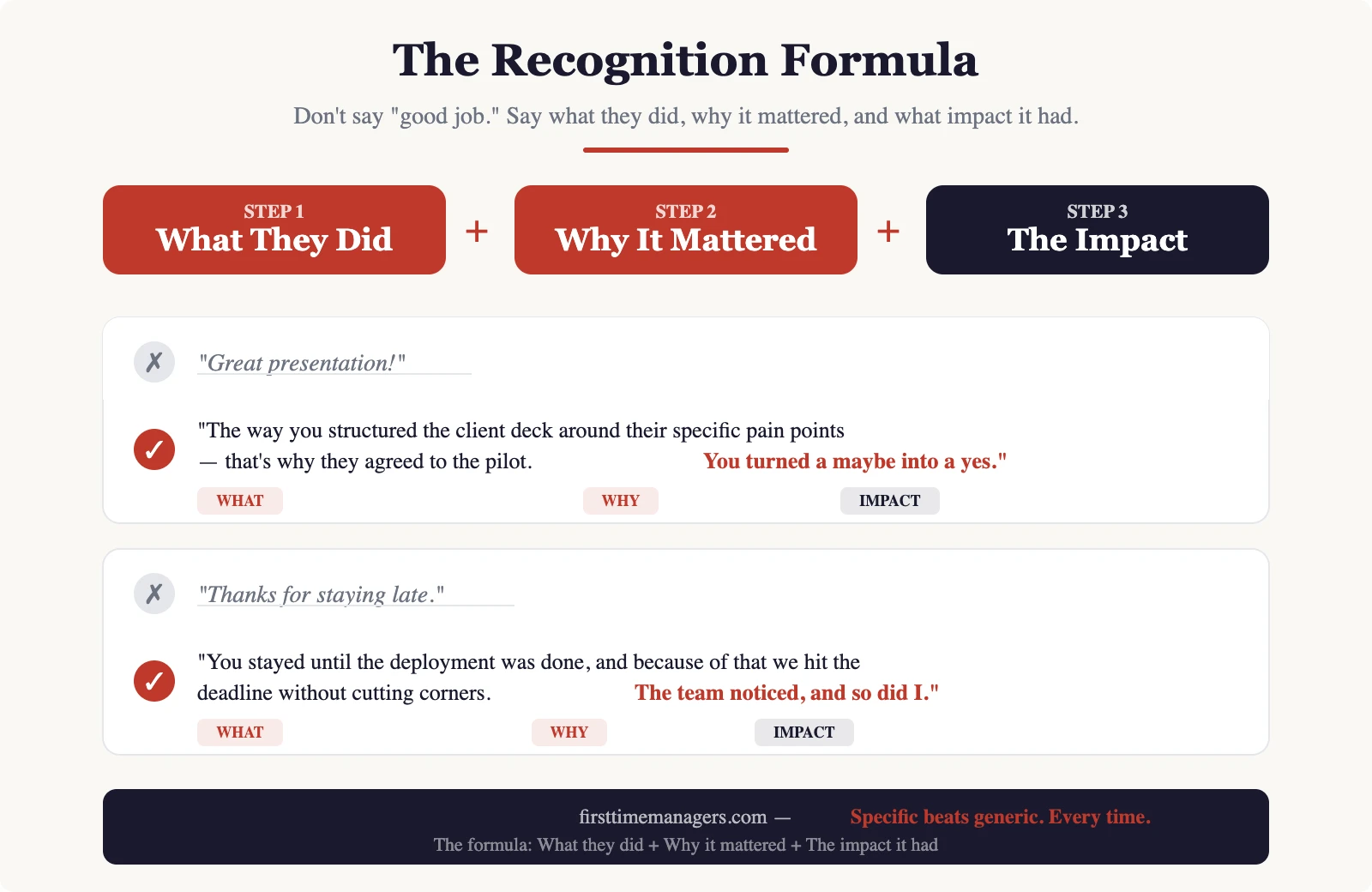
Don’t say “good job.” Say WHAT they did, WHY it mattered, and what IMPACT it had.
That’s it. Three parts. Takes about fifteen seconds longer than “nice work” but lands about fifteen times harder.
Before and After Examples
Before: “Great presentation!” After: “The way you structured the client deck around their specific pain points — that’s why they agreed to the pilot. You turned a maybe into a yes.”
Before: “Thanks for staying late.” After: “You stayed until the deployment was done, and because of that we hit the deadline without cutting corners. The team noticed, and so did I.”
Before: “Good job on the report.” After: “Your analysis on customer churn caught something nobody else saw. That one finding changed the direction of our Q3 strategy. That’s the kind of thinking that moves the whole team forward.”
Before: “Thanks for helping out.” After: “When Priya was stuck on the API integration, you dropped what you were doing and pair-programmed with her for an hour. She shipped it the same day. That kind of proactive teamwork is exactly what makes this team work.”
Notice the pattern. The what grounds it in reality — they can picture the exact moment. The why explains the significance — it wasn’t just nice, it mattered. The impact shows the ripple effect — their work didn’t happen in a vacuum.
For thirty specific rituals you can implement this week using this formula — grouped by daily, weekly, milestone, and peer recognition, each with a sample script and when not to use it — see the Recognition Without Budget library.
This is also how you give feedback that actually changes behavior. Recognition and feedback aren’t opposites. They’re the same skill, pointed in different directions.
Public vs. Private: A Decision Framework
Getting the words right is only half the equation. The other half is choosing the right venue. Public recognition in the wrong situation can be just as damaging as no recognition at all.
Default to Private
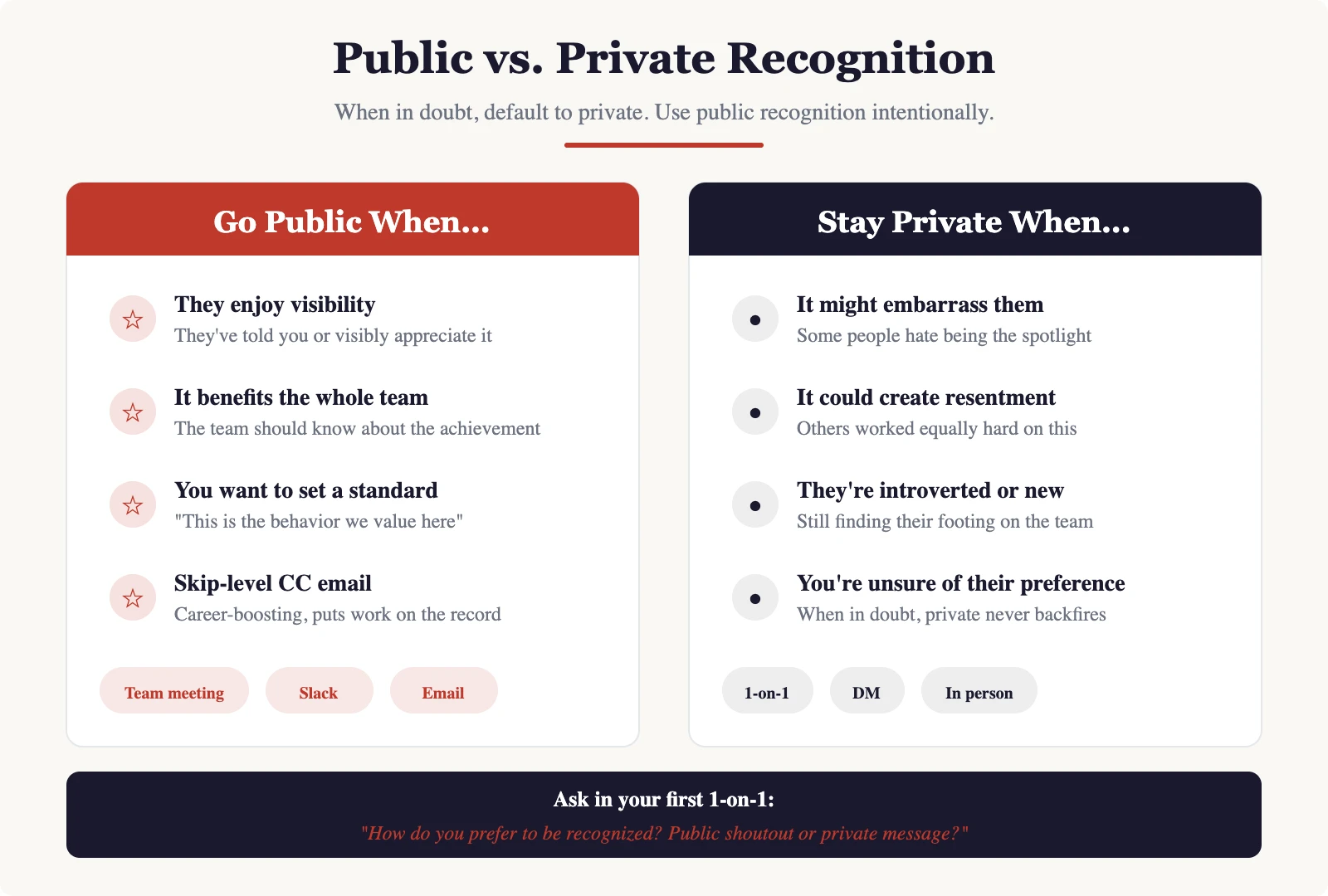
If you’re unsure, go private. A genuine, specific message in a 1-on-1 or a direct message will never backfire. It’s the safe choice, and it still carries real weight.
Go Public When…
- The person enjoys visibility. Some people light up when recognized in front of others. You’ll know because they visibly appreciate it or have told you directly.
- The achievement benefits the whole team. If someone’s work saved the entire team a headache, the team should know about it.
- You want to set a standard. Public recognition is also teaching. It says: “This is the kind of work and behavior we value here.”
Never Go Public When…
- It might embarrass them. Some people genuinely hate being the center of attention. Public recognition for them isn’t a gift — it’s a spotlight they didn’t ask for.
- It could create resentment. If half the team worked on a project and you single out one person, you’ve just created a problem.
- The person is introverted or new. When someone’s still finding their footing, public attention can feel more like pressure than praise.
The Question That Solves Everything
In your first 1-on-1 with each team member, ask this:
“How do you prefer to be recognized? Some people like public shoutouts, others prefer a private message. There’s no wrong answer — I just want to make sure I do it in a way that actually feels good to you.”
Add their answer to your notes. This one question — which takes ten seconds to ask — will prevent months of missteps. If you’re looking for more great questions to ask, here are 25 1-on-1 questions for new managers.
5 Channels and When to Use Each
Recognition isn’t one-size-fits-all. The channel you choose affects how it lands.
1. In a 1-on-1
Best for: Growth recognition, sustained effort, personal development wins.
This is where you can go deep. You have privacy, context, and the person’s full attention. Use your 1-on-1 for recognition that requires nuance — like acknowledging someone who’s been quietly improving, or someone who handled a difficult situation with maturity.
“I want to start with something I’ve noticed. Over the last month, the way you’ve been running sprint planning has completely changed. You’re tighter on time, you’re drawing out the quieter team members, and the team’s velocity is up. I don’t think that’s a coincidence.”
2. In a Team Meeting
Best for: Team-visible achievements, setting examples, celebrating milestones.
Keep it specific and brief. Nobody wants a five-minute speech. One or two sentences using the What + Why + Impact formula is perfect.
“Before we start — I want to call out something. Raj stayed on top of the vendor issue all last week and resolved it before it impacted the sprint. That saved the whole team at least two days of rework. Raj, thank you.”
3. On Slack or Teams
Best for: Quick wins, small moments, maintaining a recognition rhythm.
This is your lowest-effort, highest-frequency channel. Saw someone help a teammate? Drop a message. Someone shipped a clean PR on a tight timeline? Say it. Don’t overthink it — even two sentences with the formula work here.
“Just want to flag — @Maya’s documentation on the new onboarding flow is excellent. Clear, thorough, and it’s already saved two new hires from getting stuck. This is exactly the kind of work that compounds.”
4. In Writing — Email to Them + CC Their Skip-Level
Best for: Career-boosting recognition, major accomplishments, promotion-supporting evidence.
This is the most powerful channel and the most underused. When you email someone specific recognition and copy their skip-level manager, you’ve just done something most managers never do: you’ve put their good work on the record.
This matters for promotions, for visibility with leadership, and for the person’s confidence. Use it for genuinely significant contributions — not every small win.
5. To Their Face, Spontaneously
Best for: Authenticity, real-time reinforcement, building trust.
Walk up to someone (or hop on a quick call) and say it in the moment. No meeting, no Slack thread, no formality.
“Hey, I just sat in on your call with the client. The way you handled that objection about pricing was really sharp — you reframed it around value without getting defensive. That’s a hard skill and you nailed it.”
This is the hardest channel for new managers because it requires confidence and spontaneity. But it’s often the one people remember most, precisely because it’s unscripted.
The Timing Rule: 48 Hours or It Doesn’t Count
Recognition has a half-life. The closer it is to the moment, the more powerful it is.
If you see something good on Monday, say something by Wednesday. Not Friday. Not in next week’s 1-on-1. Not in the quarterly review three months from now.
Here’s why timing matters so much: when you recognize something immediately, the person connects the praise to the specific action. They remember what they did, how they did it, and what was going through their head. That connection is what makes them likely to repeat the behavior.
When you wait too long, the moment is cold. “Hey, remember that thing you did three weeks ago? That was really good.” It still beats silence, but it’s like clapping after the band has already packed up.
The practical rule: Set a recurring reminder every Wednesday and Friday — two minutes each — to ask yourself: “Did someone on my team do something good this week that I haven’t acknowledged?” If yes, send the message right then. Not later. Right then.
Recognition Mistakes That Backfire
Even well-intentioned recognition can do damage if you’re not careful. Watch out for these five traps.
1. Only Recognizing Results, Never Effort or Behavior
If you only praise people when they hit a target or close a deal, you’re teaching your team that only outcomes matter. But the behaviors that lead to outcomes — collaboration, persistence, creative problem-solving, helping a struggling teammate — are just as worth recognizing.
Recognize the effort that didn’t lead to a win. Recognize the process that was excellent even when the result was mediocre. Otherwise, you’ll build a team that only takes safe bets.
2. Recognizing the Same Person Every Time
You probably have a top performer who makes it easy. They deliver, they’re visible, they’re vocal. And before you know it, you’ve praised them five times and haven’t mentioned anyone else in a month.
Keep a simple tally. Who have you recognized this month? If the same name keeps showing up and others are absent, course-correct. Not by giving hollow praise to others — by looking harder for what they’re doing well. It’s there. You just have to notice.
3. Generic Praise
“Good job, team.” “Nice work, everyone.” “Thanks for a great quarter.”
This is wallpaper. People hear it and it slides right off. Every time you’re tempted to send a generic group message, stop and ask: can I name one specific person and one specific thing? If yes, do that instead. If you genuinely mean to thank the whole team, at least name what specifically you’re thanking them for.
4. Coupling Recognition With Criticism
“That was a really great demo, but next time you should probably prep your answers for the Q&A section.”
The moment you add “but,” the recognition evaporates. The person walks away remembering the criticism, not the praise. Keep recognition and constructive feedback in separate conversations. Recognize today. Give the feedback tomorrow. Never in the same breath.
5. Only Recognizing in Performance Reviews
If the first time someone hears that their work is valued is during a formal review, you’ve waited too long. Performance reviews should confirm things people already know — not reveal them for the first time.
Recognition should be continuous, lightweight, and woven into normal work. The review is the summary. Your daily and weekly interactions are the story.
What If You’re Not a “Praise Person”?
Some of you are reading this and thinking: “This all sounds great, but I’m not a warm and fuzzy person. Praising people feels forced. It’s not who I am.”
Fair enough. Here’s the thing: you don’t have to be warm and fuzzy. You have to be specific and honest.
Recognition isn’t about personality. It’s about information. You’re telling someone: here’s what you did, here’s why it mattered, here’s the impact. That’s data, not a hug.
If verbal recognition makes you cringe, start with written channels. A Slack message or an email gives you time to compose your thoughts without the pressure of real-time delivery.
If public recognition feels like theater, stick with private. A quiet, specific acknowledgment in a 1-on-1 is just as powerful — sometimes more so.
Start with one specific recognition per week. That’s your minimum. One person, one thing they did, one reason it mattered. Do it every week for a month and two things will happen: it’ll start feeling more natural, and you’ll start noticing good work everywhere because your brain is now looking for it.
This is the same muscle you build when developing psychological safety on your team. It’s a practice, not a personality trait.
Your Weekly Recognition Habit
Let’s make this concrete. Here’s a two-minute habit that will make you a better manager starting this week.
Every Friday, before you shut your laptop, ask yourself one question:
“Who did something good this week that I haven’t acknowledged?”
A name will come to mind. Maybe two. Now apply the formula:
- What did they do?
- Why did it matter?
- What impact did it have?
Send one message. Slack, email, or save it for Monday’s 1-on-1. Takes two minutes. Maybe three if you’re composing an email with a skip-level CC.
That’s it. One recognition per week. Fifty-two per year. More than most managers give in their entire careers.
Over time, you won’t need the Friday reminder. You’ll start catching good work in real time because you’ve trained your brain to look for it. You’ll mention it spontaneously because the formula is second nature. Your team will start doing better work — not because you’re paying them more or giving them fancier titles, but because they know someone is actually paying attention.
Recognition isn’t a soft skill. It’s a retention strategy, a performance tool, and the fastest way to build the kind of trust that makes everything else in management easier. Stop waiting for the perfect moment. Your team did something good this week. Go tell them.
Is lack of recognition causing someone to check out? Take the free Is My Employee Quiet Quitting? quiz — 15 scenarios that reveal the early signs of disengagement. 4 minutes, no email.
🚨 Worried about your best performer specifically? The Am I About to Lose My Best Employee? assessment measures flight risk across 5 dimensions — including Recognition Gap, the #1 reason top performers leave. Free, 4 minutes, no email.
Want a one-page recognition cheat sheet? The Manager’s Cheat Sheet Pack includes a printable Recognition card with the formula, timing rules, and public vs. private framework — plus 11 more cheat sheets covering feedback, difficult conversations, goal setting, and more. See all 12 cheat sheets →
Recognizing unevenly without realizing it? The Am I Playing Favorites free quiz screens for the access, feedback, and assignment patterns that quietly skew recognition toward the people you find easy to talk to. Most managers find one or two dimensions they did not notice.