Your team is polite. They show up to meetings. They hit most of their deliverables. On paper, nothing is wrong.
But nobody disagrees with you. Nobody pushes back. Nobody brings a problem to you early, only after it blew up. The real conversations happen in DMs you can’t see, between people who aren’t including you.
That’s not a performance problem. That’s a trust problem. And trust is the one thing every other management skill rests on. You can be a brilliant strategist, an elite communicator, a disciplined planner. If your team doesn’t trust you, none of it matters. They’ll nod, they’ll smile, they’ll do the minimum, and the moment a better offer comes, they’ll leave.
Research from Google’s Project Aristotle studied 180+ teams and found that the single biggest predictor of team effectiveness was psychological safety: whether people felt safe to take interpersonal risks. Not skill. Not talent. Not resources. Safety. And safety rests on trust.
Here are five books that will change how you build, rebuild, and protect trust on the team you manage. Every one of them is backed by research, packed with frameworks you can use next week, and written for leaders who want real influence, not compliance.
What made the cut: Every book on this list (1) gives you a concrete behavior change you can practice immediately, (2) is backed by research or decades of applied work, (3) treats trust as a skill you build, not a personality trait you’re born with, and (4) is written for people leading teams inside real organizations.
1. The Five Dysfunctions of a Team, by Patrick Lencioni
The definitive model for why teams fail, and what sits at the bottom of every failure.

- Author: Patrick Lencioni
- Published: 2002 | Pages: 229
- Rating: 4.6/5 (20,000+ ratings)
- View on Amazon
If you read one book about team dynamics, make it this one. Lencioni’s model is so widely adopted that if you ever sit in a senior leadership meeting, someone will reference it within a quarter. The structure: five dysfunctions stacked on top of each other, with absence of trust sitting at the base. Everything else (fear of conflict, lack of commitment, avoidance of accountability, inattention to results) flows from that foundation being broken.
Why it made the list
The genius of the book is that it’s written as a business fable. You follow a fictional CEO inheriting a dysfunctional leadership team, and you watch her work the model in real time. It’s under 230 pages and reads in a weekend. No jargon, no 40-page literature reviews, just a story that makes the model stick.
The core insight that most managers miss: the opposite of trust is not distrust. It’s invulnerability. Lencioni argues that teams don’t lack trust because people are lying to each other. They lack trust because nobody is willing to be the first person to say “I don’t know” or “I was wrong” or “I need help.” Without that vulnerability, every other behavior on the team becomes performative.
As a new manager, this will hit you hard: you are the variable. Your team’s willingness to be vulnerable with each other is directly downstream of your willingness to be vulnerable with them. If you pretend to have all the answers, they will pretend with you. Our guide on how to build trust with your team walks through the daily behaviors that put this into practice.
Best for you if…
You inherited a team that looks fine on the surface but something feels off. Meetings are polite but nothing gets decided. Feedback is rare. Conflict gets avoided, then erupts months later. This book gives you a diagnostic framework and a sequence for fixing it.
Key takeaway: “Trust lies at the heart of a functioning, cohesive team. Without it, teamwork is all but impossible. Teams that lack trust waste inordinate amounts of time and energy managing their behaviors and interactions within the group.”
2. The Fearless Organization, by Amy Edmondson
The research-backed case that psychological safety is a business performance issue, not a soft skill.
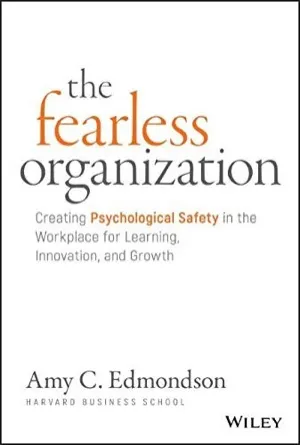
- Author: Amy C. Edmondson (Harvard Business School)
- Published: 2018 | Pages: 256
- Rating: 4.6/5 (2,500+ ratings)
- View on Amazon
Edmondson coined the term “psychological safety” in a 1999 paper that became one of the most-cited management studies of the last 30 years. This book is her 20-year synthesis. If Lencioni gives you the model, Edmondson gives you the science.
Why it made the list
The research base is unmatched. Edmondson’s work spans hospital teams, NASA, Pixar, Volkswagen, and Wells Fargo, with a decade of field studies showing exactly how silence costs companies money and, sometimes, lives. The book makes a compelling argument that most managers don’t want to hear: the reason your team doesn’t speak up is almost never that they’re disengaged. It’s that they’ve learned it isn’t safe to.
What makes this practical for a new manager is the “leader’s toolkit” she lays out in Part III. Three moves: frame the work, invite participation, and respond productively. Frame the work by being explicit that you’re in uncertainty and need the team’s input. Invite participation by asking better questions than “any thoughts?” (which is almost guaranteed to produce silence). Respond productively when someone does speak up, especially when the news is bad.
The Volkswagen emissions scandal chapter is required reading. A culture where nobody could say “this won’t work” cost the company $33 billion in fines, reputation damage, and criminal charges. The engineers knew the defeat devices were illegal. They stayed silent because speaking up wasn’t safe. That’s what broken trust actually costs.
Best for you if…
You want the research evidence to back up what your gut already tells you: the high-performing teams you’ve been on all had one thing in common, which was that they felt safe. This book gives you language, studies, and a behavioral playbook to recreate that on your team.
Key takeaway: “Psychological safety is not a personality factor, it’s not being ‘nice,’ and it’s not about lowering performance standards. It’s a felt permission for candor.”
3. Dare to Lead, by Brené Brown
The best book for understanding that vulnerability is the price of admission for trust.

- Author: Brené Brown, Ph.D., LMSW
- Published: 2018 | Pages: 298
- Rating: 4.8/5 (25,000+ ratings)
- View on Amazon
Brown spent two decades studying shame, vulnerability, and courage before this book. Dare to Lead is her translation of that research into leadership practice. The core claim: vulnerability is not weakness, it’s the measurable, observable behavior that trust is built from. You cannot ask your team for trust without being willing to go first.
Why it made the list
Brown’s BRAVING framework is the single clearest definition of trust I’ve ever seen. Trust, she argues, is made of seven elements you can actually evaluate: Boundaries, Reliability, Accountability, Vault (confidentiality), Integrity, Non-judgment, and Generosity. When trust breaks on your team, you can now diagnose which element failed, instead of just feeling that “things are tense.” That specificity is gold for a manager.
The “rumble” chapter changed how I run hard meetings. A rumble is a conversation where you commit to lean into vulnerability, stay curious, and stop armoring up. It’s designed for the moment when your instinct is to end the conversation and protect yourself. Brown’s point: those are exactly the conversations that determine whether your team trusts you. Our guide on how to handle conflict between team members uses a similar lens.
What I appreciate most: Brown is honest that vulnerability is terrifying. She doesn’t pretend this is easy. She names the specific armor we use (perfectionism, cynicism, intellectualizing, knowing-it-all, being the critic) and explains why each one kills trust, slowly and invisibly, even when your performance metrics look fine.
Best for you if…
You got promoted partly because you always had the answers, and now you’re realizing that armor is costing you the relationship with your team. You intellectually believe in vulnerability but you can’t actually make yourself do it. This book gives you permission and a practice.
Key takeaway: “Daring leaders work to make sure people can be themselves and feel a sense of belonging. That starts with not being afraid to be yourself.”
4. The Speed of Trust, by Stephen M.R. Covey
The best book for making the economic case that trust is the lowest-cost, highest-leverage thing you can build.

- Author: Stephen M.R. Covey
- Published: 2008 | Pages: 354
- Rating: 4.6/5 (5,000+ ratings)
- View on Amazon
Covey’s core thesis is a simple equation: when trust goes up, speed goes up and cost goes down. When trust goes down, speed goes down and cost goes up. He calls this the “trust tax” and the “trust dividend,” and once you see it in your organization, you can’t unsee it.
Why it made the list
Most books on trust treat it as an emotional or ethical topic. Covey treats it as a business performance issue, and that reframe is powerful for managers who feel uncomfortable with the softer framing. When trust is low, everything takes longer: approvals need more signatures, decisions need more meetings, simple changes need consultants. That’s not inefficiency. That’s the trust tax, showing up on every line of your budget.
The 13 Behaviors of High-Trust Leaders is the book’s most useful chapter. Concrete, observable actions: talk straight, demonstrate respect, create transparency, right wrongs, show loyalty, deliver results, get better, confront reality, clarify expectations, practice accountability, listen first, keep commitments, extend trust. Each one comes with a self-assessment. You can rank yourself honestly on each behavior, identify your two weakest, and work on them for a quarter.
What’s unique about Covey’s framing: trust is a skill, not a trait. He rejects the idea that you’re either a trustworthy person or not. You build trust the same way you build any other capability, through deliberate practice of specific behaviors, one interaction at a time. That’s encouraging if you’re a new manager who’s been burned and feels like you have to rebuild from zero.
Best for you if…
Your team sees you as competent but not quite trusted. You’ve been told you’re too political, too guarded, or too hard to read. You want a behavioral checklist to work through, not another plea to “be authentic.” This book is a practical audit of how you show up.
Key takeaway: “Trust is not a soft, social virtue. Trust is a hard-edged economic driver. It’s a learnable and measurable skill.”
5. Radical Candor, by Kim Scott
The best book for understanding that care and challenge aren’t opposites, they’re the foundation of high-trust feedback.

- Author: Kim Scott (former Google, Apple)
- Published: 2017 (Revised 2019) | Pages: 320
- Rating: 4.6/5 (7,000+ ratings)
- View on Amazon
Why is a feedback book on a list about team trust? Because trust is almost always destroyed by the feedback conversations you didn’t have. Scott, who built teams at Google and Apple before coaching leaders at companies like Dropbox and Twitter, argues that the single most trust-destroying thing a manager can do is withhold honest feedback in the name of being nice.
Why it made the list
The Radical Candor matrix is a career-defining mental model. Two axes: “Care Personally” and “Challenge Directly.” When you care and challenge, you get Radical Candor. When you care but don’t challenge, you get Ruinous Empathy, which feels kind in the moment but destroys people over time by letting them fail without honest signal. When you challenge but don’t care, you get Obnoxious Aggression. When you do neither, you get Manipulative Insincerity, which is the worst quadrant.
For a new manager, the insight is this: the feedback you’re avoiding because you don’t want to hurt someone’s feelings is actually the feedback that builds trust. People trust managers who tell them the truth, even when it’s hard to hear. They stop trusting managers who smile and nod for a year, then blindside them at performance review. Our guide on how to give feedback for the first time breaks this down in practical terms.
Scott also makes a point that most feedback books miss: you have to earn the right to challenge directly by caring personally first. The order matters. If you show up to a new team and start aggressively challenging without first demonstrating that you’re invested in each person as a human, you don’t get Radical Candor. You get Obnoxious Aggression, and the team shuts down immediately.
Best for you if…
You know you’re avoiding a hard feedback conversation with someone on your team. You’ve told yourself it’s kindness. This book will show you that what you’re actually doing is protecting yourself at their expense, and give you a better path.
Key takeaway: “Radical Candor is what happens when you put Care Personally and Challenge Directly together. It builds trust and opens the door for the kind of communication that helps you achieve the results you’re aiming for.”
Quick Comparison
| Book | Best For | Core Framework | Pages | Rating |
|---|---|---|---|---|
| The Five Dysfunctions of a Team | Diagnosing team dynamics | 5 Dysfunctions Pyramid | 229 | 4.6★ |
| The Fearless Organization | Research on psychological safety | Frame, Invite, Respond | 256 | 4.6★ |
| Dare to Lead | Vulnerability as trust practice | BRAVING framework | 298 | 4.8★ |
| The Speed of Trust | Economic case for trust | 13 Behaviors of Trust | 354 | 4.6★ |
| Radical Candor | High-trust feedback culture | Care/Challenge matrix | 320 | 4.6★ |
Which One Should You Read First?
If I had to pick one, it would be The Five Dysfunctions of a Team. It’s the shortest, the easiest to read, and it gives you a diagnostic model that makes every other book on this list more useful. You’ll come out of it with a clear theory of why your team operates the way it does, and what to fix first.
But here’s the honest answer: it depends on what’s broken.
- Team feels polite but stalled? Start with The Five Dysfunctions of a Team. It names the pattern.
- People aren’t speaking up? Start with The Fearless Organization. It gives you a behavioral playbook.
- You show up as guarded and you know it? Start with Dare to Lead. It rebuilds your relationship with vulnerability.
- Decisions take forever and nothing gets done? Start with The Speed of Trust. It shows you the hidden cost.
- You’re avoiding a feedback conversation? Start with Radical Candor. It reframes silence as the failure.
For the practical execution alongside the books, the how to build trust with your team guide and the psychological safety guide cover the daily behaviors that turn the frameworks above into actual team-level trust.
Beyond Books: Trust Is Built in the Boring Moments
Reading about trust is the easy part. Building it is the part nobody writes as motivating, because it’s not one dramatic moment. It’s a thousand small ones.
Research from the Edelman Trust Barometer consistently finds that trust in direct managers is the single strongest driver of trust in the broader organization. Not the CEO. Not the company mission. You. The person who runs their 1-on-1 and writes their review and decides their promotion.
One caution before the list. Trust damage is rarely something a manager spots in themselves, because the behaviors that cause it feel entirely fair from the inside. Favoritism is the clearest example: almost nobody thinks they do it, and most teams can name who the favorite is. The am I playing favorites? quiz is built to surface the version you cannot see from where you sit. If you would rather have the business case than the moral one, the disengagement cost calculator prices what a team that has quietly stopped trusting you costs per year.
Three ways to start building it this week:
-
Be the first to go. In your next 1-on-1, share something you got wrong this month. Not performative (“oh, I’m so bad at X”), but specific and real. Watch how it changes what your report is willing to share back. Our article on how to build trust with your team has specific scripts for this.
-
Keep the small promises. Trust is destroyed faster by a dozen missed 1:1s than by one missed deadline. If you said you’d follow up by Friday, follow up by Friday. If you can’t, tell them before Friday. The small commitments are where trust is actually measured.
-
Protect the team in rooms they aren’t in. The most powerful signal a manager can send is to defend their team’s work when they’re not in the meeting. Your team will find out. They always do. And it will do more for trust than any 1-on-1 agenda ever could.
Every author on this list agrees on one thing: trust is not what you say, it’s what you do repeatedly. The frameworks help. The books help. But the meeting you’re running at 10 a.m. tomorrow is where trust actually gets built or broken, one small moment at a time.
Good luck. And remember: the fact that you’re reading about this at all means you’re already further along than most managers ever get.