You’re staring at a deliverable that just… isn’t there. The report is shallow. The code is sloppy. The client presentation looks like it was thrown together in an hour. You read it again, hoping you missed something. You didn’t.
This isn’t the first time, either. You noticed it two weeks ago. Maybe three. You told yourself it was a one-off. A bad week. That they’d course-correct on their own.
They didn’t course-correct. And now you’re sitting with a knot in your stomach because you know what you have to do. You have to look this person in the eye and tell them their work isn’t good enough.
This is one of the hardest conversations you’ll ever have as a manager. Not because the words are complicated — but because everything in your brain is screaming at you to avoid it. If you want the theory behind why this is so hard (and proven frameworks for doing it well), see the top 5 books on difficult conversations at work.
Why This Conversation Feels Impossible
Let’s be honest about what’s really going on. When you tell someone their work isn’t cutting it, you’re essentially telling them they’re failing. That’s the subtext, whether you intend it or not. And most of us were raised to be kind, to avoid conflict, to find the silver lining.
You’re afraid they’ll cry. You’re afraid they’ll get angry. You’re afraid they’ll quit on the spot. You’re afraid they’ll hate you. You’re afraid the conversation will go sideways and you’ll make everything worse.
I get it. I’ve felt all of those things. Early in my career, I managed a designer — talented person, genuinely creative — whose work had started slipping badly. Missed details, inconsistent quality, deadlines sliding by without a word. I kept telling myself I should say something. As HBR’s research on the feedback fallacy suggests, empathetic managers often struggle the most with this — the very quality that makes you a good leader can make you avoid the conversation. Every week I’d put it on my mental to-do list. Every week I’d find a reason to postpone.
By the time I finally sat down with her, the rest of the team had noticed. Two of my best performers had started picking up her slack quietly, and they were resentful. One of them told me bluntly: “If her work is fine with you, then I don’t know what I’m working so hard for.”
That was the moment I understood. Avoiding this conversation doesn’t protect anyone. It just spreads the damage.
If you’re already thinking about escalating to a formal Performance Improvement Plan, pause and run the Should I Put This Employee on a PIP? free decision tool first. It walks through 15 scenarios across performance gap clarity, support given, root cause analysis, PIP readiness, and alternative paths. For most managers, the honest answer is “not yet — coaching first.” For others, it’s “yes, and here’s what you need in place.” Either way, you want to know before you trigger HR. Once the quiz says yes, the PIP Process Cost calculator gives you the actual operational cost of running it (manager hours, HR overhead, productivity loss, replacement risk) so you can decide whether the formal route is worth it or whether severance plus a replacement is cheaper.
The Cost of Staying Silent
Every week you don’t address underperformance, several things happen simultaneously:
Your credibility erodes. Your team sees the gap. They’re wondering why you’re not doing anything about it. Every day you stay quiet, they trust your judgment a little less.
Your best people disengage. High performers are watching. If mediocre work gets the same response as excellent work — which is to say, no response at all — they start asking why they bother. Some of them will quietly lose trust in you long before they ever say it out loud.
The underperformer loses their chance to improve. This is the one people forget. If someone doesn’t know their work is falling short, they can’t fix it. By avoiding the conversation, you’re not being kind — you’re denying them the information they need to grow. And when it finally becomes a formal performance issue months later, they’ll rightfully ask: “Why didn’t anyone tell me?”
The work suffers. Projects stall. Quality drops. Clients notice. Deadlines slip. The longer you wait, the bigger the hole everyone has to dig out of.
If you want a number on the invisible bill the delay is running, the Conversation Delay Cost calculator breaks it into four components — the underperformer’s reduced output, the team ripple, your own mental load, and the rising flight risk that one of your strong performers quits over watching you tolerate it. Most managers underestimate the avoidance bill by 5x because the cost is invisible by design.
Before You Say a Word: Diagnose the Problem
Here’s where most new managers go wrong. They walk into the conversation knowing what’s wrong but not why. And the “why” changes everything about how you handle it.
Before you schedule that meeting, ask yourself which of these you’re dealing with:
A skill gap. They don’t know how to do the work at the level you need. Maybe they were promoted too fast, or the role has evolved beyond their current abilities, or they never got proper training. This person wants to do well but can’t.
A clarity gap. They don’t understand what “good” looks like. Your expectations are in your head but were never clearly communicated. This is more common than you’d think — and it’s partly on you.
A motivation gap. They have the skills but aren’t applying them. Something has changed — they’re bored, burned out, resentful, or checked out. The effort just isn’t there anymore.
A personal issue. Something outside of work is affecting their performance. Health problems, family crisis, financial stress. The work is suffering, but the root cause of poor performance has nothing to do with the job.
Each of these requires a fundamentally different conversation. Walking in with a generic “your work needs to improve” speech when the real issue is that you never clearly defined what you expected is not going to end well.
If you’re not sure which one you’re dealing with, that’s actually fine. The conversation itself will help you figure it out — if you build in space to listen.
The Conversation Framework
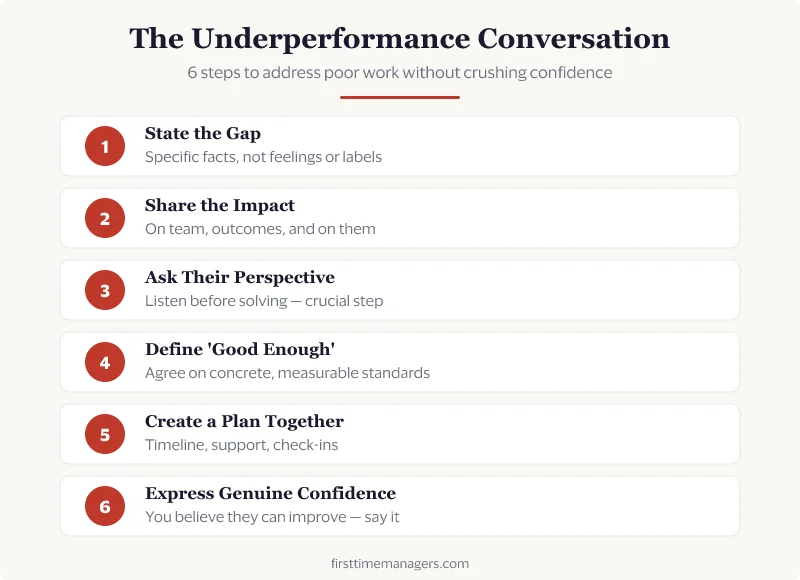
This is the structure I use every time I need to address underperformance. It works whether you’re dealing with a missed deadline or months of declining quality. If you’ve already read the guide to difficult conversations, this will feel familiar — but this version is specifically built for the “your work isn’t good enough” talk.
Need the exact words? The Difficult Conversations Scripts Pack includes a full Underperformance script with opening lines, how to handle defensiveness, measurable outcomes to set, and a follow-up email template. Plus 9 more scripts for other tough conversations. Get the Scripts Pack →
1. State the Specific Gap — Facts, Not Feelings
Start with what you’ve observed. Not your interpretation. Not your frustration. The observable, documentable facts.
Bad: “I feel like you’re not putting in enough effort lately.” Good: “The last three client reports have had significant data errors and were submitted after the deadline.”
This is the difference between specific vs vague feedback examples — and it matters enormously. Be specific. Dates, examples, deliverables. The more concrete you are, the less room there is for the conversation to devolve into “I feel like you’re picking on me.” You’re not picking on anyone. You’re pointing at the work. The constructive feedback examples library shows fifteen of these specific-vs-vague pairs across common situations (missed deadlines, repeated mistakes, attitude in meetings, scope creep) — the bad version managers default to and the good version that actually lands.
2. Share the Impact
This is where most people stop too early. It’s not enough to say what’s wrong — you need to explain why it matters. Connect the gap to real consequences.
“When those reports go out with errors, the client loses confidence in our data. Sarah had to spend half a day re-checking your numbers last week, which pulled her off the product launch. And it puts you in a position where people start double-checking your work by default — which I know isn’t where you want to be.”
Impact makes the conversation about the work, not about the person’s character. You’re not saying “you’re careless.” You’re saying “here’s what happens when this work isn’t right.”
3. Ask for Their Perspective
This is the step most managers skip — and it’s the most important one.
“That’s what I’m seeing from my side. I want to hear yours. What’s going on?”
Then stop talking. Seriously. Let the silence sit. This is where you find out whether you’re dealing with a skill gap, a clarity gap, a motivation issue, or something personal. This is where you learn things like:
- “I didn’t realize the deadline was firm — I thought it was flexible.”
- “I’ve been struggling with the new analytics tool and didn’t want to admit it.”
- “Honestly, I’ve been dealing with some stuff at home that’s been affecting my focus.”
- “I didn’t know you expected that level of detail.”
Their answer completely changes your next move. If they didn’t know the expectations, that’s a clarity problem you need to fix. If they’re overwhelmed, that’s a support problem. If they genuinely don’t care — that’s a different conversation entirely.
4. Agree on What “Good Enough” Looks Like
This is where vague feedback dies and real improvement starts. Together, define what the work needs to look like going forward. Be painfully specific.
“Going forward, client reports need to be submitted by end of day Wednesday — no exceptions without a heads-up 24 hours in advance. Each report needs to go through the data validation checklist before it comes to me. And I need the executive summary to actually summarize the key findings, not just restate the data.”
Write it down. Both of you should leave this conversation with the same concrete understanding of what success looks like. If you can’t articulate it clearly, you haven’t thought it through enough.
5. Create a Plan Together
Don’t just say “do better.” Build a real plan with real support. Lara Hogan’s feedback equation — observation plus impact plus request — is a useful structure here, and the plan you create should follow similar logic.
“I’d like to set up a 15-minute check-in every Monday for the next month so we can catch issues early. If you need training on the analytics tool, let’s get that scheduled this week. I want you to send me a draft of the next report by Tuesday so I can give you feedback before it’s final.”
Notice the word together. This isn’t a punishment plan handed down from on high. It’s a collaborative effort. You’re investing in their improvement. Use your one-on-one meetings as the natural place to track this.
If the gap turns out to be a skill problem rather than a will problem, the plan you sketch here is the first step of a longer cycle, and it has a shape worth following: diagnose together, co-design the plan rather than issue it, then hold a cadence. Our four-step framework for coaching an underperformer sets out all four steps, including how to tell in week four whether the coaching is working at all.
6. Express Genuine Confidence
End by telling them you believe they can do this — but only if you actually believe it. People can smell fake encouragement from a mile away.
“I wouldn’t be having this conversation if I didn’t think you could turn this around. You’ve done strong work before — the Henderson project was a great example. I want to help you get back to that level.”
If you don’t believe they can improve, that’s a signal you might be past the feedback stage and into performance management territory. More on that below.
Three Conversations, Three Scripts
Every underperformance situation is different. Here are three full scripts for the most common scenarios.
Script 1: Missed Deadlines
“Hey, can we talk for a few minutes? I want to check in on some things I’ve been noticing.
Over the last month, three of your deliverables have come in past the deadline — the campaign brief on the 5th, the metrics report on the 12th, and the client proposal last Friday. In each case, I didn’t get a heads-up that it would be late.
When deliverables are late without warning, it creates a chain reaction. The team can’t start their part, and I can’t give stakeholders accurate timelines. It also means I’m finding out about delays at the same time the client is, which puts us in a reactive position.
I want to understand what’s happening on your end. Is there something about the workload or the process that’s getting in the way?”
Then listen. Build the plan from what they tell you.
Script 2: Quality Issues
“I want to talk about the quality of some recent work, and I want to be straightforward about it because I think you deserve honesty.
The last two product analyses had significant gaps — the competitive section in the March report was missing three major competitors, and the financial projections in the April deck used last quarter’s numbers instead of current ones. I caught both before they went to the client, but that was luck, not process.
When work goes out with those kinds of errors, it undermines the team’s reputation and it puts you in a position where people start second-guessing your output. That’s not fair to you or them.
Help me understand — is there something about these assignments that’s not clicking? Are the expectations clear, or is there a gap I’m not seeing?”
Script 3: Effort and Engagement
This one’s the hardest because you’re essentially saying “I don’t think you’re trying.” You have to be very careful to stay on observable behavior.
“I’ve noticed some changes in how you’re approaching your work lately that I want to talk about openly.
In the last few team meetings, you haven’t contributed ideas when we’re brainstorming. The project plan you submitted last week was a copy of the template with minimal customization — it didn’t reflect the specific challenges we discussed. And I’ve noticed you’re leaving right at 5 every day, which is fine on its own, but combined with everything else, it’s creating a pattern.
I’m not here to lecture you about face time or clock-watching. But the overall pattern tells me something has shifted. The energy and initiative I used to see from you isn’t showing up in the work right now.
I’d rather hear what’s going on from you than keep guessing. What’s happening?”
Notice that none of these scripts include the word “lazy” or “careless” or “disappointing.” They describe behavior, not character. That distinction is everything.
When They Get Defensive or Emotional
It’s going to happen. Someone’s going to push back, or shut down, or tear up. Here’s how to handle it.
If they get defensive: Don’t match their energy. Stay calm and redirect to specifics. “I understand this is hard to hear. I’m not trying to attack you — I’m pointing at specific work products because I want us to fix this together. Can we look at the March report specifically?”
If they cry: It’s okay. Hand them a tissue. Give them a moment. Say: “Take your time. This is an important conversation and I want to have it when you’re ready.” Don’t rush past the emotion, but don’t let it derail the conversation entirely. You can take a short break and come back to it.
If they blame others: Listen first — sometimes they have a point. Then refocus. “I hear you about the resource constraints. Let’s talk about what you can control and what I need to help remove as a blocker.”
If they shut down completely: Acknowledge it. “I can see this landed hard, and I don’t want to push you into a conversation you’re not ready for. Can we pick this back up tomorrow morning? I want to hear your perspective.”
The worst thing you can do is back off entirely. If you walk away saying “never mind, it’s fine,” you’ve taught them that emotional reactions make accountability go away. Be compassionate, but don’t abandon the conversation.
When It’s Not the First Time
If you’ve already had this conversation and the work hasn’t improved, the second conversation sounds different. The tone shifts from collaborative to direct.
“We talked about the quality issues with your reports three weeks ago. We agreed on specific standards and a check-in process. Since then, I’ve seen the same data errors in two more reports, and the Tuesday draft review we set up has been skipped twice.
I need to be transparent with you — we’re at a point where I need to see consistent improvement in the next two weeks. This isn’t about perfection. It’s about meeting the standards we agreed on together. If we can’t get there, we’ll need to have a different kind of conversation about whether this role is the right fit.”
That’s not a threat. It’s honesty. And the person deserves to know where they stand rather than being blindsided later.
Feedback Conversation vs. Performance Warning
Know which one you’re having. They are not the same thing.
A feedback conversation is collaborative. It assumes good faith. It says: “Here’s a gap, let’s close it together.” The relationship is intact. You’re investing in the person’s growth.
A performance warning is formal. It says: “This has been addressed, the standard hasn’t been met, and there are consequences if it continues.” Documenting employee performance issues matters here — the language is precise, the timeline is firm, and the performance improvement plan steps need to be crystal clear.
Most new managers accidentally blur these two things — they give a casual feedback conversation when they should be escalating, or they come in with formal-warning energy when a simple coaching conversation would do.
If you’re unsure which one fits, ask yourself: “Do I believe this person can and will improve with support?” If yes, it’s a feedback conversation. If you’ve already given that support and it hasn’t worked, it might be time for a formal warning.
This is one of those areas where many first-time manager mistakes happen — either waiting too long to escalate or escalating too fast without giving the person a fair chance.
When to Involve HR
Involve HR before you need to involve HR. Seriously. Most HR teams would rather help you prepare for a difficult conversation than clean up the aftermath of one that went badly.
Reach out to HR when:
- You’re moving from feedback to a formal performance improvement plan
- The employee has raised a personal issue (health, disability, family situation) that might require accommodations
- You suspect the underperformance might be related to harassment, discrimination, or workplace conflict
- You’ve had the conversation twice and nothing has changed
- The employee is getting defensive to the point of hostility or making threats
- You’re unsure about the legal implications of anything you’re about to say
HR is not the enemy. They’re a resource. Use them.
The Conversation You’re Avoiding Is the One You Need Most
I know how this feels. You became a manager because you’re good at your job, not because someone handed you a manual for telling people hard truths. Every instinct is telling you to be nice, to soften the blow, to wait one more week.
But here’s what I’ve learned after years of having these conversations: the ones I’m most proud of aren’t the ones where I was gentle. They’re the ones where I was honest. Where I cared enough about someone to tell them the truth instead of letting them slowly fail while I said nothing.
Some of those people turned their performance around completely. A few of them have told me later it was the most important conversation they’ve ever had at work. Not because I was brilliant at delivering it — I wasn’t — but because I respected them enough to have it at all.
The person on your team whose work isn’t good enough? They deserve to know. And you’re the only person in a position to tell them.
So close this tab, open your calendar, and schedule the meeting. Thirty minutes. Private. This week.
You’ll feel sick beforehand. You’ll feel relieved after. And your team will be better for it.
Ready to walk in prepared? The Difficult Conversations Scripts Pack gives you word-for-word scripts for underperformance, missed deadlines, attitude problems, and 7 more tough conversations — plus a Conversation Prep Worksheet, the SBI Feedback Planner, and follow-up email templates. One PDF. Get the Scripts Pack →
🧮 Wondering if it’s worth the conversation — or cheaper to just replace them? Use our free Cost of a Bad Hire Calculator to see what underperformance actually costs per month versus the one-time cost of separation and replacement. Numbers help you decide when coaching is the right call — and when it isn’t.