Most reading lists on performance management have a quiet problem: every book on them agrees with every other book. You finish the list holding one opinion, more confidently than when you started, and you never find out that the opinion is contested.
That is a bad way to read about this particular subject, because performance management is the least settled thing a manager does. Two of the books below argue that the annual review is worth fixing. Two argue that the ratings inside it measure almost nothing. One argues the whole apparatus should be dismantled and replaced. They cannot all be right, and reading them against each other is the point.
You are probably not in a position to abolish anything. Most first-time managers inherit a review cycle, a rating scale and a deadline, and the honest question is not whether the system is good but what you can do well inside a system you did not design. Our complete guide to performance reviews covers the mechanics of running one. This list is about the thinking underneath it, including the thinking that says the mechanics are the wrong place to look.
What made the cut. Every book here (1) makes an argument rather than listing best practices, (2) is specific about what to do differently on Monday, (3) has survived long enough to be argued with, and (4) is about managing performance rather than about your own productivity. I left off the books that are really about goal setting, because those live on our goal setting reading list, and the ones about the conversation itself, which are on our difficult conversations list.
1. Nine Lies About Work, by Marcus Buckingham & Ashley Goodall
The book that explains why your rating of someone says more about you than about them.
- Authors: Marcus Buckingham and Ashley Goodall
- Published: 2019
- Find it on Amazon
Buckingham spent years at Gallup, Goodall ran leadership development at Deloitte and then Cisco, and the book is structured as nine claims that organizations repeat and the authors believe are false. Not all nine land equally. The two that matter most for a first-time manager land hard.
Why it made the list
The central finding, and the reason this book belongs at the top of a performance management list, is the idiosyncratic rater effect. When you rate someone on a scale, the variance in that number is driven far more by who is doing the rating than by who is being rated. Different managers rating the same person produce wildly different scores, and the pattern of a given manager’s scores stays stable across everyone they rate. Put plainly, your ratings are a reliable measurement of you.
Sit with what that does to the standard review. If the number is mostly about the rater, then calibration meetings are people averaging their own biases, and the resulting rating is being handed to a human being as though it were a fact about their year. The authors are not arguing that people cannot be assessed. They are arguing that asking a manager to score an abstract quality like “strategic thinking” is asking for noise, and that asking about your own future intentions (“would I want this person on my team again”, “would I promote this person today”) produces something far more reliable, because you are the reliable instrument for questions about yourself.
The second useful argument is about feedback. The authors go after the idea that people need to hear what is wrong with them in order to improve, and make the case that attention to what someone did well is the more powerful intervention, because excellence is not the absence of failure and cannot be derived from studying failure. This is the most contested part of the book, and worth reading alongside the books that disagree with it, which is exactly why the next two entries are here.
Where it is weak: the nine-lies structure forces some chapters into a contrarian shape they do not need, and the corporate examples are drawn from very large organizations. If you manage four people, some of it will feel like it is about somebody else’s problem.
Best for you if…
You have to assign ratings this cycle and you have a nagging sense that the numbers are theater. This book tells you exactly which part is theater and which part is salvageable, and gives you better questions to answer instead. Read it before your next calibration meeting, not after.
Key takeaway: the reliable question is not what someone is like, it is what you would do about them.
2. Crucial Accountability, by Patterson, Grenny, McMillan & Switzler
For the gap between the standard you set and what actually happened.
- Authors: Kerry Patterson, Joseph Grenny, Ron McMillan and Al Switzler
- Published: 2013 (second edition)
- Find it on Amazon
This is the sequel to Crucial Conversations, and the distinction between the two books matters more than the shared branding suggests. The first book is about conversations where opinions differ and stakes are high. This one is narrower and more useful for performance management: it is about what to say when someone did not do what they said they would do.
Why it made the list
Performance management is mostly a series of gaps. Someone promised Thursday and delivered the following Wednesday. Someone agreed to own the handover and it did not happen. The book’s contribution is a way to decide what the conversation is actually about before you open your mouth, using three levels: content, pattern and relationship.
Content is the single instance. The report was late this once, and you address that instance. Pattern is the second and third time, and it is a different conversation, because the subject is no longer the report, it is the reliability of the commitment. Relationship is when the pattern has gone on long enough that it has started to change what you can count on from this person at all. Most managers make one of two mistakes here, and the framework names both: they keep having the content conversation for the fifth time, which reads as nagging and changes nothing, or they jump straight to the relationship conversation on the second slip, which lands as wildly disproportionate and puts the other person into defense.
The other genuinely useful piece is the diagnostic that comes before the conversation, which separates motivation from ability. If someone can do the thing and did not, that is a different problem from someone who tried and could not, and the two require opposite responses. Managers routinely apply pressure to what is actually a capability gap, which is how you turn a solvable training problem into a performance case. Our guide on coaching an underperforming employee works through this distinction in a specific case, and the Should I Put This Employee on a PIP? assessment is a useful sanity check before you escalate anything.
Where it is weak: the acronyms pile up, and the writing has the workshop-handbook quality of a book that exists partly to support a training business. Skim the mnemonics and keep the CPR distinction, which is the part you will actually use.
Best for you if…
You have someone on your team who is not exactly failing but is quietly unreliable, and you have already had the polite version of the conversation twice. This book explains why the polite version stopped working and what the third conversation should be about instead.
Key takeaway: decide whether you are addressing an instance, a pattern or a relationship, and say which one out loud.
3. The Effective Manager, by Mark Horstman
The most operational book here, and the least interested in your philosophy.
- Author: Mark Horstman
- Published: 2016
- Find it on Amazon
Horstman spent years running Manager Tools, a podcast and consultancy built on a specific claim: that management results come from a small number of behaviors performed consistently, and that almost everything else managers worry about is noise. The book is the distilled version of that claim, and it is unusually direct about sequencing.
Why it made the list
The argument is that four behaviors produce most of the results: get to know your people, talk about performance, ask for more, and push work down. The order is not decorative. Horstman is emphatic that you do not start with the feedback, you start with the relationship, because feedback from a manager who has not spoken to you in six weeks is received as an attack regardless of how it is phrased.
The one-on-one is the foundation of the whole system, and his version is more prescriptive than most: recurring, weekly if you can, thirty minutes, on the calendar, and structured so the direct report speaks first for the first half. That last detail is the one that changes things in practice. Most new managers run a one-on-one that is functionally a status update in which they speak for twenty-five of the thirty minutes, and then conclude that one-on-ones are not very useful. If yours feel like that, our 1-on-1 effectiveness quiz will tell you fairly bluntly which half of the meeting has gone wrong.
The feedback model is similarly stripped down and deliberately small: describe the behavior, describe its effect, ask for a change. No sandwich, no preamble, and importantly, most of it positive and most of it delivered in seconds rather than scheduled. The reason this belongs on a performance management list is that it moves almost all of the load off the review. If feedback happens weekly in thirty-second increments, the annual conversation has nothing to reveal, which is precisely the state you want it in. Nothing in a review should be new information.
Where it is weak: it is dogmatic, and it knows it. Horstman tells you to do it his way for a year before you adapt it, which is either refreshing or irritating depending on your temperament. There is also little here about the organizational politics of performance, which the Buckingham book handles better.
Best for you if…
You do not need to be convinced that performance management matters, you need someone to tell you exactly what to put on the calendar and what to say in it. This is the closest thing on the list to an operating manual.
Key takeaway: the annual review should contain no surprises, and the way to guarantee that is weekly.
4. First, Break All the Rules, by Marcus Buckingham & Curt Coffman
The oldest book here, and the one that reframes what you are managing.
- Authors: Marcus Buckingham and Curt Coffman
- Published: 1999
- Find it on Amazon
This is the book that came out of Gallup’s large-scale interviews with managers and employees, and it is the origin of the twelve questions that a great many engagement surveys are still descended from. Reading it in 2026 is a slightly strange experience, because half of its once-radical claims are now received wisdom, and the other half are still ignored in practice.
Why it made the list
The central argument is that great managers do not try to fix people. They work out what each person is naturally good at and then engineer the role around it, on the grounds that talent is relatively fixed and skill is not. If someone is not naturally inclined to chase people for updates, you can train them in the process and they will still not do it reliably in month eight.
This is genuinely uncomfortable if you take it seriously, because it cuts against the developmental instinct that makes people good managers in the first place. Read carefully, though, the claim is narrower than the slogan. Buckingham and Coffman are not saying people cannot learn. They are distinguishing between things that respond well to training (knowledge and skills) and recurring patterns of thought and behavior that mostly do not. The practical consequence for performance management is that when someone is struggling, the first question is not what training to arrange, it is whether the role is asking them to be someone they are not on a daily basis. Sometimes the honest answer is that the person is fine and the role is wrong, which is a much easier problem to fix and one that almost never gets named in a review.
The twelve questions are still the fastest diagnostic in the book, and the first two are the ones most first-time managers fail: do I know what is expected of me at work, and do I have the materials and equipment I need. Those sound trivially easy until you ask your team and discover that two of them would answer differently from each other about the same project.
Where it is weak: the evidence is presented as more settled than it is, the writing has the confident house style of late-1990s business publishing, and the examples are drawn from an era of much larger and more stable organizations. Treat the twelve questions as a diagnostic worth running rather than as a law of nature.
Best for you if…
You have a person who is trying hard, is not obviously failing, and is somehow still not working out. This is the book that gives you a hypothesis other than “needs more support.”
Key takeaway: before you plan someone’s development, check whether the role is asking them to be a different person every day.
5. Abolishing Performance Appraisals, by Tom Coens & Mary Jenkins
The strongest case that the thing you are about to do is not fixable.
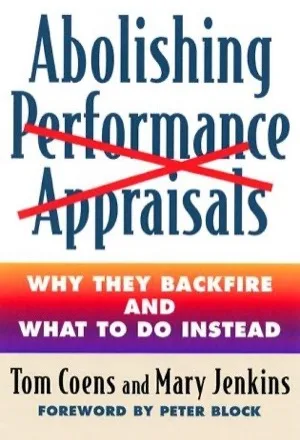
- Authors: Tom Coens and Mary Jenkins
- Published: 2000
- Find it on Amazon
Including this feels perverse on a list for managers who have to run reviews next month, and that is exactly why it is here. Coens and Jenkins argue that performance appraisal does not fail because it is done badly, it fails because it asks one conversation to serve several purposes that actively undermine each other, and that no amount of better forms or better training resolves the contradiction.
Why it made the list
The core observation is the one you will recognize immediately from your own experience. A single meeting is asked to do coaching, which requires the other person to be candid about what they are struggling with, and simultaneously to do evaluation, which determines their pay and standing and gives them every reason not to be candid at all. You cannot do both in the same room on the same afternoon, and the person opposite you resolves the conflict long before you do, by managing the impression rather than exploring the difficulty. Anyone who has watched a direct report visibly stop being honest the moment the conversation turns to their rating has seen this happen.
The authors trace the other purposes that pile onto the same meeting, including legal documentation, promotion decisions and organizational record keeping, and their point is that these are legitimate needs served terribly by bundling. The proposed alternative is to separate them: coaching happens continuously and is not scored, pay decisions are made explicitly and on their own terms, and documentation is kept when it is genuinely needed rather than manufactured annually for everyone.
You almost certainly cannot implement this. What you can do, and the reason it earns a place, is stop expecting one conversation to do all of it, and be explicit with your team about which conversation you are currently having. Saying “this part is about your rating and I will tell you what it is and why, and then we are done with that and the rest of this is coaching and nothing you say in it goes anywhere” is a small move available to any manager inside any system, and it removes most of the contradiction locally.
Where it is weak: it is the oldest and driest book on this list, it is written for people who own the process rather than people who are subject to it, and its practical chapters assume an organizational authority most readers of this site do not have. Read the diagnosis, skim the implementation.
Best for you if…
You have run a review cycle, followed the guidance carefully, and come away with the feeling that something structural was wrong rather than something you did. This book tells you what it was.
Key takeaway: coaching and evaluation cannot happen in the same conversation, so name which one you are in.
Where These Books Contradict Each Other
The list opened by promising disagreement, so it is worth being specific about where it actually is, because the contradictions are more useful than any single book’s conclusion.
On whether corrective feedback works at all. Buckingham and Goodall argue that telling someone what is wrong with them mostly produces defensiveness and rarely produces improvement, and that studying failure tells you nothing about how excellence is constructed. Horstman’s whole system runs on frequent feedback, and Crucial Accountability is entirely about delivering the uncomfortable half of it. These are not reconcilable positions, and pretending otherwise is how reading lists become mush. The narrower reading that survives contact with both: feedback about a specific observable behavior delivered within days is a different object from a rating of an abstract quality delivered annually, and most of the research the authors argue over is about the second. Horstman’s thirty-second correction on Tuesday is not what Buckingham is attacking.
On whether people change. First, Break All the Rules draws a hard line between skills, which are teachable, and recurring patterns of thought and behavior, which are mostly not, and tells you to stop trying to install the second kind. Crucial Accountability’s central diagnostic asks whether a gap is about motivation or ability, and quietly assumes ability is addressable. Take Buckingham too literally and every struggling person is a casting error you should solve by moving them. Take Patterson too literally and you will spend two quarters training someone into a shape they will not hold. The useful synthesis is that the ability question is worth asking once, seriously, with a real attempt attached, and that if the same gap survives a genuine attempt then the fit question is the honest next one rather than a failure of persistence.
On where the weight should sit. All five books agree the annual review is carrying more than it can hold, and then propose three different fixes. Horstman moves the weight forward into the week, so the review has nothing left to discover. Coens and Jenkins split the purposes apart, so no single conversation has to be both safe and consequential. Buckingham and Goodall change what is being asked, so the instrument stops pretending to measure something it cannot. Notice that only one of those three is fully available to a first-time manager. You cannot restructure the process and you cannot change the form, but nobody can stop you from making the review boring by handling everything in advance.
On what a rating is for. This is the disagreement with the sharpest practical edge. In Horstman’s world the rating is an administrative output, not the point, and you minimize its damage by removing surprise. For Buckingham and Goodall it is actively misleading and should be replaced with questions about your own intentions. For Coens and Jenkins it is the contaminant that makes the surrounding conversation impossible. If you are new and inheriting a scale, the practical order is: remove surprise first, because it is entirely within your control, then be honest with yourself about how much the number means, and only then worry about the system.
What None of These Books Will Help With
Worth saying plainly, because a reading list that implies completeness is doing you a disservice.
None of them are written for someone managing four people. Every author here has organizations of thousands in mind, and some of the advice does not scale down cleanly. Calibration across a peer group is not a thing you do when you are the only manager of your function. Formal documentation practices assume an HR apparatus that may not exist where you work.
None of them handle the situation where your own manager overrules you. You write a considered assessment, it comes back changed, and you now have to deliver a rating you do not agree with to someone you work with every day. That is one of the most common experiences a first-time manager has during a review cycle, and it is absent from all five books. Our guide on managing up as a new manager is closer to useful here than anything on this list.
None of them cover the inherited team. Four of the five assume you have been present for the performance you are assessing. If you took over in month nine, you are rating work you did not see, on standards you did not set, against a history you have to reconstruct from other people’s opinions. That is a distinct problem and it deserves its own treatment.
And none of them will make the paperwork shorter. If the cycle is eating your month, the answer is not in a book, it is in an honest count of where the hours go, followed by a conversation with whoever owns the process.
Quick Comparison
| Book | Best For | Core Argument | Published |
|---|---|---|---|
| Nine Lies About Work | Understanding why ratings are noisy | Ratings measure the rater, not the rated | 2019 |
| Crucial Accountability | The conversation after a broken commitment | Separate instance, pattern and relationship | 2013 |
| The Effective Manager | Knowing exactly what to schedule | A few behaviors, done weekly, produce most results | 2016 |
| First, Break All the Rules | The person who tries and still struggles | Fit the role to the person, not the reverse | 1999 |
| Abolishing Performance Appraisals | Diagnosing why the cycle feels broken | Coaching and evaluation cannot share a meeting | 2000 |
Which One Should You Read First?
If you read one, read The Effective Manager, and this is a recommendation about sequencing rather than quality. It is the only book here that changes what is on your calendar next week, and the other four get considerably more useful once the weekly rhythm exists, because they are all, in different ways, arguments about what to do with the information that rhythm produces.
The more honest answer depends on which part is hurting:
- You have to assign ratings and it feels like theater. Start with Nine Lies About Work.
- Someone keeps missing commitments and the polite conversation stopped working. Start with Crucial Accountability.
- You know it matters but not what to actually do. Start with The Effective Manager.
- Someone is trying hard and still not working out. Start with First, Break All the Rules.
- You suspect the system itself is the problem. Start with Abolishing Performance Appraisals.
If you want the language rather than the theory, our 150 performance review phrases covers the wording problem directly, and self-evaluation examples handles the half of the process your team writes.
If Your Review Cycle Starts in Two Weeks
You are not going to read five books before the deadline. Here is what each one contributes if you have an hour rather than a month, in the order that makes the hour count.
First, twenty minutes with a blank page, no book required. For each person, write the one sentence you would say about their year if you had to say it out loud with no form in front of you. Do this before you look at last year’s ratings or anyone else’s input, because both will anchor you. The sentences that come out slowly are the signal: they mark the people whose work you have not actually been watching, and that is a finding about your attention rather than their performance.
Then check your sentences for the rater problem. This is the Buckingham contribution and it takes five minutes. Read your five sentences side by side. If they are all warm, or all critical, or all hedged in the same way, you are looking at your own pattern rather than five different people. Rewrite the ones where you cannot point at a specific thing that happened.
Then sort every issue into instance, pattern or relationship. This is the Crucial Accountability contribution. For each concern you plan to raise, decide which of the three it is, and be prepared to say so. A single missed deadline raised as though it were a character trait will cost you the rest of the meeting, and a persistent reliability problem raised as though it were a one-off will change nothing.
Then remove every surprise you can, before the meeting. This is the Horstman contribution and it is the one that matters most if you are new. Anything in your notes that the person has not already heard from you should be said this week, in a short conversation, not saved for the review. A review that contains new criticism is not a review, it is an ambush with a form attached.
Then, in the meeting itself, name which conversation you are in. This is the Coens and Jenkins contribution, reduced to something you can actually do inside a process you do not control. Say that the first part is the rating and where it came from, finish that part, and then say explicitly that the rest is about next year and is not being scored. You will get more candor in the second half than most managers ever get.
And save the fit question for afterwards. This is the First, Break All the Rules contribution, and it does not belong in the review. If someone is trying hard and still struggling, the question of whether the role is asking them to be someone they are not is a separate conversation on a separate day, when neither of you is looking at a rating.
Beyond Books: The Cycle Is Decided Before It Starts
Every book on this list, including the one that wants to abolish the whole thing, ends up in the same place: what happens in the review is determined by what happened in the eleven months before it. That is inconvenient reading in the week you have to write six of them, but it points at where the effort actually pays.
Three things worth doing regardless of which book you pick up:
-
Write down what you would say about each person today, before the cycle starts. Not the rating, the sentence. If you cannot produce a specific sentence about someone’s year without opening a document, that is the finding, and it is about your attention rather than their performance.
-
Separate the two conversations out loud. You probably cannot restructure your company’s process, but you can say which part of the meeting is evaluation and which part is coaching, and stop expecting candor in the first part.
-
Count what the cycle actually costs you. Managers consistently underestimate this, and the estimate matters because it is the argument you will need if you ever want to change how it runs. The performance review time calculator puts a number on the hours the current cycle takes across your team.
Books will not make the annual review a good instrument. Two of the authors above would say nothing can. What they will do is stop you running it on autopilot, which is the difference between a cycle that documents a year and one that changes the next one.