You’ve been doing everything yourself. Sales, operations, customer service, bookkeeping, marketing. All of it. And it’s working, mostly. But you’re hitting a ceiling. There aren’t enough hours in the day, and the business needs more than one person can give.
It’s time to hire your first employee.
This is one of the biggest decisions you’ll make as a business owner. It’s exciting and terrifying in equal measure. You’re about to go from solopreneur to employer, and nobody gives you a playbook for that transition.
Until now. Here’s your step-by-step guide.
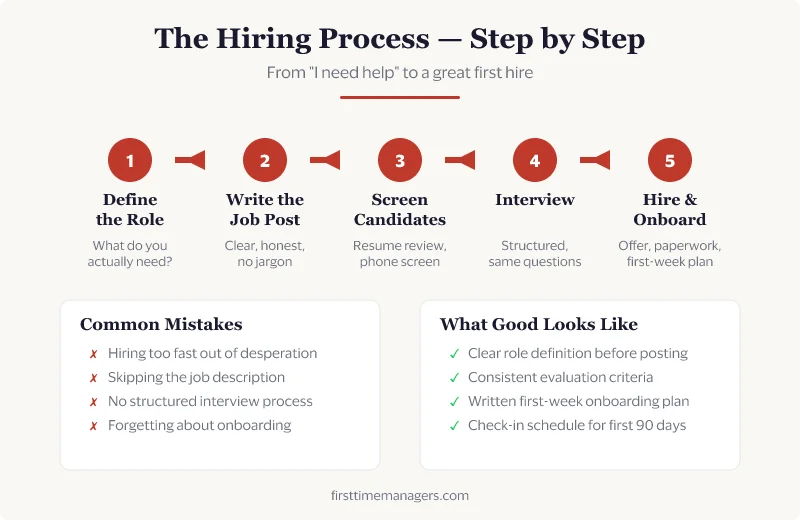
Before You Hire: Are You Actually Ready?
Not every busy founder needs an employee. Sometimes you need a system, a tool, or a contractor. Knowing when to hire vs outsource is one of the first decisions you’ll face, and hiring too early is just as dangerous as hiring too late. (If the pressure is showing up as constant overtime, run the overtime cost calculator: it converts those extra hours into full-time-equivalent work and shows whether a hire is actually the cheaper option.)
Hire when:
- You’re consistently turning down revenue because you can’t handle the volume
- A specific, repeatable function is eating 15+ hours of your week
- The work you need done requires consistency, loyalty, or deep knowledge that a contractor can’t provide
- You can afford to pay a salary for at least 6 months even if revenue dips
Don’t hire when:
- You’re busy but not sure what you’d actually delegate
- You need help with a one-time project (that’s a contractor or freelancer)
- You’re hoping an employee will “figure out” what needs doing (they won’t, and you need to know first)
- You can’t afford the full cost (salary + taxes + benefits + equipment + your time to manage them)
Employee or Contractor? This One Is Not a Preference
Before anything else, get this fork right, because it is a legal classification and not a choice you make for convenience. What the two of you agree to call the arrangement does not decide it. Under the Fair Labor Standards Act the question is the economic reality of the relationship: several factors get weighed together, and the core of it is whether the person is economically dependent on your business or genuinely running their own. Control over the work, who supplies the tools, how permanent the arrangement is, and how central the work is to your business all feed into that judgment.
In practice, if you set someone’s hours, direct how the work gets done, provide the equipment, and the work is what your business does, expect that person to be an employee.
Getting it wrong is one of the few first-hire mistakes that can cost more than the hire itself: back taxes, penalties, and owed benefits, assessed retroactively. The Department of Labor’s guidance on misclassification sets out the factors and is written for employers rather than lawyers, and the contractor vs employee calculator compares the true annual cost of each route so the decision is made on numbers rather than on which sounds simpler. Because the factors are weighed rather than scored, this is one of the places where the few hundred dollars for an attorney’s opinion is genuinely worth it. For the full picture, including the three separate tests you have to pass, why more than twenty states apply a stricter one than the federal government, and what the federal standard being rewritten in 2026 means for you, see contractor or employee.
Genuine contractor work looks different: defined deliverables, their own tools and schedule, a specialty you don’t need in-house year round. If that describes what you need, hire a contractor and be glad. It is faster, cheaper, and reversible.
The financial test: Can you pay this person’s full compensation for 6 months from cash on hand or very predictable revenue? If not, wait. The total cost of hiring an employee (salary, taxes, benefits, equipment, and your time to manage them) adds up fast, and a hire you can’t sustain is worse than no hire at all. Most first-time employers underestimate the loaded cost by 30-40%; the True Employee Cost calculator shows the full number in under a minute (salary, payroll tax, benefits, equipment, training, workspace, recruitment), so the 6-month test is run against the real figure, not just the salary line.
The other number worth knowing: when this person starts paying for themselves. A new hire is a loss for the first stretch, because they cost full price while producing at a fraction of full output. The new hire break-even calculator shows roughly which month that flips. Knowing the figure in advance stops the month-two panic when the hire has not yet earned their salary back, which is normal and not a sign you chose wrong.
Still not sure if you’re actually ready? The Am I Ready to Make My First Hire? free assessment walks you through 15 scenarios across role clarity, interview skills, bias awareness, onboarding, and decision confidence. Most first-time hirers score in the “Almost There” range. The quiz tells you exactly what to tighten before you post the role.
Step 1: Define the Role (Before You Write the Job Post)
The most common hiring mistake is posting a vague job listing and hoping the right person appears. They won’t. Clarity in, quality out.
Answer These Questions First
What exactly will this person do? List the 5-7 core responsibilities. Not “help with the business.” Specific tasks. “Respond to customer support emails within 4 hours. Process orders in Shopify. Create weekly social media posts.”
What does success look like at 30, 60, 90 days?
- 30 days: They can handle [X] independently
- 60 days: They’re managing [Y] without daily input from you
- 90 days: They’re [Z], and you’ve reclaimed 15+ hours per week
What skills are truly required vs. nice-to-have? Be honest. Do they really need 5 years of experience, or do they need to be organized, reliable, and willing to learn? Overspecifying kills your candidate pool.
Full-time or part-time? If the work doesn’t fill 40 hours, start with part-time. You can always increase hours. Reducing them is harder and more painful.
Remote, in-person, or hybrid? Each has trade-offs. For a first hire, in-person or hybrid often works better. It’s easier to train someone and build trust when you’re in the same space.
Write the Job Description
This is where most first-time employers stumble. A good job description attracts the right people and filters out the wrong ones. Our guide on how to write a job description that attracts the right people covers this in depth. Here are the essentials:
- Title: Clear and searchable (not “Rockstar Ninja Assistant”)
- About the company: 2-3 sentences. What you do, who you serve, what stage you’re at.
- The role: What they’ll actually do, day to day. Be specific.
- Requirements: Only the true must-haves. Separate from nice-to-haves.
- What you offer: Compensation range, benefits, schedule, growth opportunity. (Do not undersell the benefits: a solid package is often worth 20 to 40 percent of salary, and the benefits package value calculator shows the real dollar figure so you can make the full case to a candidate.)
- How to apply: Clear instructions. Keep it simple.
Pro tip: Include your salary range. Job posts with salary ranges get significantly more qualified applicants. It also filters out people who are too expensive before either of you wastes time.
Step 2: Find Candidates
You don’t need a recruiter or an expensive job board for your first hire. A smart small business recruitment strategy starts with the resources you already have. (One expectation to set now: the whole process, from posting to someone actually starting, usually runs six to ten weeks. The recruitment timeline calculator shows where those weeks go and which ones you can compress.)
Where to Look
Your network (best option). Tell everyone you know: friends, family, other business owners, your accountant, your dentist. The best first hires often come through personal referrals. Post on your personal LinkedIn and ask people to share.
Local job boards. Indeed, Craigslist (yes, still works for certain roles), local Facebook groups, community boards.
Industry-specific boards. If you’re hiring for a specific skill, post where those people hang out.
Your customers. Sometimes your best hire is someone who already knows and loves your product. Don’t be afraid to ask or post in your customer community.
How Many Applications Do You Need?
For a first hire, aim to review 20-30 applications and interview 5-7 people. Fewer than that, and you might settle. More than that, and you’ll get decision fatigue.
Step 3: Screen and Interview
If the whole process will happen over video and you will never be in a room with the candidate, the technique below still holds, but three things change: what the interview can no longer show you, what to substitute for it, and one signal video adds that will quietly decide the hire if you let it. Those are covered separately in hiring remotely.
The Resume Screen (15 minutes)
Don’t overthink this. You’re looking for three things:
- Relevant experience or transferable skills. Not a perfect match, just evidence they can do the work
- Stability and reliability signals. Reasonable tenure at previous jobs, clear progression
- Effort. Did they follow your application instructions? Did they write a cover note, or just blast a generic resume?
Create two piles: “Interview” and “Not right now.” Don’t agonize over the middle. When in doubt, interview.
The Phone Screen (15-20 minutes)
A quick call to confirm basics before you invest in a full interview:
- “Tell me about yourself and what interested you in this role.”
- “What’s your availability and salary expectation?”
- “Describe your experience with [key skill].”
- “What are you looking for in your next role?”
Red flags to listen for:
- They haven’t read the job description
- Salary expectations are way off from your range
- They badmouth previous employers
- They can’t explain what they’ve done in concrete terms
The In-Depth Interview (45-60 minutes)
This is where you really get to know the person. Structure matters. Research shows that unstructured interviews are unreliable predictors of job performance, and winging it leads to bad hires.
Use behavioral questions. Ask about specific past situations, not hypotheticals:
- “Tell me about a time you had to handle an angry customer. What happened?”
- “Describe a situation where you had multiple priorities competing for your time. How did you decide what to do first?”
- “Give me an example of a mistake you made at work. What did you do about it?”
- “Tell me about a time you had to learn something new quickly. How did you approach it?”
Why behavioral questions work: Past behavior is the best predictor of future behavior. Anyone can say “I’m great under pressure.” Not everyone can tell you a specific story that proves it.
One warning about the four above: they are the famous ones, which means candidates have rehearsed them. If you want questions specific enough that no prep list anticipated them, plus the follow-ups that break a polished answer, there are 50 behavioral interview questions sorted by competency to build your bank from.
Having the questions ready is the easier half. If this is your first time on the other side of the table, how to interview someone when you’ve never done it covers the part no question list prepares you for: the candidate who answers in six words, the one who talks at length without saying anything specific, the one who knows the work better than you do, and the moment they ask you something you cannot answer.
Also assess for:
- Culture fit. Will you enjoy working with this person 8 hours a day? Trust your gut here.
- Communication style. Can they explain things clearly? Do they listen?
- Self-awareness. Can they talk honestly about weaknesses and mistakes?
- Curiosity. Do they ask you good questions about the role and the business?
One discipline worth adopting from day one: ask every candidate the same core questions in the same order, and write your score for each answer down before you move to the next question. It feels stiff. It is also the only way you end up comparing candidates against the job rather than against whoever you happened to interview most recently.
The Practical Test
For your top 2-3 candidates, consider a paid practical test. 2-4 hours of real work that simulates the job:
- If you’re hiring for customer support, give them 5 sample emails to respond to
- If you’re hiring for operations, give them a process to document or a spreadsheet to organize
- If you’re hiring for marketing, ask them to draft 3 social media posts
Always pay for this. Even a small amount shows respect for their time and keeps you honest about the scope.
Check References Before You Decide
Most first-time employers skip references or treat them as a formality. That is a mistake, because references are the cheapest verification step you have and the only one where you hear about the candidate from someone who has actually managed them.
Two rules make them useful. First, insist on a former manager, not a colleague and not a friend. Second, ask questions that are hard to answer with a reflex compliment:
- “What did they need the most support with?”
- “If you were hiring again, what role would you put them in, and what role would you not?”
- “How did they handle being told their work needed changing?”
- “Would you rehire them? Why?”
Silence and careful phrasing tell you as much as the words. A manager who liked someone says so immediately. A long pause before “they were fine” is information. Where the role involves money, keys, vehicles, or vulnerable people, run a proper background check as well, and tell the candidate you are doing it.
Two things decide whether this call is worth making, and neither is the question list: when you make it, and who you call. Reference check questions covers the full set of fifteen, how to reach a manager the candidate did not hand-pick, how to open the call so you get a real answer, and what to do when their old company will only confirm dates.
Step 4: Make the Decision
You’ve interviewed your finalists. Now you need to decide. Here’s a framework:
The Three Questions
- Can they do the job? (Skills, experience, practical test results)
- Will they do the job? (Motivation, reliability, work ethic)
- Will they fit the environment? (Communication style, values, working style)
You need a “yes” on all three. A brilliant person who won’t stick around is worse than a good person who will.
Trust Your Gut, Then Verify It
If something feels off, it probably is. But also check: is your gut reacting to a real signal, or to unconscious bias? The candidate who reminds you of yourself isn’t automatically the best hire.
When in Doubt
If you’re torn between two candidates, ask yourself: “Who do I trust more?” Trust is everything in a first hire. You’re going to be working closely with this person, often without formal processes or oversight. Choose the person you’d trust to mind the shop while you’re away.
Step 5: Make the Offer
What to Include
- Title and start date
- Compensation. Salary or hourly rate, pay frequency
- Benefits. Health insurance, PTO, retirement (if applicable)
- Work schedule. Hours, location, flexibility
- Employment type. Full-time, part-time, at-will
- Probationary period. 90 days is standard, and it sets expectations for both sides
The Conversation
Call them. Don’t email the offer without talking first.
“I’m excited to offer you the [role] position. I was really impressed by [specific thing from interview], and I think you’ll be a great fit. Here are the details…”
Give them time to consider. 3-5 business days is reasonable. Don’t pressure.
Tell the Other Finalists No, and Do It Well
Your runners-up interviewed for hours, and in a small business your reputation travels through exactly the local network you just recruited from. Rejecting people badly, or by silence, is a slow tax on every role you post after this one.
Send it within 48 hours of your decision, by email, short and human. No false feedback, no “we’ll keep your resume on file” if you won’t. If someone was genuinely close, say so plainly and ask whether you can come back to them next time. First hires are often followed by second hires sooner than you expect, and the person you treated well in a rejection is the one who answers that call.
The Paperwork
Even for a small business, you need:
- Offer letter. The terms in writing (you can find a basic job offer letter template through your state’s small business development center or an employment attorney)
- W-4 and I-9 forms. Required by law in the US
- Employment agreement. If applicable (non-compete, IP ownership, confidentiality)
- Employee handbook. Even a simple 2-page version covering basics (PTO policy, communication expectations, conduct)
If this feels overwhelming, the SBA’s official guide to hiring employees covers the federal requirements step by step. You should also consult with a small business attorney for a few hundred dollars. It’s worth it. Getting the legal foundation right now prevents expensive problems later.
Step 6: Onboard Them Properly
A great hire with bad onboarding becomes a mediocre employee. Your first employee’s first week sets the tone for everything. For a complete walkthrough, see our new employee onboarding checklist.
Before Day 1
- Set up their workspace (desk, computer, tools, accounts, access)
- Prepare a first-week schedule
- Write down the top 5 things they need to learn first
- Tell your customers/clients/partners that someone new is joining
Day 1
- Welcome them personally. This matters.
- Walk them through the business: what you do, who your customers are, how things work
- Show them the tools and systems
- Give them one small, completable task. An early win builds confidence
- Have lunch together
Week 1
- Daily check-ins: “What questions do you have? What’s confusing?” These early conversations naturally evolve into regular one-on-one meetings as the relationship matures.
- Gradually increase responsibility
- Introduce them to key people (vendors, clients, partners)
- Document processes as you teach them (this benefits both of you)
The 90-Day Plan
- Days 1-30: Learn the basics, handle simple tasks independently
- Days 31-60: Take ownership of core responsibilities, need less daily guidance
- Days 61-90: Fully autonomous in the role, proactively improving processes
For a detailed week-by-week breakdown of this structure, see our first 90 days as a manager action plan. The same phased approach works for onboarding your first hire, and the onboarding timeline calculator gives you a realistic estimate of how long full productivity actually takes for your specific role, which is usually longer than 90 days.
Have a candid 90-day review: “Here’s what’s going well. Here’s what needs improvement. Here’s what I need from you going forward. What do you need from me?”
The Mistakes First-Time Employers Make
1. Hiring a mini-me. You need someone who complements your weaknesses, not someone who’s exactly like you. If you’re great at sales but terrible at details, hire the detail person.
2. Hiring too fast. Desperation leads to bad hires. A wrong hire costs you 3-6 months of salary plus the time to find a replacement. Take the extra week to get it right.
3. Not being clear about expectations. “Help me run the business” is not a job description. Be painfully specific about what you need.
4. Underpaying. You get what you pay for. A cheap hire who quits in 3 months costs more than a fairly-paid hire who stays 3 years. Pay market rate or above.
5. Not letting go of control. You hired someone so you could stop doing everything. Let them do their job. Micromanaging destroys morale and defeats the purpose of hiring.
6. Skipping the legal basics. Employment law exists whether you know about it or not. Get your paperwork right. Consult a professional.
7. Expecting them to be you. They won’t do things exactly the way you do. That’s okay. Focus on outcomes, not methods. If the result is good, the path doesn’t matter.
If It Doesn’t Work Out
Nobody plans this section into their first hire, which is exactly why it goes badly when it happens. Some percentage of first hires do not work, and it is usually not because the person was lazy. It is because the role was defined loosely, the training was improvised, or the fit was wrong in a way no interview surfaces.
Separate the two possible causes honestly. If they cannot do the work despite clear expectations, real feedback, and a fair run at it, that is a hiring outcome. If they never got clear expectations in the first place, that is a management outcome, and firing them will hand you the identical problem with the next person.
Act within the probationary period, not after it. The kindest version of this conversation happens at week 8, not month 10. Say the specific gap out loud early, in writing, with what “fixed” looks like and by when. Most first-time employers do the opposite: they hint for months, hope it resolves, then let someone go who genuinely did not see it coming.
Know the real cost before you delay. Carrying a hire who is not working is expensive in a way that stays invisible until you total it: your time, the work not getting done, and the effect on everyone watching how you handle it. The employee turnover cost calculator puts a figure on the replacement, and it is almost always smaller than the cost of another six months of avoidance.
And when the paperwork ends, consult your attorney about final pay timing and documentation before the conversation, not after. Rules vary by state and the deadlines are shorter than people expect.
One Last Thing
Hiring your first employee is a milestone. It means your business has grown beyond what one person can handle. That’s an achievement worth acknowledging. (And as the hires keep coming, structure becomes its own question. The manager-to-IC ratio calculator shows when your growing org actually needs another lead, and when it does not.)
It also means you’re now responsible for someone’s livelihood. Their paycheck, their professional development, their daily experience at work. That’s a privilege and a responsibility.
Take it seriously. Invest in the relationship. And remember: the first person who bets their career on your business deserves the best version of you as a boss.
If you want to go deeper on any of these steps, check out the best books on hiring your first employee. Five books that give you proven systems for everything from writing scorecards to running structured interviews.
Drilling deeper into each step. The job description guide, the interview questions guide, and the first-week onboarding checklist cover the three phases that most first-time hiring decisions fall apart in. The first 90 days tax bill framework explains why a new hire costs more than they produce at the start, and how to shorten that stretch.
🧮 Before you hire, see what a bad hire actually costs. Use our free Cost of a Bad Hire Calculator to put a dollar figure on the wrong hire: sunk hiring costs, lost productivity, separation, replacement, and team damage. DOL says 30% of salary. Real-world cost is often 1.5-3x. Takes 60 seconds.
🧮 Every week the role stays open is a week of lost output. The Cost of an Empty Seat calculator puts a number on the weekly bill: lost revenue, overload on the rest of the team, and the rising probability someone else quits picking up the slack. Most managers underestimate this and end up rushing the wrong hire to stop the bleeding. The math helps you decide whether to wait one more week for a stronger candidate or move on the one in front of you now.