The first time I had to hire someone, I was terrified of picking the wrong person. Not the “mild anxiety” kind of terrified — the “I will personally have to fire this person if I get this wrong” kind.
And here’s the thing nobody tells you: most first-time managers and small business owners have zero training in hiring. You learn on the job, which means you learn by making expensive mistakes. A bad hire doesn’t just cost you a salary — it costs you months of your time, your team’s morale, and sometimes your own credibility.
These five books changed how I think about hiring. Not all of them are strictly “hiring books” — some are about building teams, evaluating talent, or understanding what actually predicts job performance (spoiler: it’s not what you think). But together, they gave me a framework I still use every time I need to fill a role.
How I picked these five:
- They had to be useful for someone hiring their first, second, or third employee — not for corporate recruiters filling 200 roles a year
- They had to offer a repeatable system, not just theory or inspiration
- They had to challenge at least one common hiring myth (there are many)
- I had to have actually read them and used something from each one
1. Who: The A Method for Hiring
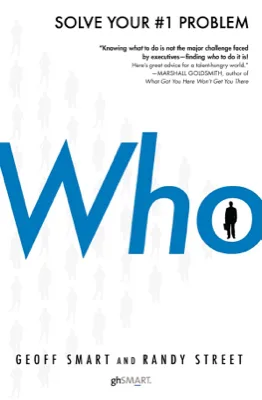
By Geoff Smart & Randy Street Published 2008 · 208 pages · ⭐ 4.1/5 View on Amazon
If you read only one book on hiring, make it this one. Who argues that the single most important thing a manager does is get the right people in the right seats — and that most hiring processes are designed to fail. The authors identify “voodoo hiring” methods (gut instinct, trick questions, personality tests) and replace them with a four-step process: scorecard, source, select, sell.
Why it made the list: The scorecard concept alone is worth the book. Before you interview anyone, you define exactly what success looks like in the role — outcomes, competencies, and cultural fit. It sounds obvious, but almost nobody does it. When you have a scorecard, interviews stop being “do I like this person?” and become “can this person deliver these specific outcomes?”
Best for you if: You’ve never hired before and want a complete, step-by-step system. The book is short, practical, and tells you exactly what to ask in every interview.
“The number one problem in business is the inability to identify and attract the right people.”
2. Work Rules!: Insights from Inside Google That Will Transform How You Live and Lead
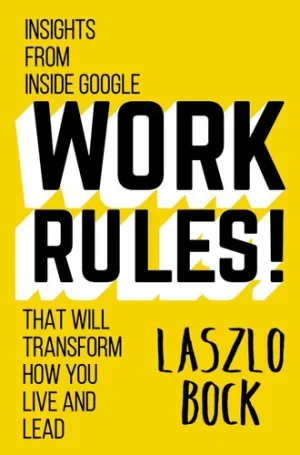
By Laszlo Bock Published 2015 · 416 pages · ⭐ 4.1/5 View on Amazon
Laszlo Bock ran People Operations at Google for a decade. This book is his distillation of what actually works in hiring, management, and culture — backed by data from one of the most studied companies in the world. The hiring chapters alone justify reading the entire book.
Why it made the list: Bock challenges common hiring assumptions with data. Unstructured interviews? His verdict is that they predict job performance about as well as flipping a coin, and it is worth flagging that later reanalysis has softened that specific claim, though the practical conclusion he draws from it has held up. Years of experience? Barely correlated with success after the first two years. What does work: structured interviews with consistent questions, work sample tests, and cognitive ability assessments. Even if you’re hiring for a 5-person team, these principles scale down perfectly.
Best for you if: You want evidence-based hiring practices, not folklore. Especially valuable if you’re the kind of manager who wants to understand why something works, not just what to do.
“The best predictor of how someone will perform in a job is a work sample test. Not the interview. Not their resume. A work sample.”
3. The Best Team Wins: Build Your Business Through Predictive Hiring
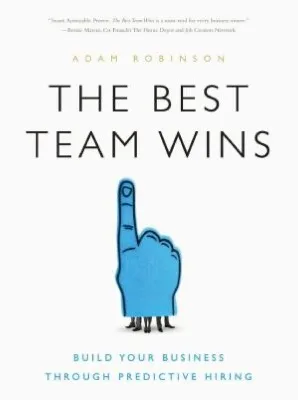
By Adam Robinson Published 2017 · 224 pages · ⭐ 4.4/5 View on Amazon
Adam Robinson wrote this specifically for small and mid-size businesses — not Fortune 500 companies with dedicated recruiting departments. His “predictive hiring” approach focuses on identifying the behaviors and traits that actually predict success in a role, then structuring your entire process around finding those signals.
Why it made the list: This book is the most practical for first-time hirers. Robinson walks you through writing better job ads, phone screens, structured interviews, and reference checks — all with templates and scripts you can use immediately. His framework for scoring candidates reduces the “gut feeling” problem that leads to bias and regret. He also covers the employer brand problem honestly: when you’re small and unknown, you can’t just post a job and wait for great candidates to find you.
Best for you if: You’re a small business owner or startup founder making your first few hires. This book respects the reality that you don’t have a recruiter, an ATS, or a strong employer brand — and works within those constraints.
“The cost of a bad hire isn’t just the salary. It’s the lost productivity, the damaged morale, the management time, and the opportunity cost of what that seat could have been.”
4. Hiring for Attitude: A Revolutionary Approach to Recruiting and Selecting People with Both Tremendous Skills and Superb Attitude
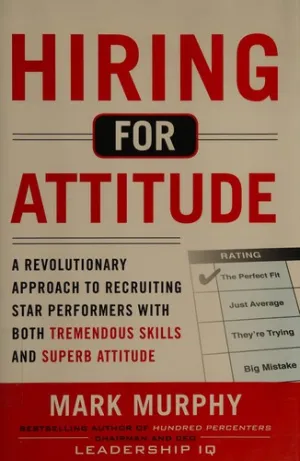
By Mark Murphy Published 2012 · 240 pages · ⭐ 4.0/5 View on Amazon
Mark Murphy’s research found that 46% of new hires fail within 18 months — and of those failures, 89% were for attitudinal reasons, not technical skill. People get hired for what they can do and fired for who they are. This book flips the typical hiring approach by putting attitude, coachability, and emotional intelligence at the center of your evaluation process.
Why it made the list: It changed how I think about what I’m actually screening for. Technical skills can be taught. Work ethic, accountability, resilience, and the ability to take feedback — those are much harder to develop. Murphy gives you specific interview questions designed to surface attitude (not just rehearsed answers), and a framework for defining what “good attitude” actually means for YOUR team and culture. This is not about hiring “nice people” — it’s about hiring people whose natural behaviors match what your environment demands.
Best for you if: You’ve been burned by a hire who looked great on paper but was a disaster to work with. Or if you’re building a small team where culture and fit matter as much as skills — because when there are only 3-5 people, one toxic hire poisons everything.
“Hiring failures are not usually about skills. They’re about attitude — coachability, emotional intelligence, motivation, and temperament.”
5. Topgrading: The Proven Hiring and Promoting Method That Turbocharges Company Performance
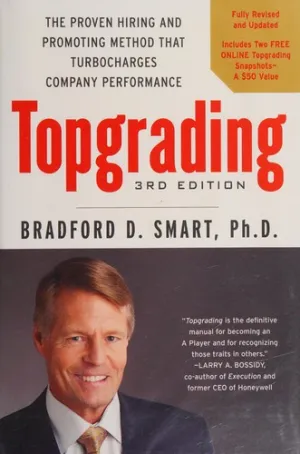
By Bradford D. Smart Published 2012 (3rd edition) · 592 pages · ⭐ 4.0/5 View on Amazon
Topgrading is the most comprehensive (and demanding) hiring methodology on this list. Brad Smart argues that most companies tolerate a 50% mis-hire rate because they don’t know how to do better — and that a rigorous, structured approach can bring that rate below 10%. The centerpiece is the “Topgrading interview” — a chronological walk through the candidate’s entire career history, job by job, asking the same questions for each role: what were you hired to do, what did you accomplish, what mistakes did you make, who was your boss and what would they say about you?
Why it made the list: The TORC technique (Threat of Reference Check) is brilliant. You tell candidates upfront that the final step is a reference check — and you’ll ask THEM to arrange the calls with their former bosses. This single move eliminates most exaggeration and dishonesty in interviews, because candidates know their claims will be verified. Even if you don’t adopt the full Topgrading methodology, the TORC technique and chronological interview structure are immediately useful.
Best for you if: You’re making a critical hire — the kind where getting it wrong would seriously hurt your business. This book is more intense than the others, but the payoff for high-stakes hiring decisions is enormous. Skim the parts about large organizations and focus on the interview methodology and reference check approach.
“The most important decisions leaders make are people decisions. And the most common mistake is spending too little time and effort on getting them right.”
Quick Comparison
| Book | Best For | Core Framework | Pages | Rating |
|---|---|---|---|---|
| Who | Complete hiring system from scratch | Scorecard → Source → Select → Sell | 208 | ⭐ 4.1 |
| Work Rules! | Evidence-based hiring practices | Structured interviews + work samples | 416 | ⭐ 4.1 |
| The Best Team Wins | Small business / first-time hirers | Predictive hiring with templates | 224 | ⭐ 4.4 |
| Hiring for Attitude | Screening for culture and fit | Attitude-first interviewing | 240 | ⭐ 4.0 |
| Topgrading | High-stakes, critical hires | Chronological interview + TORC | 592 | ⭐ 4.0 |
Which One Should You Read First?
It depends on where you are:
“I’ve never hired anyone before and I need a system.” Start with Who. It gives you a complete, repeatable process in under 210 pages. You’ll walk away knowing exactly what to do before, during, and after interviews.
“I’m making my first hire for a small team and I need something practical, not theoretical.” Start with The Best Team Wins. Adam Robinson wrote it for people like you — small teams, no recruiter, limited brand recognition. Templates and scripts included.
“I’ve hired before, but my picks keep not working out.” Read Hiring for Attitude. If your hires have the skills but not the fit, you’re probably screening for the wrong things. Murphy’s framework will change what you look for in interviews.
“I want to understand what actually predicts job success, backed by data.” Read Work Rules! Bock’s insights from Google apply to teams of any size. You’ll stop trusting your gut and start trusting structured evidence.
“I’m making a hire that absolutely cannot go wrong.” Read Topgrading. It’s the most rigorous approach and requires more time investment, but for a make-or-break hire, that rigor pays for itself ten times over.
Beyond Books: What to Do This Week
Reading about hiring is valuable. But the real shift happens when you put frameworks into practice. Here are four things you can do right now:
-
Write a scorecard before your next job posting. Define 3-5 outcomes the person needs to deliver in their first year. Not responsibilities — outcomes. This is the single most impactful change from Who.
-
Prepare structured interview questions in advance. Write 8-10 questions that you’ll ask every candidate in the same order. Score their answers on a 1-5 scale. This eliminates the “I just liked them” problem from Work Rules!
-
Add one attitude question to every interview. “Tell me about a time you received critical feedback that was hard to hear. What did you do?” The answer tells you more about long-term fit than any technical question. Straight from Hiring for Attitude.
-
Tell candidates you’ll ask them to arrange reference calls. Even if you never do a formal Topgrading interview, the TORC technique from Topgrading eliminates most exaggeration instantly.
When You Are Ready to Hire
If you are actively hiring (or about to), these books give you the knowledge. The companion guides on the site cover the practical execution: how to hire your first employee (the full pillar), how to write a job description that attracts the right people, interview questions for small business owners, and the first-week onboarding checklist. For the math, the True Employee Cost calculator (the fully loaded annual cost, not just salary), the Cost Per Hire calculator, and the Cost of Bad Hire calculator give you the numbers most managers do not have when they start. And if the book you actually need right now is a question sheet rather than a book, the 50 behavioral interview questions by competency are ready to use in your next interview.