You know you’re burning out. You’ve taken the quizzes. You’ve read the warning signs. You’ve told yourself you’ll “take a break soon” for the sixth month in a row.
The last thing you want is another 400-page book on your nightstand making you feel guilty for not reading it.
I get it. So here’s the deal: every book on this list is under 320 pages. Each one attacks burnout from a different angle — the biology, the workplace systems, the mindset, the recovery. And each one gives you something concrete you can do this week, not just something to think about.
What made the cut: Every book (1) is backed by real research or decades of practice, (2) goes beyond “just take a bath and meditate,” (3) addresses the specific pressures managers face, and (4) won’t take you more than a weekend to read.
1. Burnout: The Secret to Unlocking the Stress Cycle — Emily & Amelia Nagoski
The best book for understanding why you’re exhausted even when you “should” be fine.
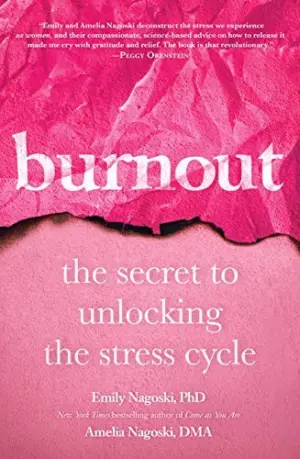
- Authors: Emily Nagoski, PhD & Amelia Nagoski, DMA
- Published: 2019 | Pages: 304
- Rating: 4.3/5 (45,000+ ratings)
- View on Amazon
This is the book that reframes everything. The Nagoski sisters’ core insight is deceptively simple: dealing with the stressor is not the same as dealing with the stress. You can solve the problem at work — the deadline, the difficult employee, the impossible project — and still carry the stress in your body. That’s why you feel exhausted even after the crisis passes.
Why it made the list
Most burnout advice focuses on removing stressors: better time management, set boundaries, delegate more. That’s important — we wrote a whole guide on prevention systems. But the Nagoskis explain why that’s not enough. Your body has a stress response cycle that needs to be completed, and if you don’t complete it, the stress accumulates physically — regardless of whether the problem got solved.
The book gives you practical ways to complete the stress cycle: physical activity, breathing exercises, creative expression, and social connection. These aren’t woo-woo suggestions — they’re grounded in neuroscience and human physiology.
For managers, this is particularly powerful because your job generates stress that often has no resolution. You can’t “fix” the fact that your boss changed priorities again. You can’t “solve” the team member who’s underperforming. But you can process the stress those situations create, and that changes everything about how you show up the next day.
Best for you if…
You do all the “right” things — you exercise, you have boundaries, you’re organized — and you’re still exhausted. You need someone to explain the biology of why that happens and give you specific tools to break the cycle.
Key takeaway: “To deal with stress, you have to complete the stress response cycle. Dealing with the thing that caused the stress doesn’t automatically complete the cycle.”
2. The Body Keeps the Score — Bessel van der Kolk
The best book for understanding what chronic stress actually does to you.
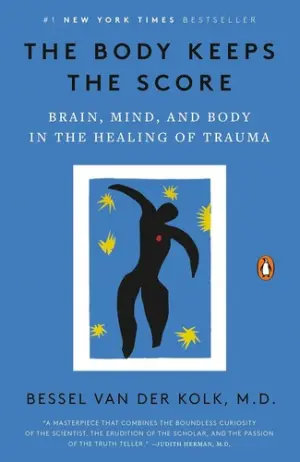
- Author: Bessel van der Kolk, MD
- Published: 2014 | Pages: 464
- Rating: 4.4/5 (180,000+ ratings)
- View on Amazon
I know — 464 pages. I said everything on this list is under 320. But this book is worth the exception. It’s the most important book on this list, and you can read the first 150 pages and get 80% of the value.
Van der Kolk is a psychiatrist who spent 30 years studying how stress and trauma live in the body. While this book covers severe trauma, the sections on chronic stress are directly relevant to every manager running on empty.
Why it made the list
This book explains why burnout manifests physically — the insomnia, the headaches, the jaw clenching, the constant low-grade anxiety that won’t go away even on vacation. Your body is keeping score of every stressful meeting, every sleepless night, every time you absorbed someone else’s emotional crisis.
For managers, the chapter on “being in charge of yourself” is essential reading. It covers how chronic stress rewires your nervous system — making you more reactive, less patient, and worse at exactly the skills management requires (empathy, listening, judgment under pressure). This is why burnout makes you a worse manager, not just a tired one.
The practical takeaway: your body needs recovery that goes beyond sleep. Movement, breathwork, and genuine safety in relationships are biological necessities, not luxuries. When you understand the neuroscience, “self-care” stops feeling selfish and starts feeling like professional maintenance.
Best for you if…
You’ve been stressed for so long that it feels normal. You can’t remember the last time you felt genuinely relaxed. You notice physical symptoms — tension, fatigue, irritability — that don’t go away with rest. This book explains what’s happening and what to do about it.
Key takeaway: “Being able to feel safe with other people is probably the single most important aspect of mental health; safe connections are fundamental to meaningful and satisfying lives.”
3. Dying for a Paycheck — Jeffrey Pfeffer
The best book for understanding that the problem might not be you — it might be the system.
- Author: Jeffrey Pfeffer (Stanford Business School)
- Published: 2018 | Pages: 272
- Rating: 4.2/5 (1,000+ ratings)
- View on Amazon
This is the angry book on the list. Pfeffer, a Stanford management professor, argues that modern workplace practices are literally killing people — and he has the data to prove it. Workplace stress contributes to an estimated 120,000 deaths per year in the US and $190 billion in healthcare costs.
Why it made the list
Every other book on this list focuses on what YOU can do about burnout. This one asks a different question: why is the workplace like this in the first place?
Pfeffer’s research shows that the biggest drivers of workplace stress aren’t individual — they’re systemic. Long hours, economic insecurity, lack of autonomy, work-family conflict, toxic management practices. He names specific companies and industries, backs everything with data, and doesn’t pull punches.
For managers, this book is a mirror and a warning. A mirror because you may recognize your own organization’s practices in his research. A warning because as a manager, you are both a victim of these systems AND a potential propagator of them. Every time you send a late-night email, expect weekend availability, or fail to push back on unreasonable workloads, you’re passing the stress downstream to your team.
This isn’t a guilt trip — it’s a wake-up call. You can’t fix the system alone, but you can refuse to participate in the worst of it. And sometimes, as we discussed in the recovery guide, the right answer is to leave.
Best for you if…
You suspect your burnout isn’t a personal failure — it’s a predictable outcome of a broken environment. You want data and research to validate what you already feel: that something about how we work is fundamentally wrong.
Key takeaway: “The workplace has become the fifth leading cause of death in the United States — and it doesn’t have to be this way.”
4. How to Stop Worrying and Start Living — Dale Carnegie
The best book for the manager whose brain won’t shut off at night.
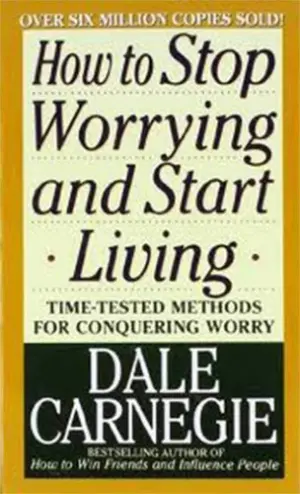
- Author: Dale Carnegie
- Published: 1948 | Pages: 320
- Rating: 4.2/5 (80,000+ ratings)
- View on Amazon
Yes, 1948. This book is almost 80 years old. And it’s still on this list because the fundamental nature of worry hasn’t changed — only the delivery mechanisms have (now it’s your phone buzzing at midnight instead of a telegram).
Why it made the list
Carnegie was writing for business professionals who couldn’t stop their minds from racing — lying awake at 2 AM thinking about the meeting tomorrow, the decision they made last week, the project that might fail. Sound familiar?
The book’s greatest strength is its relentless practicality. Carnegie doesn’t philosophize about worry — he gives you specific techniques to interrupt it:
- “Live in day-tight compartments” — stop borrowing tomorrow’s problems. Most of what managers worry about never happens.
- The worry decision tree — ask: “What’s the worst that can happen? Can I accept that? What can I do to improve on the worst?” Then act, and stop spinning.
- The “busy” cure — anxiety lives in idle space. When you catch yourself spiraling, do something physical or productive. Not as avoidance — as interruption.
These feel obvious when you read them. That’s because they work. Carnegie collected hundreds of real stories from executives, managers, and professionals who applied these principles. The stories are dated, but the psychology is timeless.
For managers specifically, the chapters on decision-making worry and criticism worry are gold. You will never stop making decisions people disagree with. You will never stop being criticized. Carnegie teaches you to make the decision, accept the criticism, and move forward — instead of replaying it in your head for three days.
Best for you if…
Your burnout isn’t from overwork — it’s from overthinking. You lie awake at night replaying conversations. You worry about things you can’t control. You need someone to grab you by the shoulders and say “here’s how to stop doing that.” Carnegie is that person.
Key takeaway: “Our main business is not to see what lies dimly at a distance, but to do what lies clearly at hand.”
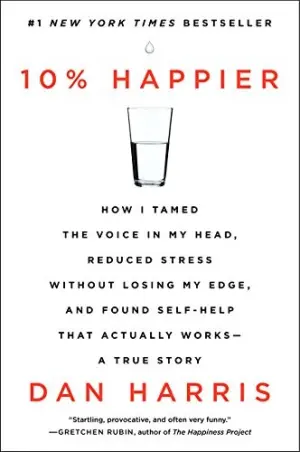
5. 10% Happier — Dan Harris
The best book for the skeptical manager who thinks meditation is nonsense.
- Author: Dan Harris
- Published: 2014 | Pages: 256
- Rating: 4.0/5 (25,000+ ratings)
- View on Amazon
Dan Harris is an ABC News anchor who had a panic attack on live television, then reluctantly discovered meditation — while remaining deeply skeptical of anything that sounded even vaguely spiritual. This book is his journey from “meditation is for hippies” to “okay, this actually works, but I’m not going to be weird about it.”
Why it made the list
Every burnout book eventually mentions mindfulness. Most managers tune out at that point. “I don’t have time to sit on a cushion. I have a team to manage.”
Harris wrote this book for exactly those people. He’s not a guru. He’s a type-A, ambitious, skeptical journalist who tried meditation as a last resort and found that it made him roughly 10% happier. Not enlightened. Not transformed. Just… slightly less reactive, slightly more aware of his own mental patterns, slightly better at not getting hijacked by stress.
That 10% matters enormously for managers. The difference between reacting to a crisis and responding to it. The difference between absorbing your team’s stress and noticing it without drowning in it. The difference between spiraling into burnout and catching yourself before you spiral.
Harris makes the case with humor, self-deprecation, and zero spiritual language. If you’ve ever thought “I should probably try meditation but the whole thing seems ridiculous” — this is the book that will actually get you to try it.
Best for you if…
You’re stressed, skeptical, and allergic to anything that smells like self-help. You want evidence and honesty, not platitudes. You’re willing to try something new if someone makes the case without being insufferable about it.
Key takeaway: “The voice in my head is an asshole. Mindfulness is about not being carried away by that voice.”
Comparison: Which One Should You Read First?
| Book | Best for | Time to read | Practical vs. philosophical |
|---|---|---|---|
| Burnout | Understanding the stress cycle | 6-8 hours | 70/30 practical |
| The Body Keeps the Score | Understanding what stress does to your body | 10-12 hours | 50/50 balanced |
| Dying for a Paycheck | Understanding systemic causes | 5-7 hours | 60/40 research-driven |
| Stop Worrying, Start Living | Stopping the mental spiral | 6-8 hours | 90/10 practical |
| 10% Happier | Starting meditation without the woo | 5-6 hours | 60/40 practical |
If you’re actively burning out right now: Start with Burnout. Understanding the stress cycle will give you immediate tools.
If you’re the overthinking type who can’t shut off at night: Start with Stop Worrying, Start Living. It’s the most immediately actionable.
If you’re skeptical of everything: Start with 10% Happier. Harris will earn your trust before asking you to try anything.
If you want to understand the big picture: Start with Dying for a Paycheck. It validates what you’re feeling and puts it in systemic context.
If you want the deepest understanding: Read The Body Keeps the Score. It’s the longest but the most transformative.
🔥 Not sure if you’re burning out? Take the free Are You Burning Out? quiz — 15 questions across 5 dimensions (Emotional Drain, Cynicism, Overload, Identity Erosion, Physical Warning Signs). 4 minutes, no email required.
📖 Already know you’re burning out? Read the full 3-part burnout series: recognize the signs, build prevention systems, and find the way back.