Here’s the awkward truth about AI books for managers: most of them are written by people who don’t manage anyone.
They’re written by futurists, venture capitalists, and tech CEOs who have teams of PhDs to run the numbers for them. Their advice is either so abstract it’s useless (“embrace the paradigm shift!”) or so technical you need a computer science degree to apply it.
That’s not what you need. You need books written by people who understand two things: (1) AI is moving faster than your company’s official policies can keep up, and (2) you still have to run a 1-on-1 with Jessica tomorrow and figure out what to say when your boss asks if you’re “using AI yet.”
These five books are the ones that respect your time and your role. Each one gives you a framework you can actually use — whether you want to experiment with AI yourself, help your team adopt it, or just stop feeling like you’re falling behind.
What made the cut: Every book on this list (1) is written by someone who has skin in the game (teaches, leads, or researches real organizations), (2) gives you frameworks, not just predictions, (3) is readable in under a week, and (4) will still be useful in a year — even though AI moves fast.
1. Co-Intelligence: Living and Working with AI — Ethan Mollick
The best book for any manager who wants to actually understand what AI can do — and what it can’t.

- Author: Ethan Mollick (Wharton School professor)
- Published: 2024 | Pages: 256
- Rating: 4.5/5 (5,000+ ratings)
- View on Amazon
If you only read one book on this list, read this one. Mollick is a business professor at Wharton who has spent the last two years experimenting with AI in classrooms, research labs, and with companies. He’s not a hype merchant — he’s the rare academic who’s genuinely tried the tools and can explain what works and what doesn’t in plain language.
Why it made the list
The book’s core idea is simple and useful: treat AI as a co-worker, not a calculator. Mollick lays out four practical rules that will change how you use AI immediately:
- Always invite AI to the table. Try it on every task you do. You’ll be surprised what it’s good at and what it’s terrible at.
- Be the human in the loop. AI produces confident nonsense sometimes. Your job is to catch it.
- Treat AI like a person (but tell it what kind of person). “Act as a senior manager helping me prep for a tough conversation” works better than “write a script.”
- Assume this is the worst AI you’ll ever use. Whatever it can’t do today, it’ll probably do in six months.
For managers specifically, the sections on delegation are gold. Mollick shows how AI changes what “junior-level work” means — and why your team’s roles may need to evolve faster than HR thinks. He also introduces the concept of the “jagged frontier”: AI is shockingly good at some tasks and shockingly bad at others, often in the same domain. Knowing where the edges are is the difference between looking brilliant and looking like you outsourced your thinking.
Best for you if…
You’ve used ChatGPT a few times, felt mildly impressed, and then forgot about it. You want someone to show you the full range of what’s possible — for your own work AND your team’s — without talking down to you or overselling it.
Key takeaway: “The only way to know what AI can do is to use it for things that matter to you. Start today, start small, and be ready to be surprised.”
2. The AI-Driven Leader — Geoff Woods
The best book for managers who want to actually integrate AI into how they lead, not just use it as a fancy calculator.
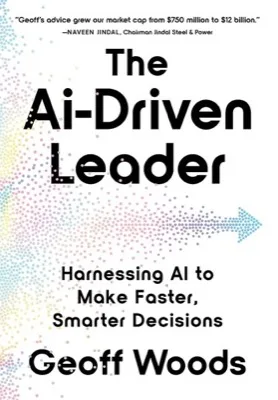
- Author: Geoff Woods (former COO, AI strategist)
- Published: 2024 | Pages: 272
- Rating: 4.5/5 (500+ ratings)
- View on Amazon
Woods writes this book from the perspective of someone who spent years as a COO before going all-in on AI. That matters. He’s not a researcher speculating about the future — he’s a former operator explaining how to use AI to make better decisions, faster, with less noise.
Why it made the list
Most AI books stop at “here’s what AI can do.” Woods goes further: he shows you how to restructure your thinking so AI actually amplifies your judgment instead of replacing it.
His core framework is about using AI as a “thought partner” — someone you brainstorm with before big decisions, stress-test your plans with, and debrief with after meetings. This is a completely different use case from “write me an email” and it’s where the real value is for managers.
Some of the most useful sections cover:
- Pre-meeting prep — using AI to anticipate questions, objections, and blind spots before you walk in
- Decision frameworks — how to structure prompts so AI pressure-tests your logic, not just agrees with you
- Strategic thinking — using AI to see around corners when you’re buried in the day-to-day
For first-time managers, the value is less about the AI and more about the discipline the book forces. Woods essentially teaches you how to think more rigorously — AI is just the excuse to do it.
Best for you if…
You feel like you’re always reacting, never thinking strategically. You want a book that shows you how to use AI to upgrade your decision-making process, not just to save you time on email.
Key takeaway: “AI doesn’t replace your thinking. It gives you a partner who’s patient enough to challenge it.”
3. Prediction Machines: The Simple Economics of Artificial Intelligence — Agrawal, Gans & Goldfarb
The best book for managers who want to understand what AI actually does — and why that changes the economics of every decision you make.
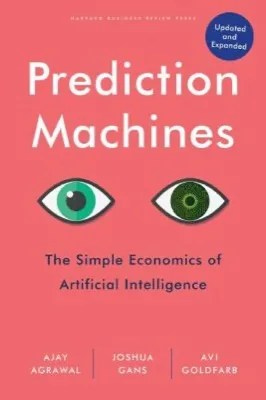
- Authors: Ajay Agrawal, Joshua Gans, Avi Goldfarb (University of Toronto economists, Creative Destruction Lab)
- Published: 2018 (Updated and Expanded 2022) | Pages: 272
- Rating: 4.4/5 (1,000+ ratings)
- View on Amazon
Three economists walk into an AI lab — and come out with the best framework for thinking about AI that any manager will ever read. Agrawal, Gans, and Goldfarb run the Creative Destruction Lab at the University of Toronto, where they’ve watched hundreds of AI startups up close. Their insight is deceptively simple and genuinely powerful.
Why it made the list
Their core argument: AI isn’t magic. It’s one thing — cheap prediction. And when something that was expensive becomes cheap, it changes everything around it.
Think about what changed when lightbulbs made artificial light cheap. Suddenly factories could run 24 hours, schools could hold evening classes, and reading at night became normal. The lightbulb wasn’t the point — it was the collapse in the cost of something important that rewired entire industries.
AI does the same thing for prediction. And prediction is the input to every decision you make as a manager:
- Who to hire (predicting future performance)
- Who to promote (predicting readiness)
- Which project to fund (predicting returns)
- When to intervene on a struggling employee (predicting recovery)
Once you see AI as “cheap prediction,” the book walks you through the management implications: which decisions should you delegate to AI, which ones require human judgment, and how the line moves as AI gets better.
For first-time managers, the most useful chapters cover:
- Prediction vs. judgment — the book’s most durable framework. Prediction is what AI does. Judgment is what you do with the prediction. Judgment becomes MORE valuable as prediction gets cheaper.
- AI and workflow — how to spot tasks in your team’s work that are really just “prediction in disguise” — and what happens when they become 10x cheaper to do
- Strategy under uncertainty — how AI shifts the cost-benefit of experimentation, letting managers try more things with less risk
Best for you if…
You want the intellectual foundation, not just the tool. You’re the kind of manager who wants to understand WHY AI is disruptive, not just HOW to use it. You’d rather have one sharp framework that applies to every decision than 100 specific prompts.
Key takeaway: “When prediction is cheap, we will predict more. And we will use prediction in places we never thought to — including judgments we used to make on gut alone.”
4. The Coming Wave — Mustafa Suleyman
The best book for managers who want to understand the bigger picture — from one of the few people who actually built this stuff.
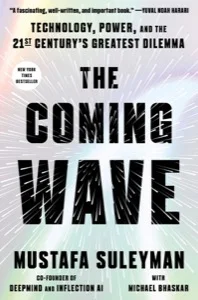
- Author: Mustafa Suleyman (co-founder of DeepMind, now CEO of Microsoft AI)
- Published: 2023 | Pages: 352
- Rating: 4.4/5 (3,500+ ratings)
- View on Amazon
Suleyman helped build the AI that’s now reshaping work. This book is his attempt to explain what’s coming — and why it matters — in terms a non-technical reader can follow.
Why it made the list
Unlike the other books on this list, The Coming Wave is less about how to use AI and more about what to think about as it spreads through every industry. That matters for managers because:
- Your team members are already using AI (whether you know it or not)
- Your organization will have to make policy decisions about it
- Your career will be shaped by how well you navigate this transition
Suleyman walks through the forces driving AI’s development, the failure modes to watch for, and the choices society — and organizations — need to make. He doesn’t pretend to have all the answers, but he asks the right questions.
For first-time managers, the most useful chapters cover what Suleyman calls “containment” — the practice of setting boundaries around powerful new technology so it creates value without creating chaos. You can apply the same framework to your team: where will AI help, where could it hurt, and what guardrails do you need?
This is the longest book on the list (352 pages), but it’s also the most substantive. If you want to sound informed at your next leadership meeting — not just about productivity tools but about where the world is going — this is the book.
Best for you if…
You’re the kind of manager who thinks about two-year-out implications, not just this sprint. You want to understand AI at a level deeper than “it’s like autocomplete but fancy.” You want to be the person in the room who asks smart questions, not the one nodding along.
Key takeaway: “This wave is coming. The question isn’t whether to adopt AI — it’s how to shape it. Managers who opt out of the conversation will have it shaped for them.”
5. Human + Machine: Reimagining Work in the Age of AI — Paul Daugherty & James Wilson
The best book for the practical manager who wants frameworks for blending human and AI work in actual teams.
- Authors: Paul Daugherty & H. James Wilson (Accenture leaders)
- Published: 2018 (updated 2022) | Pages: 272
- Rating: 4.3/5 (700+ ratings)
- View on Amazon
Yes, 2018. Before ChatGPT. Before the generative AI boom. This book made the list anyway because its core framework has aged remarkably well — and the updated 2022 edition fills in the newer context.
Why it made the list
Daugherty and Wilson spent years studying how real companies actually integrate AI with human work. Their framework — called the “Missing Middle” — is the most useful mental model I’ve found for thinking about AI in teams.
The idea: most discussions of AI focus on either full automation (the robot does the whole job) or pure augmentation (the robot helps the human a little). But the real opportunity is in the middle — where humans and AI work together in new ways that neither could do alone.
For managers, this book gives you three things most AI books don’t:
- Role-level thinking — how AI changes specific roles on your team (not just “jobs” in the abstract)
- Skills that actually matter — the book names specific human skills that become MORE valuable as AI spreads (judgment, empathy, ethical reasoning, complex problem-solving)
- Real case studies — not futuristic predictions, but actual organizations that redesigned work successfully
The framework for training your team on AI is especially useful. The authors argue that the biggest manager mistake isn’t adopting AI too slowly — it’s adopting it without thinking about how roles and workflows need to change alongside it.
Best for you if…
You’re thinking about AI adoption at the team level, not just your personal productivity. You want case studies and frameworks, not philosophy. You want to answer the question: “How should the work on my team actually change?”
Key takeaway: “The companies that win with AI aren’t the ones who automate the most. They’re the ones who redesign work so humans and machines amplify each other.”
Comparison: Which One Should You Read First?
| Book | Best for | Time to read | Focus |
|---|---|---|---|
| Co-Intelligence | Getting hands-on with AI today | 5-6 hours | 70/30 practical |
| The AI-Driven Leader | Using AI to upgrade decisions | 6-7 hours | 80/20 practical |
| Prediction Machines | Understanding AI’s economic logic | 7-8 hours | 40/60 frameworks |
| The Coming Wave | Understanding where this is going | 10-12 hours | 30/70 strategic |
| Human + Machine | Redesigning team workflows | 6-7 hours | 60/40 frameworks |
If you’ve never used AI seriously: Start with Co-Intelligence. Mollick will get you experimenting within a day.
If you use AI but want to level up: Start with The AI-Driven Leader. Woods will change how you think about what AI is for.
If you want a sharp mental model: Start with Prediction Machines. The “cheap prediction” framework will change how you see every decision on your team.
If you’re thinking strategically: Start with The Coming Wave. Suleyman will give you the vocabulary to sound informed in leadership conversations.
If you manage a team and want to redesign work: Start with Human + Machine. The Missing Middle framework is worth the read alone.
What to Skip
A quick note on what didn’t make this list and why:
- Books by people who don’t manage anyone. The AI field is full of futurists and researchers. Their books are interesting, but they’re not written for managers. We deliberately chose authors with operational experience.
- Books from before 2023. With one exception (Human + Machine), AI moves too fast. A book from 2019 about “the future of AI in the workplace” is now a book about the past.
- Books that are mostly prompts. There are dozens of “1,000 ChatGPT prompts” books. They’re fine as quick references, but they don’t change how you think — and that’s where the real value is.
If you want a starting point alongside the books, the practical guide to using AI as a new manager covers seven specific ways to use AI this week, and the Is AI Making You a Lazier Manager? quiz catches the patterns where AI quietly substitutes for your judgment instead of accelerating it.
🧠 Not sure how AI fits into your management work? Start with our practical guide to using AI as a new manager — 7 specific ways to use it this week, no fluff.
📖 Already using AI but not getting good results? Read Your AI Isn’t Underperforming — You’re Undermanaging It — the 5 management frameworks that turn AI from a toy into a team member.
🧠 Before you pick a book — check where you actually stand. Take our free 4-minute quiz: Is AI Making You a Better Manager — Or a Lazier One? — 15 scenarios across Critical Review, Judgment Retention, Privacy & Safety, Skill Development, and Appropriate Use. Then you’ll know which book to start with.